Last updated 2026-08-21
TL;DR
Solar panel cleaning is washing photovoltaic modules so dirt stops blocking light. You start it like other property-service work: register a business, buy insurance, follow OSHA once you leave the ground, and confirm any license with your state board. No national washer card exists. PVWatts defaults soiling loss to 2 percent. Most first-year operators should stay on single-story homes with purified water and a pole.
What is solar panel cleaning?
Solar panel cleaning is washing photovoltaic modules so dust, pollen, soot, bird droppings, and mineral film stop blocking light. That is the whole job. You are not swapping microinverters. You are not a solar installer.
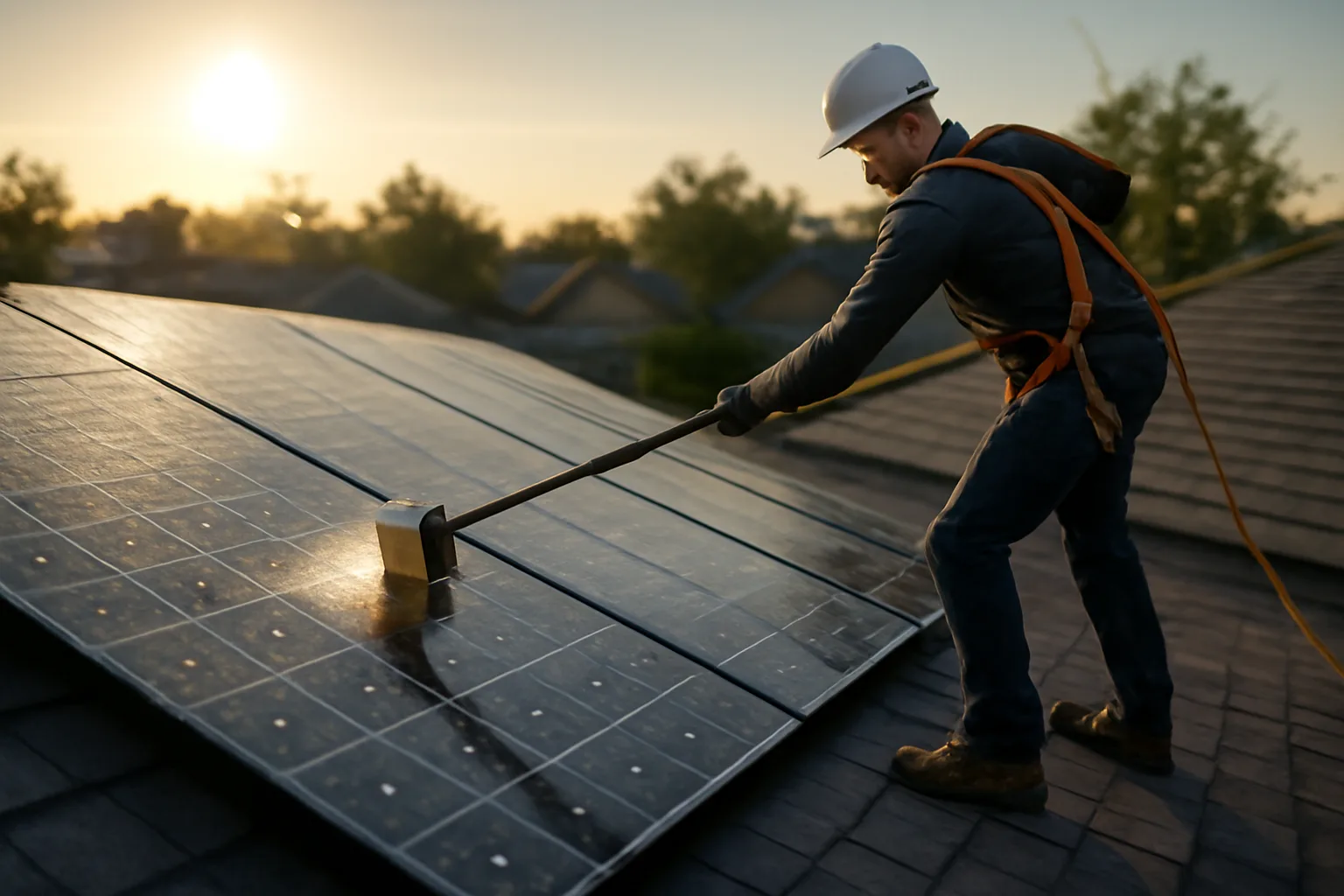
Most crews do it with purified water and a soft brush on a water-fed pole. Some work stays on the ground. Some work puts you on a roof. The product is cleaner glass, not a new array.
Homeowners call it a wash. Plant owners call it soiling mitigation. Same physical act. Dirt cuts irradiance. NREL's operations and maintenance best-practices report treats cleaning as ordinary PV upkeep, not a research project [5].
A national solar washer license does not exist. A federal card does not exist. Your paper path is local: a business entity, insurance, maybe a contractor class, and OSHA rules once you leave the ladder's bottom rung.
I'd tell a neighbor it is window cleaning for gear that makes kilowatt-hours. The chemistry is milder. The fall risk is not. Soft wash mixes made for siding do not belong on modules. High-pressure tips do not belong on modules. If a maker's manual says deionized water and a soft brush, follow that. If you cannot find the manual, stop promising a method you have not read.
Dirty glass still costs yield on modern systems with optimizers. You may not see a whole-string collapse the way an older series string can sag. You still clean it. You just should not sell a magic kWh recovery you have not measured on that roof.
Does cleaning solar panels actually raise output?
Yes, when soiling is real. No, when rain already rinses the array and you are selling a ritual. The gain lives entirely in how dirty the glass got before you showed up.
NREL's PVWatts default soiling loss is 2 percent [6]. That is a modeling default, not a promise for your street. Arid sites, agricultural dust, and pollen seasons run higher. Wet climates often run lower. Nobody has a clean national residential dataset that maps every ZIP code to a dollar recovery. The closest widely used number stays that 2 percent default in PVWatts [6].
NREL's O&M guidance tells owners to treat soiling as a site fact, then wash on a schedule that matches the climate and the module warranty, not a calendar copied from a Facebook ad [5]. If you cannot show production before and after, do not advertise a fixed percent gain. The FTC's Green Guides warn against environmental marketing claims that are not qualified and substantiated [13].
I'd wash a dusty Central Valley roof. I'd skip a weekly upsell in western Washington unless the customer has bird soil or construction dust. Rain is not a brush. Rain also leaves minerals. Both sentences are true at once.
How often should solar panels be cleaned?
As often as soiling actually costs more than the visit. That is the honest answer. It is also unsatisfying, because you cannot see the loss from the driveway.
NREL's O&M best-practices report frames cleaning frequency as a site decision tied to soiling, water, access, and manufacturer rules [5]. Utility plants sometimes wash on a measured soiling ratio. Residential customers usually buy spring and fall, or one visit after pollen. Agricultural edges may need more.
I would not lock a new customer into 12 visits in year one. That is how you get chargebacks. Offer a first wash, pull a production screenshot if they will share the portal, then recommend a repeat only if the roof still looks filthy or the kWh dip is obvious.
Bird droppings are not soiling in the dust sense. They are local shading. Spot-clean those. Do not wait for a seasonal route if a nest is painting six modules white.
How do you start solar panel cleaning as a business?
You start solar panel cleaning the same way you start other building-exterior work. Pick a structure, get an EIN if you need one, register where your state tells you to, buy insurance, then take jobs you can reach without dying on a 10/12 pitch.
The SBA walkthrough on choosing a business structure is the right first read if you have never formed an LLC [8]. Sole prop is simpler. An LLC is what most people actually want once a ladder is involved. Confirm formation and assumed-name rules with your state, not with a national blog.
Apply for an EIN on the IRS online EIN assistant if banks or insurers ask for one [7]. It is free from IRS.gov. Paid "EIN services" are a waste of money.
Census NAICS 561790 is the bucket that includes pressure washing and other building exterior services [10]. Banks and insurers sometimes ask. It is a classification, not a permit.
Then pick a territory. Single-story tract homes beat steep custom roofs in month one. Read a state start guide before you print door hangers. California is its own paper stack (how to start solar panel cleaning in California). Arizona and Colorado are different stacks (how to start solar panel cleaning in Arizona, how to start solar panel cleaning in Colorado). Alabama and Connecticut are different again (how to start solar panel cleaning in Alabama, How to start solar panel cleaning in Connecticut).
Do not buy a box truck in week one. A van, a tank, a pump, a pole, and fall gear you were trained to use will do.
Do you need a license to clean solar panels?
Sometimes. There is no federal solar panel cleaning license. Your city, county, or state contractor board may still pull you into a class if the work looks like construction, alteration, or a listed specialty.
California's Business and Professions Code section 7026 defines a contractor as a person who does or offers to do construction, alteration, repair, and related work on a structure or project [9]. Cleaning is not automatically that. It also is not automatically exempt. Confirm with CSLB before you advertise in California (solar panel cleaning license in California). Never treat a blog as a substitute for the board.
Arizona and Colorado have their own contractor and local business-license maps (solar panel cleaning license in Arizona, solar panel cleaning license in Colorado). Fees, exemptions, and dollar thresholds change. I will not invent a current fee. Call the board. Get the answer in writing if the clerk will email.
A home-improvement sales registration, a city business tax certificate, and a contractor class are three different papers. People mash them together. Don't.
If you only wash from the ground with a pole, some jurisdictions treat you closer to a window cleaner. If you unmount arrays, walk tile, or "restore" glass with chemicals, expect a harder look. Stay in the lane you registered for.
What insurance and safety gear do you actually need?
General liability first. Then whatever your state requires if you have employees. Then fall gear if your feet leave the ground.
I would not take a roof job with a $300 internet policy and a harness still in the bag. Insurers ask about heights, heat, and water on electrical equipment. Answer honestly. A cheap policy that excludes rooftop work is not a policy.
OSHA construction fall protection kicks in at 6 feet on walking and working surfaces with an unprotected side or edge [1]. The rule says each employee "shall be protected from falling by the use of guardrail systems, safety net systems, or personal fall arrest systems" [1]. Residential solar sits on roofs that meet that description more often than people admit.
If you have employees doing construction-like work, OSHA also requires fall-protection training [3]. A YouTube video is not that program. PPE has to fit the hazard, not the catalog photo [12].
Skylights kill people. NIOSH documented falls through skylights and roof openings and told employers to guard them, not step around them [11]. Treat every cloudy plastic dome as a hole.
Workers' compensation is a state statute issue once you have staff. Confirm with your state. Do not copy a friend's exemption story.
What equipment actually belongs on a truck?
A water-fed pole, soft brushes made for PV glass, a tank, a pump, a deionizing setup or a vendor who fills you with purified water, hose that will not scrape frames, and shoes that will not crush tiles. That is the working set.
Pressure washers with turbo tips are a waste of money on modules and a fast way to void a warranty. Abrasive pads are worse. Soap is usually worse. If a chemical is not named in the module manual, leave it on the shelf.
Roof gear is separate. Harness, anchor method you were trained on, helmet, gloves that still grip wet aluminum. OSHA's ladder rule is blunt: when a portable ladder reaches an upper landing, the side rails "shall extend at least 3 feet (.9 m) above the upper landing surface" [2]. Most first-year operators break that on day two.
If you want a bundled starter set, SolarWashPath publishes a $149 one-time DI Water + Roof-Safety Kit. Skip it if you already own a tank and a fitted harness. Local farm-store tanks work. Cheap unrated straps do not.
Electrical work practices still apply around energized equipment. OSHA's general-industry rule on live parts tells employers to use safety-related work practices to prevent shock [4]. You are not a qualified electrician because you own a pole. Do not open combiner boxes. Do not "reset" inverters for a customer.
How much does it cost to start solar panel cleaning?
A careful ground-only start can land in the low thousands of dollars if you already own a vehicle. A roof-ready start costs more because training, anchors, and insurance dwarf the brush.
I will not invent a national average. Truck prices, water, and liability premiums move by metro. The honest range I see people spend in year one is a used van plus a few thousand in water gear, or a five-figure splash if they buy a branded trailer they did not need.
The waste-of-money list is stable. Vinyl wraps in month one. Robotic crawlers before you have 50 roofs. Chemicals no module maker named. Lead-gen apps that sell you the same tired HOA list twice.
IRS Publication 535 is the federal explainer for ordinary business expenses if you deduct gear and insurance [14]. Keep receipts. Do not deduct a family SUV at 100 percent because a pole rode in it twice.
Confirm local water-fill rules. Some utilities hate you filling tanks from a park spigot. That is a city problem, not an IRS problem.
How do you price a solar panel cleaning job?
Price the access, more than the panel count. A 20-module ranch with a garden path is not a 20-module two-story with crumbling tile.
Per-module rates are easy to advertise and easy to regret. Per-visit minimums save you. I'd rather lose a cheap job than drive 40 minutes for a number that does not cover deionized water and a second person on a roof.
Nobody publishes a trustworthy national residential price index for this trade. If a competitor is at a number that looks like car-wash money, they are skipping insurance, skipping fall gear, or losing money. You do not have to match them.
Commercial sites sometimes bid on cents per watt or a site day rate. Ask for array maps. Ask who shuts the system down, if anyone does. Many washes happen with the system live, which is why you stay off connectors and you do not flood junction boxes.
Put travel, water, dump fees, and a weather abort in the quote. Morning dew jobs look pretty and cut recovery. Say that before the customer expects a same-day production spike.
What OSHA rules apply on a roof?
If the work is construction, OSHA's construction fall rule is the one that bites. Unprotected edges at 6 feet or more need guardrails, nets, or personal fall arrest [1]. Training is required for employees who use that gear [3]. Ladders need that 3-foot rail extension at the landing [2]. PPE has to match the hazard [12].
Is residential panel washing always "construction"? People argue. I would not bet my company on the argument. Treat the roof as a fall hazard and train like OSHA will visit. The inspection you want is the one that never happens because nobody fell.
OSHA's electrical work-practice rule is the other quiet one. Prevent shock. Do not work on live parts you are not qualified to touch [4]. Wet roofs plus nicks in PV wire are a bad mix. If you see chewed cable, stop and tell the owner to call their installer.
NIOSH's skylight publication is short and grim. Guard the opening. Do not walk the plastic [11].
I would not send a new hire onto a tile roof alone. Two people. One on the ground. Radios if the street is loud. Heat kills slower than a fall and still kills. Water, shade, and a stop time belong on the work order in July.
Can you use tap water on solar panels?
You can. You often should not.
Tap water leaves mineral spots as it dries. Those spots are new soiling. Hard-water cities make this worse. Deionized or otherwise purified water is the usual field answer because it dries without a crust. NREL's O&M best-practices report tells operators to follow manufacturer cleaning instructions rather than invent a chemistry [5]. Most module makers still point you at low-mineral water and a soft brush.
A garden hose from the homeowner's spigot is fast and sloppy. I'd use it only if the customer accepts spotting and the water is already soft. I'd rather roll a DI tank.
Do not add dish soap "for extra shine." Do not use window ammonia. Do not use hydrofluoric anything. If a stain is etched glass, a wash will not save it. Say that before you take the check.
Runoff is a local stormwater issue on some commercial sites. Confirm with the property manager. Residential drip onto mulch is usually boring. Residential drip onto a fresh stucco wall is how you buy a paint job.
What first-year paperwork should you keep?
Keep the papers a board, an insurer, or IRS would ask for, not a binder of motivational quotes.
Entity formation, EIN confirmation, city business certificate if your city issues one, insurance certificates, training records, and every signed work order. OSHA training for fall protection belongs in that stack if you have employees on roofs [3]. Photo the completed roof. Photo the ladder set. Photo obvious preexisting tile cracks. People forget cracks after a rain.
IRS wants ordinary expense records if you deduct them [14]. Bank statements are not a bookkeeping system. A simple ledger beats a shoebox.
Contracts should say what you wash, what you do not unmount, who supplies water, and what happens when wind shuts you down. Do not promise production gains you cannot measure. The Green Guides are about environmental claims, but the same habit saves you in small-claims court [13].
If a state contractor board has a written exemption for maintenance cleaning, print it. If they do not, do not invent one. Confirm with the relevant board. No approval or timing guarantees belong in your ads.
Where should you check the rules before you take a job?
Start with the state contractor board, the city business license desk, your insurer, and OSHA's fall and ladder text. Then read the module manual. That order saves more grief than any Facebook group.
California operators should read the license walkthrough before they bid HOA work (solar panel cleaning license in California). Colorado operators should do the same on Colorado paper (solar panel cleaning license in Colorado). Arizona is not Colorado. Confirm each fee and class with the board that issues it.
NAICS 561790 is a census label for exterior building services, including pressure washing [10]. It does not replace a license. An EIN does not replace a license [7]. An LLC does not replace fall training [8] [3].
SolarWashPath is an independent publisher, not a law firm and not a service company. If you want the kit-shaped start on this site, use /start. The rest of this page still works if you never do.
Take smaller roofs first. Write things down. Call the board when a clerk's answer is fuzzy. That is the whole first year.
Frequently asked questions
What is solar panel cleaning?
It is washing photovoltaic modules so dust, pollen, droppings, and mineral film stop blocking light. Crews usually use purified water and a soft brush on a water-fed pole. It is maintenance, not installation. NREL treats cleaning as ordinary PV upkeep in its O&M best-practices report.
How do you start solar panel cleaning?
Form a legal business, get an EIN if you need one from IRS.gov, buy liability insurance, confirm any local or contractor license with the board, then take ground-reach jobs before steep roofs. There is no national washer card. OSHA fall rules apply once you work at height. Keep work orders and training records.
Is solar panel cleaning a good first business?
It can be if you already like ladders, early mornings, and fussy customers. It is a poor first business if you need a huge marketing budget to feel legitimate. Start on single-story homes. Skip the wrapped trailer. Your real constraints are insurance, access, and weather, not branding.
Do I need deionized water?
Often yes if you care about spots. Tap water can leave mineral film that becomes new soiling. Follow the module maker's manual. NREL's O&M guidance tells operators to follow manufacturer cleaning instructions. Hard-water cities make DI or other purified water the practical default.
Can I use a pressure washer on solar panels?
I would not. High pressure and turbo tips can drive water under frames, pit glass, and void warranties. A water-fed pole with a soft PV brush is the usual method. If a manufacturer named a max pressure, stay under it. If they did not, do not invent one.
Do I need a contractor license?
Maybe. There is no federal solar cleaning license. California's contractor definition in BPC 7026 is broad, and boards still decide whether washing is maintenance or construction. Confirm with your state board and city. Do not copy another state's exemption. Fees change, so verify them with the board.
What OSHA height triggers fall protection?
For construction walking and working surfaces with an unprotected edge, OSHA requires fall protection at 6 feet (29 CFR 1926.501). Ladders used to reach a landing need side rails extending at least 3 feet above that landing (29 CFR 1926.1053). Train employees before you send them up.
Is rain enough to clean solar panels?
Sometimes for light dust in wet climates. Not for bird droppings, pollen cakes, agricultural soil, or mineral crust. Rain can also spot glass. If production is flat after storms and the modules still look filthy, schedule a wash. Do not sell monthly rain as a service plan.
What NAICS code do solar panel cleaners use?
Census NAICS 561790 covers other services to buildings and dwellings, including pressure washing of buildings and similar exterior work. Insurers and banks sometimes ask for it. It is a statistical class, not a permit and not a substitute for a contractor license.
Should I get on the roof or stay on the ground?
Stay on the ground when a water-fed pole can reach the glass safely. Get on the roof only with fall gear, training, and a second person. OSHA's 6-foot construction trigger is the number I'd plan around. Skylights are holes. NIOSH has been blunt about that for years.
Can I promise a percent production increase?
Not as a blanket ad. NREL's PVWatts default soiling loss is 2 percent, which is a model default, not your customer's roof. The FTC Green Guides expect environmental marketing claims to be qualified and substantiated. Sell a clean array. Show portal data when the owner shares it.
What first-year expenses can I deduct?
Ordinary and necessary business costs, if you actually run a business. IRS Publication 535 is the federal explainer. Keep receipts for gear, insurance, water, and training. Do not deduct a personal vehicle at 100 percent because a brush rode along. A tax preparer beats a forum thread.
Sources
- OSHA 29 CFR 1926.501 Duty to have fall protection: Construction employees on walking/working surfaces with an unprotected edge 6 feet or more above a lower level must be protected by guardrails, safety nets, or personal fall arrest.
- OSHA 29 CFR 1926.1053 Ladders: Portable ladders used to access an upper landing must have side rails extending at least 3 feet above that landing.
- OSHA 29 CFR 1926.503 Training requirements (fall protection): Employers must train each employee who might be exposed to fall hazards in the recognition and minimization of those hazards.
- OSHA 29 CFR 1910.333 Selection and use of work practices: Safety-related work practices must be used to prevent electric shock from live parts.
- IRS Apply for an Employer Identification Number (EIN) online: Businesses can apply for an EIN online at no charge through IRS.gov.
- U.S. Small Business Administration, Choose a business structure: SBA outlines sole proprietorship, partnership, LLC, and corporation choices for new firms.
- California Business and Professions Code section 7026: California defines a contractor as a person who undertakes or offers construction, alteration, repair, or similar work on a structure or project.
- U.S. Census Bureau 2022 NAICS 561790 definition: NAICS 561790 includes pressure washing of buildings and other services to buildings and dwellings.
- NIOSH Publication 2004-156 Preventing Falls Through Skylights and Roof Openings: NIOSH warns that workers fall through skylights and roof openings and that those openings must be guarded.
- OSHA 29 CFR 1926.95 Criteria for personal protective equipment: PPE must be provided, used, and maintained in a sanitary and reliable condition wherever hazards require it.
- 16 CFR Part 260 Guides for the Use of Environmental Marketing Claims: FTC Green Guides require environmental marketing claims to be properly qualified and substantiated.
- IRS Publication 535 Business Expenses: Federal rules for deducting ordinary and necessary business expenses, including equipment and insurance.