Last updated 2026-08-21
TL;DR
Solar panel cleaning is washing photovoltaic glass so dust, pollen, droppings, and film stop cutting light to the cells. You start as a local service business with a tax ID, a city license if required, insurance, OSHA-matching fall protection, and pure water. No federal solar-washer card exists. Confirm permits with the city and, where roof work counts as contracting, the state board.
What is solar panel cleaning?
Solar panel cleaning is the physical removal of soil from the glass face of a photovoltaic module so more sunlight reaches the cells. That soil is dust, pollen, soot, mineral scale, agricultural residue, and bird droppings. It stays maintenance work as long as you stay on the glass and never open an electrical enclosure.
People confuse it with installation. Installers set racks, land conductors, and commission inverters. Cleaners wash glass. Rewire a string or swap an optimizer and you have left the cleaning trade for electrical work. Different paper. Different risk.
The reason the work exists is boring physics. Dirt scatters light and shades cells. Bird droppings are worse than a uniform film because they cast local shade and can push a cell into a hot spot. NREL has spent real research time on soiling as a measured performance loss, not a marketing story.[2]
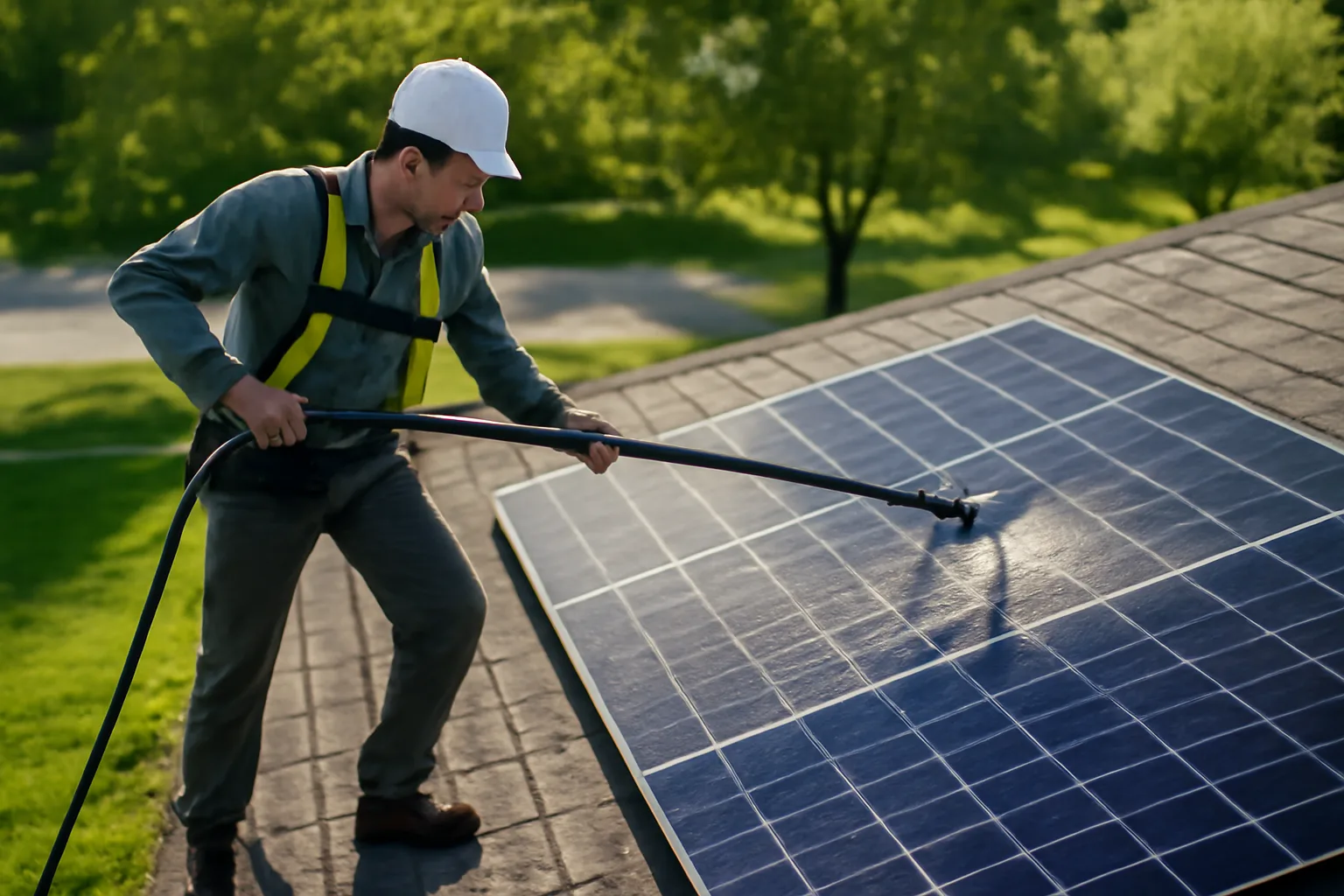
Most residential solar panel cleaning you will see is a soft brush and controlled water, either from the ground on a water-fed pole or from the roof on a tether. Utility-scale sites use tractors, robots, or night crews. You will not start there.
I treat it as window cleaning with extra fall hazard and extra warranty language. That framing keeps people from inventing a mystical new profession. It also keeps you from promising production miracles you never measured.
How do you start solar panel cleaning?
You start solar panel cleaning by standing up a local service business that can legally reach a roof, not by hunting a national license that does not exist. Pick a structure (sole prop, LLC, or whatever your accountant will actually file), get the city or county business license if that jurisdiction wants one, and get an EIN from the IRS if you need one. The IRS EIN application is free on IRS.gov.[9]
Then buy insurance before the first paid roof. General liability at a minimum. Workers' compensation once you have employees, which most states will not let you skip. Tell the agent you work on roofs. A ground-only janitorial policy is a bad surprise after a fall claim. For a longer walk through that paper, see solar panel cleaning guide 11.
Write a method before you write an invoice: pure water, soft contact, no walking on glass if the manufacturer forbids it, shutdown awareness for the inverter, fall protection matched to the height. OSHA's green-jobs guidance covers electrical, heat, and fall hazards for exactly this kind of work.[3]
SBA's 10-step start list is a decent order of operations for bank accounts, licenses, and tax accounts. It is not solar-specific. Use it as a checklist, then go back to the city clerk and the state contractors board and ask whether washing already-installed modules counts as contracting in that state.[7]
Do not buy a wrapped van in month one. First jobs come from people who already trust you. Charge enough to cover insurance. If the math only works with unpaid labor and a $0 safety budget, it does not work.
Does cleaning solar panels actually raise output?
Yes, soiling cuts output, and cleaning wins it back. The honest amount is site-specific. NREL's soiling research treats dust and precipitation as the two drivers, which is why a rainy roof and a canal-adjacent desert roof never share a percentage.[2]
Nobody has a single national soiling number you can print on a door hanger. Published U.S. site results often sit in a low single-digit annual percent where rain is common. Dry, agricultural, and high-dust sites run higher, and short dry spells can look ugly even when later storms rinse part of the year back down. That spread is why I will not let a first-year operator promise 20% more kWh as a standard result.
Want to be a professional? Measure something. A before-and-after production week at least, or an irradiance-normalized check if you know how. A garden-hose rinse and a handshake is a wash, not a performance contract.
Bird-heavy arrays and pollen season are the residential cases where the customer sees the dirt from the driveway. Those are easier sales and more honest ones. A steep, slick array in a wet climate may already be cleaner than your pitch deck claims. Say so. You lose one wash and keep the referral.
What equipment do you need to clean solar panels?
You need a way to put pure water and a soft brush on glass without falling or scratching the module. For most one-story homes, that means a water-fed pole, a deionizing resin tube or RO tank, a TDS meter, and hose connections that do not leak on the customer's stucco.
Going on the roof adds a harness, a lanyard or self-retracting lifeline, and an anchor you are allowed to use. Cheap hardware-store kits fail in ugly ways. Roof shoes that mark glass become a claim. A non-contact voltage tester does not make you an electrician, but it can keep you from grabbing a damaged pigtail.
Skip the pressure washer on turbo. Skip abrasive pads. Module warranties are picky about chemicals and impact. NREL's PV O&M best-practices report treats cleaning as ordinary water work, not a chance to blast frames.[1]
SolarWashPath publishes a $149 one-time DI Water and Roof-Safety Kit if you want those items in one pile. You can also assemble the same class of gear from a window-cleaning supplier. Neither path is a license.
Money wasted in month one: a trailer-mounted robot, a branded chemical line, and a $400-a-month CRM you never open. Buy water quality and fall gear first. Buy marketing vinyl last.
Do you need a license to clean solar panels?
There is no federal solar panel cleaning license. Full stop. Cities and counties often want a general business license. Some states pull roof work or home improvement under the contractors board. Some do not. I will not quote a board fee or a processing time, because those change and I am not your clerk.
Ask two offices. The city business-license desk. The state contractors board classification person. Tell them you wash already-installed modules and you do not alter wiring or racks. If they say you need a classification, get it. If they say you do not, keep that answer in writing.
Do not advertise as a solar contractor if you only clean. That phrase pulls you toward C-46 style classifications in states that have them.
The IRS still wants the tax side handled. Its starting-a-business guidance and Schedule C are the federal paper path for a sole proprietor. Confirm current forms on IRS.gov, not in a Facebook group.[8][11]
What safety rules apply on a roof with solar panels?
If you are an employer, OSHA applies. Cleaning a finished array often reads as general industry maintenance, where 29 CFR 1910.28 sets fall protection at 4 feet on an unprotected edge. Construction rules in 29 CFR 1926.501 use 6 feet. A compliance officer looks at the facts of the job. Do not hang your life on a classification argument.[4][5]
OSHA's general industry rule is blunt. It requires that "each employee on a walking-working surface with an unprotected side or edge that is 4 feet (1.2 m) or more above a lower level is protected from falling by one or more of the following." That is 29 CFR 1910.28(b)(1)(i).[4]
The construction text is just as plain. 29 CFR 1926.501(b)(1) says each employee on a walking/working surface with an unprotected side or edge 6 feet or more above a lower level "shall be protected from falling by the use of guardrail systems, safety net systems, or personal fall arrest systems."[5]
Ladders carry their own numbers. When a portable ladder reaches an upper landing, the side rails must extend at least 3 feet above that landing under 29 CFR 1926.1053(b)(1).[10]
Electrical work practices live in 29 CFR 1910.333. Modules generate whenever they have light. Wet hands on damaged connectors are how a simple wash becomes a hospital visit.[6]
With no employees, federal OSHA is aimed at employers, but state plans, general contractors, and your insurer still have opinions. Gravity does not care about your entity type. More on the insurance side sits in solar panel cleaning guide 17 and solar panel cleaning guide 23.
How much does it cost to start solar panel cleaning?
I will not invent a national average startup cost. No public census of solar panel cleaning shops exists. The open-market pile looks like this. A usable water-fed pole and resin setup runs a few hundred dollars, or a couple thousand if you want a tank system. A fall-arrest setup that is not a toy costs hundreds. Insurance is often the largest recurring check. Confirm the premium with a licensed agent in your state.
A business license fee is set by the city. Confirm it there. Do not trust a blog for that number, including this one if a clerk later changes it.
Money wasted: franchise fees for a wash method you can learn from the module warranty, lead services that sell the same homeowner to four cleaners, and a new truck when a used van works.
Budget time, more than cash. First-year operations are scheduling, callbacks, and weather. Rain cancels you and also does free marketing for the next dry month. Snow states have a real off-season. Price that into the year or you will eat savings in January.
What water should you use on solar panels?
Use deionized or reverse-osmosis water if you want a spot-free dry. Hard tap water leaves mineral rings that look like you made the array dirtier. A handheld TDS meter is cheap honesty. Spot-free work wants water very close to 0 ppm dissolved solids.
Most module makers prefer water and a soft brush. Detergent is a maybe, and only if the chemical is allowed in the warranty. If you use soap, rinse it. Dumping soapy water to a storm drain can break a local illicit-discharge rule. Confirm with the city. I default to pure water.
NREL's O&M best-practices report treats module washing as a normal water-based task. It is not a chemistry experiment.[1]
Do not mix bleach, dish soap from under the sink, and the degreaser of the month. You are one film away from a warranty fight. If a customer hands you a bottle and a smile, read the module warranty before you spray it.
How often should solar panels be cleaned?
Clean when dirt is actually costing energy or creating a visible problem, not on a calendar you invented to fill Tuesdays. Rainy climates often need one or two visits a year, sometimes none on a steep, slick glass array. Desert, pollen belts, and farms need more. Bird roosts run on their own schedule.
Tilt matters. A 30 degree array sheds better than a 5 degree flush mount. Nearby gravel roads change the math. So does a dryer vent that blows lint onto the bottom row. Agricultural spray months lay a film that rain does not fully rinse.
Be honest with the customer when rain already did the job. Selling a 12-visit contract under Seattle drizzle is how you train people to ignore you. Sell inspections plus washes when the glass actually needs it.
What insurance do you need for solar panel cleaning?
You need general liability to step on anyone's property as a business. With employees, you almost certainly need workers' compensation. Some GCs and HOAs will also ask for an additional-insured endorsement and a waiver of subrogation. Confirm forms with the agent and the client. I will not invent a minimum limit. Many commercial clients ask for $1 million per occurrence because that is a habit, not because a statute named solar washers.
Climb? Say so. Use chemicals? Say so. Mis-classifying the work is how claims get denied.
For deeper insurance paper, keep going through solar panel cleaning guide 35, solar panel cleaning guide 47, and solar panel cleaning guide 71.
What first-year mistakes waste money?
Year one dies in a few repeat ways. Walking unprotected on a low pitch because it is only a ranch house. Reaching for a pressure washer because it feels productive. Promising a kWh bump you never measured. Skipping the city license. Naming yourself Solar Contractors LLC when you do not hold the classification.
Another waste is gear theater. You do not need a $12,000 pure-water van in month two. You need repeatable water quality, a way off the roof, and invoices that match what you did.
Keep a simple incident log even if you work alone. Insurers and future you will want dates. Carry enough pure water too. Running a garden hose from a hostile neighbor is how a 40 minute job becomes a two hour argument.
Do not buy leads before you can finish a roof without improvising the tie-off. Skill first. Ads later.
How do you price a solar panel cleaning job?
No honest public price index exists for residential solar panel cleaning. Anyone quoting a national average is guessing or selling. Price the job by access, stories, pitch, panel count, water haul, and bird mess. Per-panel and per-kW both work once you know your minutes per module.
Look at local window-cleaning labor as a floor, then add roof risk and drive time. A steep two-story with no tie-off is either expensive or a decline. Declining is allowed.
Do not undercut yourself to farm reviews. Cheap jobs attract the customers who will also argue about a water spot on a car.
Write the scope. Glass only. No inverter troubleshooting. No while-you-are-up-there gutter surprise unless you priced it. Put the no-walk-on-glass rule in the estimate so nobody is shocked when you refuse to dance on a module.
Can you clean solar panels from the ground?
Yes, many arrays clean from the ground with a water-fed pole. That is what I would do whenever reach and pitch allow it. You stay off the shingles. You stay off the glass. You still need ladder sense when the pole work puts you on rungs.
You cannot always reach the ridge row on a tall or steep roof. Then it is a roof job with anchors, or it is a no-bid. Flat commercial membranes are their own puncture problem. Do not walk ballast around like it is a sidewalk.
| Access method | Where it fits | Main failure mode |
|---|---|---|
| Ground water-fed pole | One-story, moderate pitch | Cannot reach upper rows |
| Roof walk with soft brush | Steep or tall arrays | Falls, glass traffic |
| High-pressure wand | Almost no residential roof | Forced water, warranty fights |
Inverters and combiners stay closed. If a connector is melted, stop and tell the owner to call the installer. That is not a wash.
SolarWashPath is an independent publisher, not a law firm and not a service company. The start page at /start is there if you want the kit. This article stands if you never click it.
Confirm every license, fee, and insurance form with the board or agent who actually issues it. Nobody here can approve you.
Frequently asked questions
What is solar panel cleaning?
It is washing the glass face of photovoltaic modules so dust, pollen, droppings, and mineral film stop blocking light. It stays maintenance, not electrical work, as long as you do not open boxes or alter wiring. Most residential jobs use a soft brush and deionized or RO water from the ground or a tethered roof walk.
How do you start solar panel cleaning?
Stand up a local service business. Get the city license if required, an EIN if you need one, general liability, and workers' comp once you hire. Write a water and fall-protection method. Confirm with the state contractors board whether washing installed modules counts as contracting. There is no federal solar-washer card.
Is solar panel cleaning the same as solar installation?
No. Installation sets racks, lands conductors, and commissions inverters. Cleaning washes glass. Rewire a string or swap an optimizer and you have left the cleaning trade. Advertising as a solar contractor can pull you into a state contractor classification you do not hold. Keep the scope on glass.
Do I need a contractor license to wash panels?
Maybe. There is no federal license. Many cities want a business license. Some state boards treat roof work or home improvement as licensed contracting. Ask the city clerk and the contractors board, in writing if you can. I will not invent a fee or a wait time. Confirm with the board that issues the card.
Can I use a pressure washer on solar panels?
I would not, not on a residential module at typical wand pressure. You can drive water under frames, pit glass, and walk into a warranty denial. Soft contact and controlled pure water is the boring method that still works. If a manufacturer publishes a max pressure, stay under it. Most first-year operators should just skip the wand.
Does OSHA apply if I work alone?
Federal OSHA standards are written for employers. A true lone sole proprietor with no employees sits in a different legal box, but state plans, GCs, and insurers still care, and a 4 foot edge does not. Hire anyone and 29 CFR 1910.28 and related rules are in play. Confirm your status with a lawyer or the state plan.
Will cleaning void a solar panel warranty?
It can, if you scratch glass, use the wrong chemical, walk on modules the maker forbids, or force water under the frame. Read the warranty before the first stroke. Stay with soft brushes and pure water unless the maker names a product. Photograph conditions before you start so a pre-existing crack is not your crack.
Do I need an EIN to start?
Not always. Some sole proprietors can file with a Social Security number. An EIN is still free from the IRS and useful once you open a bank account or hire. Apply on the IRS EIN page and confirm current rules there. Do not pay a reseller for a number the IRS already issues at no charge.
Is tap water good enough for solar panel cleaning?
In a hard-water city, tap water often leaves mineral spots that look like new dirt. Deionized or RO water near 0 ppm TDS dries cleaner. Soft-water towns get luckier, but a $20 TDS meter beats guessing. If you use soap, rinse it and check the storm-drain rules with the city.
How do I get the first solar panel cleaning customers?
Start with people who already trust you. Neighbors, past window-cleaning clients, the installer who does not want to wash glass. Skip paid lead mills until you can finish a roof without inventing the tie-off on site. Charge enough to cover insurance. Cheap first jobs train the wrong customers.
Do I need workers compensation with no employees?
Often no, but that is a state rule, not a vibe. Some states still want coverage for certain owners or for work on GC sites. HOAs and commercial clients may require it anyway as a contract term. Confirm with your state workers' comp agency and the agent who would write the policy.
Can I clean commercial solar arrays in year one?
You can bid small, easy-access commercial if your insurance and the site allow it. Big flat roofs, ballasted membranes, and live substations are a different job. Puncturing a roof membrane can dwarf a wash fee. Get the site rules, the COI language, and a no-bid reflex for work you cannot tie off.
Should I shut the inverter down before washing?
Modules still make voltage in light even with the inverter off. Shutdown can reduce some system-level hazards and is often in the owner's manual. It does not make wet, damaged connectors safe. Do not open combiner boxes to look busy. If you see melted plastics, stop and send the owner back to the installer.
Sources
- OSHA, Green Job Hazards: Solar Energy: OSHA green-jobs guidance identifies electrical, heat, and fall hazards associated with solar work.
- OSHA, 29 CFR 1910.28 Duty to have fall protection and falling object protection: General industry fall protection is required at 4 feet on an unprotected walking-working surface edge under 1910.28(b)(1)(i).
- OSHA, 29 CFR 1926.501 Duty to have fall protection: Construction fall protection is required at 6 feet on an unprotected walking/working surface edge under 1926.501(b)(1).
- OSHA, 29 CFR 1910.333 Selection and use of work practices: OSHA requires safety-related work practices to prevent electric shock from live electrical parts, which remain relevant around energized PV equipment.
- U.S. Small Business Administration, 10 steps to start your business: SBA publishes a 10-step federal checklist for licenses, tax accounts, and structure when starting a U.S. business.
- IRS, Starting a Business: IRS starting-a-business guidance is the federal tax paper path for a new sole proprietor or small firm.
- IRS, Apply for an Employer Identification Number (EIN) Online: The IRS EIN application is available online at no charge.
- OSHA, 29 CFR 1926.1053 Ladders: Portable ladders used to reach an upper landing must extend at least 3 feet above that landing under 1926.1053(b)(1).
- IRS, About Schedule C (Form 1040), Profit or Loss from Business: Sole proprietors report business profit or loss on IRS Schedule C (Form 1040).
- OSHA, 29 CFR 1910.140 Personal fall protection systems: OSHA sets performance criteria for personal fall protection systems used in general industry.