Last updated 2026-08-18
TL;DR
In Arizona, residential solar panel cleaning costs $150 to $300, and most 20-panel systems run about $200. A typical cleaning takes 1 to 2 hours. No state contractor license is required for individual jobs under $1,000 because the handyman exemption applies. Cities like Phoenix and Tucson want a basic business license first.
How much does solar panel cleaning cost in Arizona?
Expect $150 to $300 to clean the panels on a typical Arizona home. The national range lands at $150 to $330 per HomeAdvisor [1], and EnergySage reports $150 to $300 [2]. In Phoenix and Tucson, local crews often charge around $200 for a 20-panel system, which pencils out to $10 to $20 per panel [3].
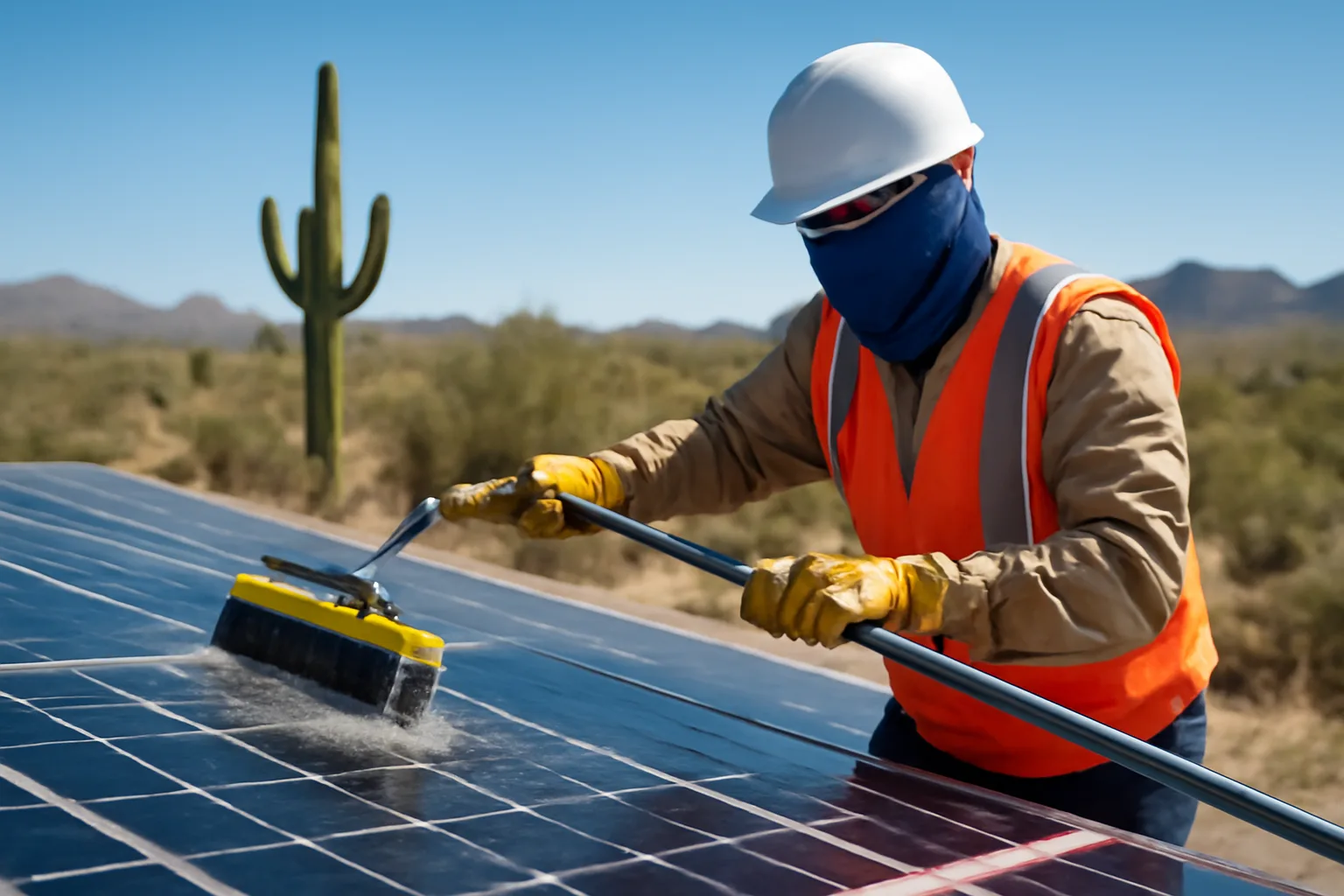
That price usually buys deionized water, a soft brush or water-fed pole, and a visual look at the array. Steep tile roofs and three-story homes push you toward the top of the range. Some companies knock a little off for a first cleaning or a quarterly service plan. Arizona dust is relentless, so cleaning is a recurring bill, and installers tend to price it competitively.
Commercial arrays start near $1 per panel per cleaning for large ground-mount sites, but the math flips to a per-watt or per-kilowatt structure above 100 kW. Get a firm quote before you book. Walk away from any contractor who demands a full year paid upfront with no detailed contract.
Do you need a license for solar panel cleaning in Arizona?
No. Arizona has no solar-cleaning-specific license, and the Registrar of Contractors exempts residential work under $1,000 per job, labor and materials included [4]. A standard panel cleaning sits well below that line, so the handyman exemption covers it. The statute, A.R.S. § 32-1121(A)(14), exempts "any person who performs work on a residential structure ... if the aggregate contract price ... is less than one thousand dollars" and the work needs no permit [5]. Cleaning needs no building permit.
That exemption is per project, not per year. A cleaner doing several small jobs a week never trips into contractor-license territory. Add other services though, like installing critter guard or swapping a panel, and the combined price can clear $1,000. Now you need a license.
Cities set their own rules. Phoenix requires a business license for any company operating inside city limits [6]. Tucson runs a similar process [7]. Fees are small, usually under $50 a year. Some cities also want a privilege (sales) tax license. Call the city clerk before you advertise. A business license is not a skills test. It just tells the tax collector you exist.
How long does solar panel cleaning take in Arizona?
A standard cleaning on an accessible single-story roof with 20 panels takes 1 to 2 hours [2]. Ground-mount systems go faster, often 30 to 45 minutes. Steep tile, second-story arrays, or caked monsoon mud can push a job past 2 hours.
Time disappears when a crew repositions a ladder five times, works around skylights, or waits for a deionized tank to fill. Good crews move fast. They map the array, set a fall-protection anchor, and work top-down with a water-fed brush so nothing streaks. The clock also includes a short walkthrough to catch cracked panels, loose wires, or pest damage.
Hiring out? A 2-hour window is realistic. A company promising a 30-minute job is skipping something, usually the final rinse or the gutter line. In Arizona's hard-water zones, that rinse is the whole game, because mineral residue bakes on within minutes under the midday sun.
What factors drive solar panel cleaning costs in Arizona?
System size moves the price most. A 10-panel system often runs $100 to $150. A 30-panel home can hit $300. Access comes second. Single-story comp-shingle roofs are the cheapest to clean. Tile roofs cost more because you cannot walk on them without cracking them, so a crew either spans the tile with a ladder system or pole-cleans from the ground.
Water type matters. Deionized water costs more than tap but skips the water spots. Cleaners hauling a DI tank charge a premium for it. Hard Phoenix tap water leaves calcium that drags down output over time, so a cheap tap-water job can cost you money in lost production.
Pitch and height push price too. A 12/12-pitch roof needs a harness and anchors. Two-story homes need taller ladders. Both add labor time and insurance risk, and some companies tack on a steep-roof surcharge of $50 to $100.
Extras add up last. Critter guard inspection, bird-dropping treatment, or an electrical output test each add $25 to $75. Bundle a few and you might earn a discount.
Why professional cleaning matters in Arizona's dusty climate
Arizona panels sit under a steady deposit of dust, pollen, and monsoon mud. Left alone, soiling can cut output by 15 to 25 percent, worst in agricultural or construction-heavy areas [3]. A 6 kW array that should make $1,800 of electricity a year could shed $270. Two $200 cleanings run $400, and heavy soiling pays that back fast.
Pros use deionized water and soft brushes built not to scratch the anti-reflective coating. They know the trap that ends homeowner cleanings badly: never spray cold water on a 150°F panel in July, because the temperature shock can micro-crack the glass. That detail gets missed all the time in the driveway.
There is no universal schedule. A Phoenix subdivision beside a gravel lot might need four cleanings a year. A Tucson house ringed by native desert might need two. Smart pros do one cleaning, then watch inverter output to see when soiling starts eating production. Let that data set the schedule, not a calendar.
DIY solar panel cleaning vs. hiring a pro in Arizona
You can clean your own panels. You need a soft brush, a hose set to a gentle spray, and either deionized water or real patience with hard water. For committed DIYers, a kit like the $149 DI Water + Roof-Safety setup from SolarWashPath bundles the essentials. But you take on the risk of standing on a roof in 110° heat, and a fall from a single-story roof can kill you.
A pro carries general liability and workers' compensation. They bring the right gear and they know the mistakes to avoid, like pressure washers and abrasive sponges. Step through a tile and cause a leak, and your homeowners insurer may deny the claim if the work needed a license and had none. The gap between DIY gear and two pro cleanings a year closes fast once you count ladder rentals, filter replacements, and your own hours.
Ground-mount system? DIY is safer and simpler. Second-story tile roof? Hire the pro almost every time. Many Arizona installers clean panels under a service plan, so read your original warranty before you climb.
How often should you clean solar panels in Arizona?
Most Arizona households clean every 3 to 6 months. The University of Arizona Cooperative Extension advises inspecting panels after heavy dust storms and cleaning once a visible film builds [8]. In practice, many owners book a post-monsoon cleaning in September or October and another in late spring before peak heat.
Bird droppings are a local problem. Live under a flock route and you may need monthly spot cleaning. Dried droppings block far more light per square inch than plain dust. Ground-mount systems in treeless rural spots can go 6 to 9 months.
Here is a simple test. Check your inverter's daily kWh on a clear day, clean the panels, then compare the next clear day. A jump over 5 percent means you waited too long. Set your reminder to that interval. Arizona leans toward the short end because the dust never quits and summer rates near 30 cents per kWh make lost production expensive.
Local business license rules for solar panel cleaners in Arizona
The handyman exemption handles the state. Local jurisdictions still want their cut. Phoenix requires a business license for any company providing services inside city limits, even if the owner lives elsewhere [6]. The City of Phoenix Finance Department issues privilege tax licenses. Tucson also requires a business license, though an exemption for occasional small jobs can apply if gross receipts stay under $12,000 a year [7].
Mesa, Scottsdale, and Chandler run similar rules. Typical fee is $50 to $100 a year. Use anything other than your own legal name and you also register a trade name with the Arizona Secretary of State, which costs $10 to $25.
Hire employees and you need a state employer number and workers' comp. Skipping required workers' comp in Arizona is a criminal violation. A solo cleaner with no employees may stay exempt from comp. But slip on a customer's roof with no insurance and you pay for your own injuries plus any roof damage. That gamble is why even a one-person LLC usually buys a general liability policy.
How to find a reliable solar panel cleaning company in Arizona
Look for at least two years of local reviews, general liability insurance, and a plain statement that they use deionized water instead of tap. Ask whether they carry workers' comp even when a sole proprietor is not required to. A serious cleaner has it.
Good signs: they ask to see your panels or a photo before quoting, they talk about fall-protection gear, and they guarantee no scratches. Skip anyone who swears a pressure washer "works fine." It does not. Tempered solar glass scratches when dirt gets dragged under a pressure jet.
Check the Arizona Registrar of Contractors' site to see if the company holds any license. For under-$1,000 jobs they do not need one, and that is fine. But if they also do electrical work or panel replacement, they should hold a C-11 electrical or a B general contractor classification. Ask for the insurance certificate with your name listed as an additional insured. It costs the contractor nothing and protects you directly.
Solar panel cleaning and insurance: what to know
A homeowners policy usually covers sudden, accidental damage, but a cleaner who steps through a tile may not be covered if the cleaner carried no insurance. Arizona treats the contractor's liability policy as the primary coverage. Without it, you can end up fighting your own insurer over negligence.
So the one question that matters most is blunt: "Do you carry general liability and workers' comp?" A yes is step one. Verifying it is step two. Ask for the certificate.
On the cleaner's side, liability coverage for a small solar-cleaning business usually costs $400 to $800 a year. That premium is baked into what a legitimate pro charges. When a bid comes in $50 under everyone else, the insurance is often the line item that went missing. In Arizona, where monsoon wind throws grit and a fall off a tile roof is real, that missing coverage is a bet you do not want made on your roof.
Arizona solar panel cleaning costs compared to nearby states
Arizona's rates sit in the middle of the Southwest. Our guide to solar panel cleaning cost in California shows similar residential pricing, $150 to $350, with Los Angeles and San Diego on the high end solar panel cleaning cost in California. Colorado also lands in the $150 to $300 range, but snow and mountain-town soot change the service mix solar panel cleaning cost in Colorado.
Florida's humidity cuts dust but brings pollen and lichen, holding costs between $120 and $250 solar panel cleaning cost in Florida. Georgia, with pine pollen and light industrial dust, hits similar numbers solar panel cleaning cost in Georgia.
All five states share two things: no statewide cleaning-specific regulation and a crowded market of small operators. The table below lines up typical costs against the main soiling drivers.
| State | Typical Residential Cost | Primary Soiling Source |
|---|---|---|
| Arizona | $150 to $300 | Dust, monsoon mud, bird droppings |
| California | $150 to $350 | Coastal salt, wildfire ash, dust |
| Colorado | $150 to $300 | Snow, road grit, pine pollen |
| Florida | $120 to $250 | Pollen, lichen, humidity mold |
| Georgia | $120 to $250 | Pine pollen, clay dust |
Prices assume a 20-panel accessible roof and deionized water. National cost data [1] [2] and local state research inform these ranges.
Frequently asked questions
Do you need a license for solar panel cleaning in Arizona?
No state-issued solar panel cleaning license exists. For residential jobs under $1,000 total, the Arizona handyman exemption applies and no contractor license is required. Cities like Phoenix and Tucson require a basic business license. If a job exceeds $1,000 (combined cleaning and other services), a contractor's license from the Arizona Registrar of Contractors is necessary.
How much does solar panel cleaning cost in Arizona?
Most residential cleanings fall between $150 and $300. The typical 20-panel home in Phoenix runs around $200. Per-panel pricing averages $10 to $20. Commercial systems cost about $1 per panel for large arrays. Roof pitch, height, and water type move the price up or down.
How long does solar panel cleaning take in Arizona?
A standard residential cleaning takes 1 to 2 hours for a crew of one or two. Ground-mount systems take less, about 30 to 45 minutes. Steep tile roofs and second-story arrays require more time. The work includes setup, careful brush-and-rinse cleaning, and a quick visual inspection.
Does solar panel cleaning require a permit in Arizona?
No building permit is required for routine cleaning. It counts as maintenance, not construction. The handyman exemption at A.R.S. § 32-1121(A)(14) covers work that needs no permit. If you are also installing hardware like critter guard, a permit may apply, but cleaning alone does not trigger one.
What is the handyman exemption limit in Arizona?
The exemption covers residential jobs with a total price (labor plus materials) under $1,000. That ceiling is per job, not per year. A cleaner who does ten $200 cleanings in a month stays exempt because each project falls under $1,000. The limit comes from A.R.S. § 32-1121(A)(14).
Can I clean my own solar panels in Arizona?
Yes. You need a soft brush, a gentle water source, and ideally deionized water to avoid mineral spots. Ground-mount systems are safest. Rooftop cleaning on steep tile or second-story roofs is dangerous in the heat. A fall or a cracked tile can cost far more than hiring an insured professional.
Do I need a business license to start a solar panel cleaning business in Arizona?
Usually yes, at the city level. Phoenix, Tucson, Mesa, and most other municipalities require a general business license for commercial activity. The fee is modest. You may also need an Arizona transaction privilege tax license. Check with each city where you plan to work before accepting jobs.
Does homeowners insurance cover solar panel cleaning damage?
It may cover damage that is sudden and accidental, but generally only if the person doing the work is insured or you are covered under your policy's liability section. If an uninsured cleaner falls or breaks a tile, you could be liable. Always verify the cleaner's liability and workers' comp coverage before letting them on your roof.
Are there tax incentives for solar panel cleaning in Arizona?
No. There are no federal, state, or utility rebates for cleaning. It is an operating expense. The financial return comes entirely from recovering lost energy production. Keeping panels clean maintains the system's original output, but you cannot claim a tax credit for it.
Does SRP or APS offer cleaning rebates?
Neither Salt River Project (SRP) nor Arizona Public Service (APS) offers a rebate or incentive for panel cleaning. Both utilities say cleaning improves performance but treat it as the owner's responsibility. Some solar lease agreements and power purchase agreements include maintenance and cleaning, so check your contract.
How much does commercial solar panel cleaning cost in Arizona?
For arrays above 100 kW, pricing often shifts to a per-kilowatt or per-megawatt model. Rates range from $0.08 to $0.20 per watt per year for biannual cleanings, depending on site access and water logistics. A 500 kW ground-mount system might cost $400 to $1,000 per cleaning. Larger sites with easy truck access get volume discounts.
What water should I use to clean solar panels in Arizona?
Deionized or distilled water is the standard for professional cleaning. Tap water, especially in Phoenix, leaves calcium and magnesium spots that bake on and cut light transmission. If you must use tap water, squeegee immediately or finish with a DI water rinse. Never use softened water, because the salt leaves a film.
How often should you clean solar panels in Arizona?
Every 3 to 6 months for most homes. After monsoon storms, a cleaning is often needed to remove caked mud. Bird-heavy areas may need monthly spot cleaning. Use your inverter's production data to decide: a 5 percent drop from a clean baseline signals it is time.
Can hard water damage solar panels?
Yes. Mineral deposits from hard water create a film that scatters light and can permanently etch the glass if left to bake in the Arizona sun. Over time, output drops noticeably. That is why professionals run deionized water systems, which leave no residue. Once etching happens, the loss is permanent.
Sources
- EnergySage, Solar Panel Cleaning Cost: National residential cleaning costs $150 to $300 and takes 1 to 2 hours.
- AZ Central, How often should you clean your solar panels in Arizona? Experts weigh in: Typical Arizona cleaning around $200; soiling losses up to 25 percent in dusty regions.
- Arizona Registrar of Contractors, Handyman Exemption: Exemption for residential work under $1,000 total price, no permit required.
- Arizona Revised Statutes § 32-1121(A)(14): Statutory language of the handyman exemption: any person doing work under $1,000 without a permit is exempt from contractor licensing.
- City of Phoenix, Business Licenses and Regulations: Businesses operating in Phoenix must obtain a City of Phoenix privilege tax license.
- City of Tucson, Business License Requirements: Tucson business license required unless gross receipts under $12,000 annually.
- University of Arizona Cooperative Extension: Recommendation to inspect panels after dust storms and clean when a visible film forms.
- U.S. Department of Energy, Solar Energy Technologies Office: Panel soiling and dust reduce photovoltaic performance and energy output.