Last updated 2026-08-21
TL;DR
Solar panel cleaning is washing photovoltaic glass so dust, pollen, and mineral film do not sit on the cells. You start with local paper (entity, tax ID, insurance), then roof fall protection that matches OSHA, then deionized or otherwise spot-free water. There is no federal cleaning license. Confirm contractor status with your state board before you bid roofs.
What is solar panel cleaning?
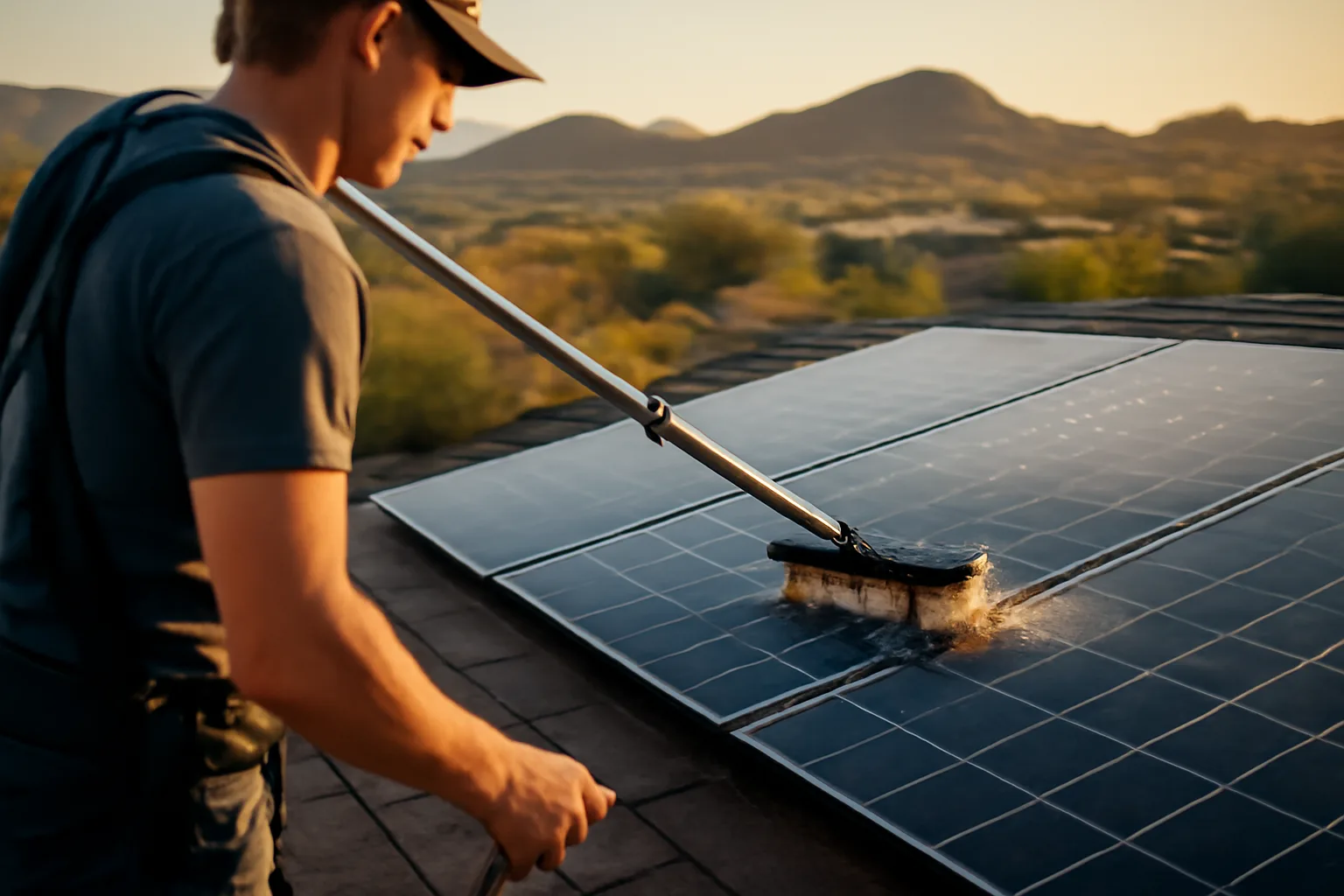
Solar panel cleaning is the physical wash of photovoltaic module glass. You remove dust, pollen, bird mess, soot, and mineral film so more light hits the cells. Dirt on the glass is not a branding problem. It is a light problem.
It is not electrical repair. You do not open a junction box, re-torque a connector, or touch an inverter. You wash the face. If a customer wants troubleshooting, that is a different trade and a different risk.
Residential work is usually a pitched roof, a few kilowatts, and a homeowner who noticed a dull film. Commercial work is bigger, flatter, and heavier on site rules. Utility-scale work is rarely a first-year job. Those sites have O&M contractors, badging, and lockout procedures you will not fake your way into.
Soiling varies by rain, tilt, traffic, farms, and desert dust. A wet climate with frequent storms may rinse modules for free. A dry valley near a gravel road will not. Nobody has a single national soiling number you can print on a flyer. The closest public federal guidance treats module cleaning as site-driven operations and maintenance, not a monthly ritual. [6]
DOE's solar PV basics page is blunt about the physics: modules make electricity from sunlight that reaches the cell. [14] Anything sitting on the glass steals some of that sunlight. That is the whole product.
I would not sell coatings, robots, or "nanotech" as the job. For someone entering the trade, solar panel cleaning is still water, a soft brush, and getting off the roof without a fall.
How do you start solar panel cleaning?
You start solar panel cleaning as a local service business. There is no federal washer card. There is no national exam. The order is paper, then fall protection, then water that does not spot the glass.
Do it in that order. Pick a structure. Most people begin as a sole proprietor and report on Schedule C. IRS Publication 334 is the tax guide written for that setup. [7] An LLC can wait until you have money and a reason. The SBA page on choosing a business structure lays out the tradeoffs plainly. [12] Confirm filings with your state and county clerk. A blog is not a filing.
Get a tax ID if you need one. The IRS issues an EIN online at no charge. [8] A true sole prop with no employees may not need one. Banks, insurers, and some commercial buyers will still ask. Confirm on the IRS page, not through a paid reseller.
Then call your state contractor board and ask a plain question. Is washing photovoltaic modules on a roof "contracting" here? Do not guess the class. Do not print a license number you do not have.
Buy fall protection that matches the roof before you buy pretty hose reels. Write a one-page method: spot-free water, soft brush, no abrasives, no standing on modules, no electrical work. Practice on a ground-mount or a low roof you know.
If you want this work stacked against other outdoor gigs, read solar panel cleaning vs nearby career. A shorter starter pass in this series is solar panel cleaning guide 12.
Do you need a license for solar panel cleaning?
There is no federal solar panel cleaning license. Full stop. Whether you need a state contractor license is a board question, and the answer is not the same in every state.
California's contractor definition lives in Business and Professions Code section 7026. It covers a person who "does himself or herself or by or through others, construct, alter, repair, add to, subtract from, improve, move, wreck or demolish" listed structures. [9] Washing glass may or may not land inside that sentence. The board decides, not a Facebook thread.
Florida defines contractor types in section 489.105 of the 2023 Florida Statutes. [10] That chapter is about contracting, not about deionized water. If your board says roof work of this kind is contracting, you stop and apply. If they say it is janitorial, you still carry insurance and you still follow OSHA on the roof.
I would not buy a private "national certification" and call it a license. It is not. Confirm the current class, exemption, and any local business tax with the board and the city. Never invent a current fee, quota, or processing time. Those change. The board's page is the source, not this article.
City business licenses, HOA vendor lists, and property-manager vendor packets are separate paper. They are annoying. They are also how commercial work actually starts. For more on how neighboring states talk past each other, see solar panel cleaning guide 18.
What OSHA rules apply on a solar roof?
Step onto a roof and fall rules apply. OSHA construction fall protection on an unprotected edge starts at 6 feet (29 CFR 1926.501). [1] That is a clean number you can remember.
29 CFR 1926.501(b)(1) says: "Each employee on a walking/working surface (horizontal and vertical surface) with an unprotected side or edge which is 6 feet (1.8 m) or more above a lower level shall be protected from falling by the use of guardrail systems, safety net systems, or personal fall arrest systems." [1]
General industry walking-working surfaces use a lower trigger. 29 CFR 1910.28 requires fall protection at 4 feet on an unprotected side or edge. [2] The quoted duty is that "the employer must ensure that each employee on a walking-working surface with an unprotected side or edge that is 4 feet (1.2 m) or more above a lower level is protected from falling." [2]
Which part applies to your wash day is fact-specific. Roof work on a house often gets analyzed as construction. Confirm with current OSHA material and your insurer. A one-person shop is not magically exempt because you like working alone.
If you use a harness, 29 CFR 1910.140 is the personal fall protection systems rule. [4] Ladders have their own construction standard at 29 CFR 1926.1053. [5] Electrical contact is a separate hazard. 29 CFR 1910.333 requires safety-related work practices "to prevent electric shock or other injuries resulting from either direct or indirect electrical contacts." [3] You are washing glass. You are not opening energized gear.
NIOSH still publishes fall-prevention material for housing construction. Read it. [13] A $40 lanyard clipped to a gutter is a waste of money. Use a real anchor, a full-body harness, and training you can show. I would walk away from a steep roof with no tie-off plan. The invoice is not worth a fall.
What water should you use to clean solar panels?
Use water that does not leave mineral spots. City water often does. Those spots bake in the sun and become the next film you get hired to remove.
Deionized water or reverse-osmosis water is the usual professional answer. A cheap TDS meter tells you when the resin is dead. When the meter climbs, you change the resin. Guessing is how you leave white rings on black glass.
Soap is optional and often a problem. Use it and you now own wash-water chemistry and a rinsing job. I would rather run high-purity water and a soft brush than a citrus cocktail you cannot discharge. NREL's 2018 PV O&M best-practices report treats cleaning as maintenance and is not a sales brochure for detergents. [6]
Do not blast modules with a pressure washer. You can drive water into frames, lift seals, and etch coatings. Manufacturers hate that. Warranties hate that. A water-fed pole from the ground is the right tool when the array is reachable. On a roof, a low-pressure flow and a soft brush beat a wand every time.
Hard water plus a squeegee is a residential window trick. It is a weak premium story on photovoltaic glass. Spend on resin and a meter before you spend on a trailer wrap.
What equipment should you buy in year one?
Buy safety, then water quality, then reach. That order saves people.
Fall kit: full-body harness, shock-absorbing lanyard or SRL that matches the roof, and an anchor method you can actually install or attach without wrecking the shingles. Inspect it. Log it. OSHA's personal fall protection rule is not a catalog. [4] Ladder: rated, tied off, used per 29 CFR 1926.1053, not leaned on a gutter and hoped. [5]
Water: a deionizing setup or RO, spare resin, a TDS meter, hoses that will not dump plastic shards, a soft modular brush, and a water-fed pole for ground work. A small pump helps on long runs. A giant hot-water skid does not help a first-year residential book.
You can assemble that from parts. SolarWashPath also lists a $149 one-time DI Water + Roof-Safety Kit if you want a packaged start rather than a parts run (see /start). Equivalent parts from a supplier are fine. The kit is not a license and it does not replace board rules.
Skip in year one: drones, robots, ceramic coatings you cannot reverse, and a wrapped truck. Those are ego purchases. A phone camera, a notebook, and a meter will do more for your first fifty jobs.
For a gear-versus-paper comparison in this series, solar panel cleaning guide 36 is the next click if you are still shopping lists.
How do you deal with wash water and neighbors?
You are putting water on a roof and it has to go somewhere. Plan that before you open a valve.
Keep water off walkways that freeze. Keep it out of an open window. Keep soapy water out of a storm drain unless the city told you that is allowed. Municipal stormwater desks care about this even when your state contractor board does not.
On a house, runoff usually hits landscaping. Ask where the client wants it. Bird mess and heavy soil may need collection on a sensitive site. Do not invent an EPA permit number for a residential rinse. Do confirm local discharge rules if you are using soap or working on a commercial yard.
Neighbors notice ladders, noise, and overspray. A five-minute heads-up beats a complaint to the HOA. HOA vendor rules are local paper. They are not OSHA, and they can still kill a Saturday job.
I would rather rinse with pure water and no soap than argue about suds in a driveway. Simple chemistry, fewer phone calls.
How often should solar panels be cleaned?
As often as soiling actually costs the owner money. That is a site answer, not a national calendar.
Rain does a lot of the work in wet regions. Dust, pollen season, agriculture, and desert film do the opposite. Tilt matters. Flat commercial glass holds soil. Steep residential glass sheds more of it.
NREL's O&M best-practices report (NREL/TP-7A40-73822, 2018) treats cleaning as a maintenance item driven by conditions at the site. [6] It is not a mandate to wash every house every 90 days. Anyone selling a fixed national frequency is guessing.
An honest first visit includes photos, a look at drainage, and a note on nearby dirt sources. Then you propose an interval you can defend. Two visits a year is common talk in dry markets. It is still talk until you see the array.
Do not promise production gains you did not measure. You washed glass. You did not install a new inverter. If a customer wants monitoring proof, use their portal, not a story.
More on scheduling language people overuse is in solar panel cleaning guide 54.
What tax paper does a new operator actually file?
A sole proprietor lives in IRS Publication 334 territory. That guide exists for small business owners who are sole proprietors, which is most people in year one. [7]
Track mileage, resin, insurance, PPE, and phone costs as you go. A shoebox in April is how you overpay. Photos of completed roofs help in disputes. They are not a substitute for receipts.
The IRS issues an EIN online at no charge when you need a federal tax ID. [8] Confirm on that page whether your facts require one. Paid EIN middlemen are a waste of money.
Hire anyone and wage rules show up. That is a different desk (Wage and Hour), and you should not wing it. Stay solo and you still pay self-employment tax on net profit. Publication 334 walks that in plain language. [7]
Sales tax on services is a state question. Some states tax cleaning. Some do not. Confirm with your revenue department. Do not copy a rate from another operator's Instagram.
I would not form an LLC on day one just because a YouTube video said so. Paper has a cost. Form it when a customer, a partner, or a lender makes it rational.
How do you price solar panel cleaning when you have no book?
Price the visit you will actually perform, on the roof you measured, with the safety you need. Do not scrape a national average off a forum. There is no government price table for this niche.
BLS median pay for janitors and building cleaners is the closest Occupational Outlook Handbook category, and it is a poor proxy for roof solar work. [11] Use it only as a reminder that indoor floor care and rooftop PV glass are not the same job.
Quote from a site visit or from clear photos plus pitch, height, and access. A ground-mount with a hose bib is not a three-story Victorian. If you cannot tie off, the price is "no."
I would charge enough to cover resin, fuel, insurance, and slow, careful time on the roof. Racing a 6/12 pitch in worn shoes to beat a $99 coupon is how people get hurt. First jobs are for references and for learning your minutes-per-module. They are not for teaching the market that this work is cheap.
Put the method in the quote: deionized or RO water, soft brush, no pressure wand, no standing on glass. That stops the customer from comparing you to a driveway crew.
For a pricing-versus-career framing, solar panel cleaning vs nearby career is worth a read before you copy someone else's number.
What should you skip in the first year?
Skip anything that pretends to be a license. Private certificates, weekend "academies," and laminated cards from a marketing company do not bind a state board. A class that teaches fall protection from a real trainer can be worth it. A class that teaches you to upsell coatings is not.
Skip pressure washing on modules. Skip standing on the glass. Skip opening electrical hardware because a microinverter LED looks funny. 29 CFR 1910.333 is about preventing shock from electrical contact, not about being curious. [3]
Skip a wrapped van, a drone, and a robot. Skip nationwide franchise math. This is local, seasonal, weather-stopped work. Rain cancels you. Wind cancels you. Ice cancels you.
Skip promising production percentages you did not measure. Skip same-day bids on roofs you have not seen. Skip working without a written method and a photo set.
Buy the meter. Buy the harness. Call the board. That is the whole "hack."
A later series piece, solar panel cleaning guide 72, is useful if you are comparing start paths after you already have a few jobs.
How is this different from nearby outdoor work?
Window cleaning teaches water-fed poles and customer talk. It does not teach module frames, DC drop, or walking around glass you must not step on. Pressure washing teaches pumps. It teaches the wrong contact pressure for AR coatings.
Roofing teaches pitch and felt. It is construction, and the license picture is clearer. Solar panel cleaning sits in a gray belt between janitorial work and roof access. That gray belt is why you call the contractor board instead of guessing. [9] [10]
| Start path | Paper you actually touch | When I would use it |
|---|---|---|
| Sole proprietor | DBA if required, Schedule C, Pub 334 | First season, solo |
| LLC | State formation, EIN | After revenue, or a partner |
| Licensed contractor | Board application only if the board says this work is contracting | When the board says so |
Gravity is the same as any roof trade. The product is not. You sell clean glass and a method, not a new shingle line.
SolarWashPath is an independent publisher, not a law firm and not a service company. Confirm licenses, exemptions, and fees with the relevant board. If you want the packaged DI and roof-safety start after you have read the paper path, it is at /start.
Frequently asked questions
What is solar panel cleaning?
It is washing photovoltaic module glass so dust, pollen, bird mess, and mineral film do not block light. It is not electrical repair and not inverter work. You use soft contact and water that does not spot. Production claims belong to the owner's monitoring, not to a rinse story.
How do you start solar panel cleaning?
Start as a local service: structure and tax paper, then a board call on contractor status, then OSHA-matching fall protection, then deionized or RO water and a soft brush. There is no federal washer license. Confirm current rules with your state board and city. Practice on a low, known roof before you bid steep work.
Is deionized water required for solar panel cleaning?
No statute says you must use DI water. Spot-free water (DI or RO) is still the professional finish because tap minerals bake onto glass. A TDS meter tells you when resin is spent. I would not sell city water and a squeegee as premium work on PV glass.
Can I use a pressure washer on solar panels?
I would not. High pressure can drive water into frames, lift seals, and damage coatings. Soft brush plus low-pressure pure water is the method. If a manufacturer manual bans pressure washing, that ban is the rule for that array, not a suggestion.
Do I need an EIN to start?
Maybe. The IRS issues an EIN online at no charge. A sole proprietor with no employees may not need one, but banks and insurers often ask. Confirm on the IRS EIN page. Do not pay a reseller for a free federal form.
Does OSHA apply if I work alone?
Working alone does not delete fall or electrical rules. Construction fall protection on an unprotected edge is 6 feet under 29 CFR 1926.501. General industry walking-working surfaces use 4 feet under 29 CFR 1910.28. Use a real anchor and harness. Confirm classification with current OSHA material and your insurer.
Can I clean solar panels from the ground?
Yes, when a water-fed pole can reach the glass without standing on modules or overreaching a ladder. Ground work is the safer default. If you cannot reach, you need a roof plan that includes fall protection, not a longer pole and hope.
Do I need a contractor license?
There is no federal cleaning license. Some states may treat roof work as contracting. California's BPC 7026 and Florida's 489.105 define contractor in broad construction language, not in a neat "solar washing" sentence. Call your board and confirm. Do not invent a class or a fee.
Should I form an LLC on day one?
Usually no. Sole prop plus Schedule C (IRS Publication 334) is how most people start. Form an LLC when revenue, a partner, or a customer makes the extra paper rational. Confirm formation steps with your state, not with a formation upsell ad.
How often should panels be cleaned?
When soiling at that site actually matters. Rain, tilt, dust, and farms change the answer. NREL's 2018 PV O&M best-practices report treats cleaning as condition-driven maintenance, not a national calendar. Do not promise a fixed gain you did not measure.
What insurance do new operators carry?
Talk to a broker who understands roof work, not only indoor janitorial. General liability is the usual starting policy. If you have employees, workers' comp rules apply. Confirm limits with the broker and with any property manager who will let you on site. This publication is not a broker.
Is a private solar cleaning certificate a license?
No. A marketing certificate is not a state contractor license and not an OSHA card by itself. A real fall-protection class can still be useful. Confirm every license claim with the board that actually issues paper in your state.
Sources
- OSHA 29 CFR 1926.501 Duty to have fall protection: Construction employees on an unprotected edge 6 feet or more above a lower level must be protected by guardrails, safety nets, or personal fall arrest systems.
- OSHA 29 CFR 1910.28 Duty to have fall protection and falling object protection: General industry walking-working surfaces with an unprotected side or edge 4 feet or more above a lower level require fall protection.
- OSHA 29 CFR 1910.333 Selection and use of work practices: Safety-related work practices must be used to prevent electric shock or other injuries from direct or indirect electrical contacts.
- OSHA 29 CFR 1910.140 Personal fall protection systems: OSHA sets performance and use requirements for personal fall protection systems such as harnesses and connecting devices.
- OSHA 29 CFR 1926.1053 Ladders: Construction ladder use, including access and setup, is regulated under 29 CFR 1926.1053.
- IRS Publication 334, Tax Guide for Small Business: Publication 334 is the IRS tax guide for small business owners who are sole proprietors.
- IRS Apply for an Employer Identification Number (EIN) Online: The IRS issues an EIN online at no charge to identify a business entity.
- California Business and Professions Code section 7026: California defines contractor to include a person who constructs, alters, repairs, adds to, subtracts from, improves, moves, wrecks, or demolishes specified structures.
- Florida Statutes 2023 section 489.105 Definitions: Florida statute 489.105 defines contractor classes used in that state's contracting chapter.
- BLS Occupational Outlook Handbook, Janitors and Building Cleaners: Janitors and building cleaners is the BLS Outlook category closest to cleaning work, and it is a poor wage proxy for rooftop PV washing.
- U.S. Small Business Administration, Choose a business structure: SBA publishes a walkthrough of sole proprietorship, partnership, LLC, and corporation tradeoffs for new firms.
- NIOSH Publication 2011-180, Preventing Falls in Housing Construction: NIOSH publishes fall-prevention guidance specific to housing construction work.
- U.S. Department of Energy EERE, Solar Photovoltaic Technology Basics: Photovoltaic modules convert sunlight that reaches the cell into electricity, so anything blocking the glass reduces incoming light.