Last updated 2026-08-21
TL;DR
Solar panel cleaning is washing photovoltaic glass so dust, pollen, droppings, and film do not cut energy. NREL’s PVWatts default soiling loss is 2%. Starting a service means entity paper, an EIN if you need one, insurance, a local license check, and fall protection at 6 feet under OSHA 1926.501. Confirm every license and fee with your board. There is no federal washing license.
What is solar panel cleaning?
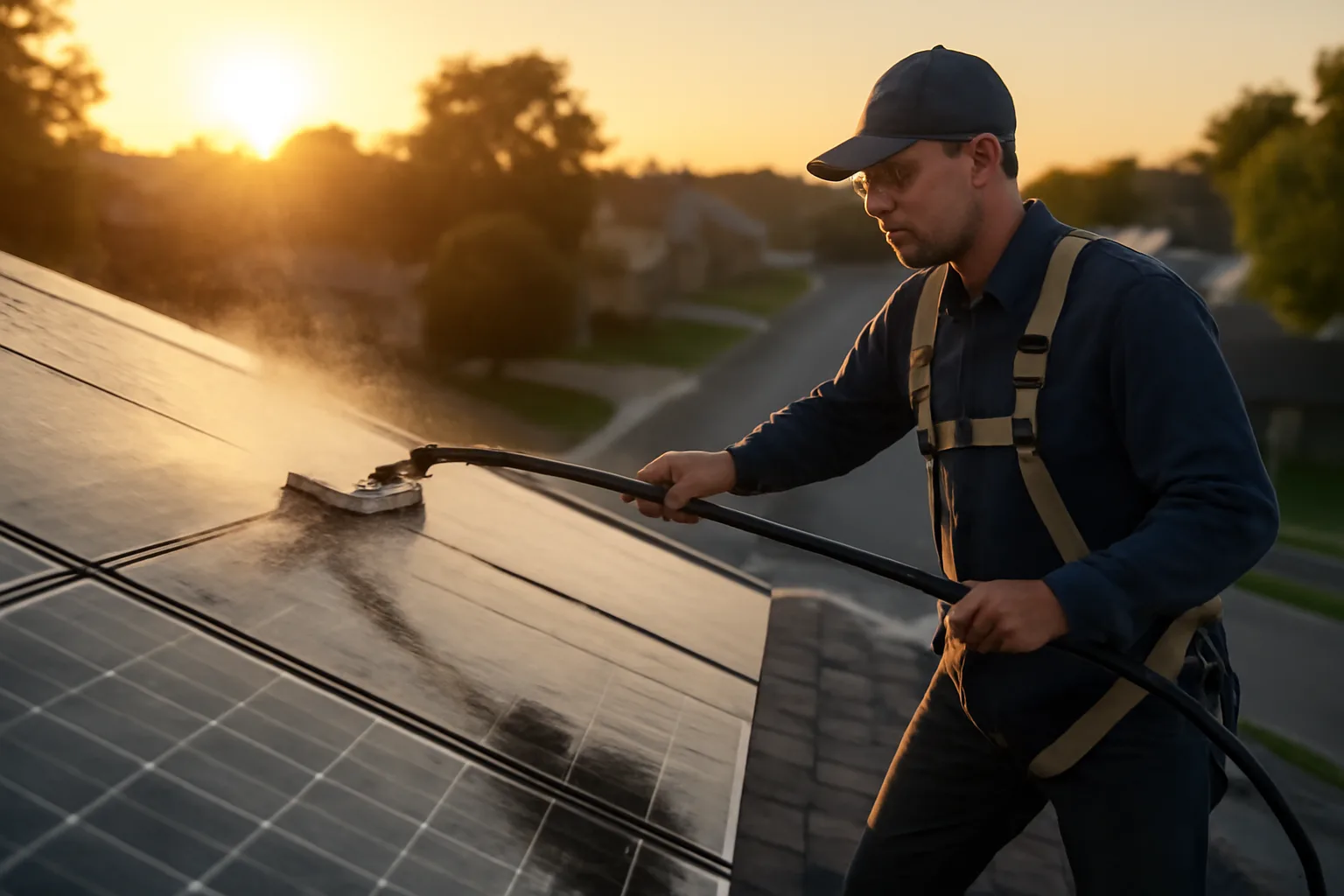
Solar panel cleaning is washing photovoltaic modules so dust, pollen, soot, bird droppings, and mineral film stop blocking light. It is maintenance, not electrical installation. A typical residential job uses purified water, a soft brush, and either a water-fed pole from the ground or careful work up on the roof.
You are not replacing optimizers. You are not commissioning a new array. You are taking soil off glass. That distinction is what licensing boards care about. Pure washing often sits nearer janitorial work. Taking modules off rails sits nearer contracting. Confirm the line in writing with your state board. Do not treat a national blog as the statute.
NREL’s PVWatts Version 5 Manual sets the default soiling loss at 2% [4]. That is a modeling default, not a measurement of the roof you will see Tuesday. Agricultural dust, desert sites, and heavy pollen run higher. Wet climates with frequent rain often run lower. Nobody has a clean federal time series of residential soiling by zip code. The 2% figure in PVWatts is the modeling default most people actually use [4].
I treat this trade as roof work that happens next to live equipment. Do not open inverters. Do not probe strings unless you are the electrician of record. If you see melted connectors or chewed insulation, stop. Tell the owner to call the installer.
Ground-mount arrays are simpler. Pitched homes are where falls happen. Commercial roofs add site rules, badging, and sometimes a required orientation. Same dirt. Different paper.
Say you wash modules in your ads. If you say solar service, people hear repairs you may not be allowed to sell.
Does dirt on solar panels actually reduce energy?
Yes. Dirt on the glass cuts the light that reaches the cells, so the system makes less energy until rain or a wash clears it. NREL’s PVWatts Version 5 Manual sets the default soiling loss at 2% [4]. Use that as a starting point, then look at the actual site.
The NREL Best Practices for Operation and Maintenance of Photovoltaic and Energy Storage Systems (3rd edition) treats soiling and washing as ordinary plant work [5]. It is an engineering handbook, not a sales deck. Read it if you want the tone of operators instead of a pitch.
Rain fails when the soil is oily, mineral-heavy, or sitting in bird disks. Pollen cakes. Wildfire ash is its own mess. I would not sell a monthly plan in a rainy coastal town without monitoring data. I would sell a seasonal wash in a dusty valley if the customer can watch the dip on the app.
Default PVWatts loss factors that are not zero look like this [4]:
| Loss factor | Default |
|---|---|
| Soiling | 2% |
| Mismatch | 2% |
| Wiring | 2% |
| Availability | 3% |
| Light-induced degradation | 1.5% |
| Nameplate | 1% |
| Connections | 0.5% |
Snow is a separate input (default 0%). Do not mix snow with soiling on a quote. If the customer has a monitoring app, compare similar-weather days before and after a wash. That is the only local proof that matters.
How do you start solar panel cleaning?
You start by creating a legal person (yourself as a sole proprietor or an LLC), getting tax IDs, buying insurance, checking local license boards, and assembling purified water plus fall gear. Then you take small jobs and keep records. There is no federal solar panel cleaning license.
The SBA Register Your Business page maps entity choice and state registration [8]. The IRS lets you apply for an EIN online at no charge [7]. I would get the EIN even as a sole proprietor so I am not printing a Social Security number on every W-9.
| Setup | Paper you actually touch | What I would do |
|---|---|---|
| Sole proprietor | Local DBA if required, Schedule C [11] | Fine for the first year if you want simple books |
| LLC | State formation plus tax classification | Do it if a broker or property manager demands the extra box |
| No registration | Hope | A waste. It does not make the roof safer and it does not impress an insurer |
I would not lease a new van in month one. I would not buy a franchise. I would not pay for a private certificate that no state board lists. Get liability quotes from a broker who understands roofs. If you hire anyone, workers’ compensation is a state law issue.
Write a one-page method: purified water, no high pressure on glass, no stepping on modules, abort in wind or active rain. Property managers ask for that page. So do some underwriters.
Practice the water system in a driveway before you take a two-story pitch. Learn your TDS meter. Learn your abort rule. Then book work you can finish without rushing the harness.
Do you need a license for solar panel cleaning?
Maybe. There is no single U.S. license titled solar panel cleaning. Some cities want a business tax certificate. Some states want a contractor classification if they treat the visit as construction. Some treat a water-only wash as janitorial. Confirm with the contractor board and the city before you take a deposit.
I will not quote a fee or a processing time. Boards change both. Anyone posting a national license chart with dollar amounts is guessing. Confirm with the relevant board. No approval promise belongs in a guide.
California is the example people copy. Cal/OSHA still expects an Injury and Illness Prevention Program under 8 CCR 3203 for employers in that state [9]. That is safety paper, not a washing card. Different agency. Different pile.
If you only wash with a pole from the ground and never touch electrical parts, you may sit on the janitorial side. If you remove modules, torque racking, or open equipment, you have likely crossed into contractor work. Ask the board in writing. Keep the email.
City rules can be tighter than state rules. HOAs can be tighter than both. None of that shows up on a national myth thread. Read the classification list yourself.
What insurance and tax paper do you file first?
Start with an EIN if you need one [7], a bookkeeping method, and Schedule C if you operate as a sole proprietor [11]. IRS Topic No. 554 says, "The self-employment tax rate is 15.3%. The rate consists of two parts: 12.4% for social security (old-age, survivors, and disability insurance) and 2.9% for Medicare (hospital insurance)." [6] Budget that. People forget it and then call the tax a surprise.
General liability is not optional if you go on other people’s roofs. Umbrella, hired or non-owned auto, and inland marine for gear are broker questions. I do not invent premiums. They move with claims and with whether you actually use fall protection.
If you have employees, payroll withholding and workers’ compensation attach. Calling a helper a contractor does not erase that. When in doubt, treat helpers as employees and ask a payroll service plus a lawyer in your state.
Keep copies of certificates of insurance, the policy declarations page, and any additional-insured endorsement a property manager demands. Dull file. Useful file.
I would not start jobs on a personal auto policy and a handshake. That is how a broken skylight becomes a household problem.
What OSHA rules apply when you work on a roof?
If the work is treated as construction and you are on a walking surface with an unprotected edge 6 feet or more up, OSHA 29 CFR 1926.501 requires fall protection [1]. The standard at 1926.501(b)(1) says, "Each employee on a walking/working surface with an unprotected side or edge which is 6 feet (1.8 m) or more above a lower level shall be protected from falling by the use of guardrail systems, safety net systems, or personal fall arrest systems." [1]
Lawyers argue about construction versus general industry. I would not join that argument from a wet 8/12. Use fall protection and keep moving.
Ladders have their own rule in 29 CFR 1926.1053 [3]. NIOSH’s Portable Ladder Safety publication is a short companion worth the time [12]. OSHA’s roofing falls booklet (OSHA 3755) is a 15-minute read that beats a motivational reel [10].
Electrical work practices sit in 29 CFR 1910.333 [2]. You should not be inside an inverter. Treat the array as live anyway, stay off damaged wiring, and abort if you see burnt connectors. Call an electrician. Do not wipe a fault and hope.
I would not work a steep wet roof. I would not use an unrated harness. I would not tie off to a vent pipe. Those choices are how this trade gets a bad name.
What equipment do you need for solar panel cleaning?
You need a way to get purified water to the glass, a soft wash tool, hose and fittings that do not shed junk, and fall gear if you leave the ground. Deionized or RO/DI water dries without mineral spots. Hard tap water is a waste on glass. It leaves rings the customer will blame on you.
A cheap pressure washer aimed at modules is a bad buy. High pressure can drive water into junction boxes and fight ordinary manufacturer cleaning notes. Soft brushes and low-pressure purified water match how arrays are built.
Poles, a TDS meter, a pump, hose, a filter stack or DI resin, roof-safe shoes, a harness, a lanyard, an anchor you are allowed to use, cones, and a tank if you cannot reach a hose bib. That is the kit. Site robots belong on large commercial contracts that pay for them, not on your first Saturday.
SolarWashPath sells a $149 one-time DI Water + Roof-Safety Kit if you want a bundled starter. You can buy the same classes of parts separately and do as well.
Skip ceramic coatings sold as a miracle. Skip dish soap. Skip anything abrasive. If you use a chemical at all, keep the safety data sheet in the binder and confirm the module maker allows it.
How often should solar panels be cleaned?
As often as soiling costs more than the wash. That is the only honest answer. Rainy climates may need one seasonal clean or none. Dusty, agricultural, or high-pollen sites may want several. NREL’s 2% default is an annualized model loss, not a calendar reminder [4].
I would start homeowners on a spring clean plus a check after wildfire ash or a heavy pollen dump. Then look at monitoring. If yield does not move, do not upsell monthly service. Monthly service is how you lose trust.
Bird-heavy roofs are different. Droppings are local and ugly. Spot-clean those. Do not pretend a driveway pole wash got the nesting corner.
Commercial O&M contracts often set a frequency in the agreement. Follow the contract and the site safety rules. Residential is a conversation with data, not a script.
The NREL O&M handbook is the right place to see how plant operators think about washing inside a broader maintenance plan [5]. Steal the seriousness. Do not steal a utility’s budget.
What should you charge in year one?
Charge enough to cover labor, drive time, water, resin, insurance, and the 15.3% self-employment tax on profit [6]. There is no official national price list. I have not seen a federal series that tracks residential wash prices. Anyone quoting one U.S. average made it up.
Look at local window cleaning and roof-work rates, then read state-level notes. solar panel cleaning cost in California is a sensible next read if you work there. Solar panel cleaning cost in Arizona behaves differently because dust and HOA habits differ. solar panel cleaning cost in Florida has its own humidity, pollen, and condo-board pattern.
I would price by array size and roof difficulty, not by a cute per-panel number that ignores pitch. A two-story 6/12 with no legal anchor is not the same job as a one-story 3/12.
Do not win work by being the cheapest person willing to skip fall protection. That race has a predictable end.
If you work mountain or island markets, read those pages too: solar panel cleaning cost in Colorado and solar panel cleaning cost in Hawaii. Confirm local license facts on the board site, not on a price blog.
What first-year mistakes waste money?
Buying too much truck. Paying for a private certification no regulator lists. Using dish soap that streaks. Working without a written abort rule for wind and rain. Skipping the city business license because a forum said you did not need one.
Also: mixing household bleach, walking on modules, and quoting a statewide license fee you saw on a 2019 thread. Confirm fees with the board. Confirm insurance with a broker. Confirm HOA rules with the manager.
Paper you actually need in a binder: entity documents, EIN letter, insurance declarations, method statement, safety data sheets if you use any chemical, fall plan, and invoices. That is enough. Laminated slogans are a waste.
I would not spend early cash on wraps, drones, or a second pressure washer. I would spend it on resin, a real harness, and enough liability limit that a property manager will let you on the roof.
Keep drive time honest. A cheap job 90 minutes away is not cheap. Fuel and the empty return eat the day.
How do you confirm board rules without guessing?
Call or email the state contractor licensing board and the city business license office. Ask two questions. Is washing photovoltaic modules from the roof considered contractor work here? Do I need a local business tax certificate? Save the reply.
The SBA registration guide points you at state portals [8]. It does not replace them. California’s Title 8 IIPP rule is an example of a safety duty that is not a contractor card [9]. Different pile of paper. Other states have their own safety and contractor split. Confirm each one.
If a clerk is unsure, ask for the classification list and read it. Do not let a salesperson at an equipment booth interpret statute for you.
Market notes can still help you see how crowded a state feels. Use them as market notes, not as law: solar panel cleaning cost in Georgia, Solar panel cleaning cost in Alabama and license facts, solar panel cleaning cost in Idaho.
If two agencies disagree, get both answers in writing and follow the stricter one until a lawyer in that state says otherwise.
What should a first-year job file contain?
A useful file has the estimate, signed permission to access the roof, photos before and after, a weather note, the water source, a TDS reading if you use DI, the invoice, and the payment record. If you used a helper, their status and any certificate of insurance sit in the same folder.
Schedule C instructions explain how sole proprietors report profit and expenses [11]. Keep receipts that match. Resin, fuel, insurance, and phone are ordinary costs. That is not tax advice. That is matching the form to the work.
Add the fall plan and the method page. If a claim happens six months later, you will want those dates, not your memory.
For a single start checklist on this site, go to /start. SolarWashPath is an independent publisher, not a law firm and not a service company.
Do the wash. Write the invoice. File the paper the same day. That habit is the whole first year.
Frequently asked questions
What is solar panel cleaning?
Solar panel cleaning is washing photovoltaic glass so dust, pollen, soot, droppings, and mineral film do not block light. It is maintenance, not installation or electrical repair. Most residential work uses purified water and a soft brush from the ground or the roof. NREL’s PVWatts default soiling loss is 2%, which is a model input, not a reading from one house.
How do you start solar panel cleaning?
Form a sole proprietorship or LLC, register where your state requires, get an EIN if you need one, buy liability insurance, and ask the contractor board plus the city whether washing modules needs a license. Build a purified-water kit and fall gear. There is no federal washing license. Confirm every fee with the board. Do not treat a national chart as the law.
Is a pressure washer safe on solar modules?
I would not use a pressure washer on modules. High pressure can drive water into junction boxes and fight ordinary manufacturer cleaning notes. Soft brushes and low-pressure purified water match how the glass and frames are built. Save the pressure washer for the driveway, not the array.
Do I need deionized water for solar panel cleaning?
You need water that will not leave mineral spots. Deionized or RO/DI water does that because the dissolved solids are stripped out. Hard tap water is a waste on glass. A cheap TDS meter tells you if the resin is spent. You do not need a laboratory. You do need a number near zero before you rinse.
How much energy does soiling take?
NREL’s PVWatts Version 5 Manual sets the default soiling loss at 2%. That is a national modeling default, not your customer’s roof. Dusty, agricultural, and pollen-heavy sites often lose more. Wet climates often lose less. Compare similar-weather monitoring days before and after a wash if you want a local answer.
Is there a federal license for solar panel cleaning?
No. There is no federal solar panel cleaning license. Some cities want a business tax certificate. Some states treat roof washing as contractor work. Some treat water-only washing as janitorial. Email the contractor board and the city. Keep the reply. Confirm fees there. Do not copy a fee from a blog.
What does OSHA require at 6 feet?
OSHA 29 CFR 1926.501 requires fall protection for employees on a construction walking surface with an unprotected edge 6 feet or more above a lower level. Guardrails, safety nets, or a personal fall arrest system satisfy that rule. I would use fall protection even when someone online says the visit is not construction.
How do I get an EIN?
Apply on the IRS EIN page online at no charge if you qualify. Many sole proprietors still get an EIN so they are not handing out a Social Security number on every W-9. The letter that comes back belongs in your binder next to insurance and invoices. Confirm current steps on the IRS page, not on a third-party form mill.
Should I form an LLC before the first job?
Not always. A sole proprietor with Schedule C is a clean first-year path if you want simple books. Form an LLC if a broker, property manager, or your own risk tolerance wants that extra box. State formation rules and fees vary. Confirm them on your state portal. An LLC is not a substitute for liability insurance or fall gear.
How often should residential solar panels be washed?
Wash when soiling costs more than the visit. Rainy sites may need one seasonal clean or none. Dusty or bird-heavy roofs may need more. I would start with spring plus a check after ash or a pollen dump, then use monitoring. Do not sell monthly service without data. NREL’s 2% figure is not a monthly calendar.
Will cleaning void a module warranty?
It can if you scratch glass, use harsh chemicals, or blast water into boxes. I will not invent a warranty clause. Read the module maker’s cleaning note for that brand and follow it. Water-only purified rinses with a soft brush are the conservative path. Keep photos. If you cannot find the note, ask the installer before you experiment.
Do I pay self-employment tax on solar panel cleaning profit?
If you are self-employed, yes, on net earnings. IRS Topic No. 554 sets the self-employment tax rate at 15.3% (12.4% social security plus 2.9% Medicare). Extra Medicare tax can apply above the IRS threshold. That is why cheap jobs that ignore tax and insurance are not cheap. Confirm details on the IRS topic page.
Sources
- OSHA 29 CFR 1926.501 Duty to have fall protection: Construction employees on a walking/working surface with an unprotected edge 6 feet or more above a lower level must have guardrails, a safety net, or personal fall arrest.
- OSHA 29 CFR 1910.333 Selection and use of work practices: Safety-related work practices are required to prevent injury from contact with energized electrical parts.
- OSHA 29 CFR 1926.1053 Ladders: Portable and job-made ladders on construction sites have specific use and condition requirements.
- IRS Tax Topic No. 554, Self-Employment Tax: The self-employment tax rate is 15.3%, made of 12.4% social security and 2.9% Medicare.
- IRS Apply for an Employer Identification Number (EIN) Online: Eligible applicants can request an EIN online from the IRS at no charge.
- U.S. Small Business Administration, Register Your Business: New businesses need to choose an entity and complete the state and local registrations that apply to them.
- California Code of Regulations, Title 8, Section 3203 Injury and Illness Prevention Program: California employers must establish, implement, and maintain an Injury and Illness Prevention Program.
- OSHA Publication 3755, Falls in Construction: Roofing: OSHA publishes specific fall-hazard guidance for roofing work.
- IRS Instructions for Schedule C (Form 1040): Sole proprietors use Schedule C to report profit or loss from a business.
- NIOSH Publication 2011-156, Portable Ladder Safety: NIOSH publishes portable ladder safety practices for workers who climb to elevated work.