Last updated 2026-08-18
TL;DR
Connecticut has no dedicated solar panel cleaning license. You register a business entity or DBA with the Secretary of State, carry general liability insurance (most clients require at least $1 million per occurrence), and comply with local business permits. Residential roof access may trigger contractor registration in some towns. Expect to charge $150 to $350 per residential job in Connecticut's market.
Do you need a license for solar panel cleaning in Connecticut?
No. Connecticut does not issue a solar panel cleaning license, and there is no specialty trade license that covers panel washing. The Connecticut Department of Consumer Protection licenses contractors for electrical, plumbing, HVAC, and home improvement work, but exterior surface cleaning is not on that list [1].
'No state license' does not mean 'no paperwork.' A few things matter depending on how you operate. If you work on rooftops rather than just ground-mounted arrays, some Connecticut towns treat that as home improvement contracting. The state's Home Improvement Act (Connecticut General Statutes Section 20-418 through 20-432) covers contractors who perform work on residential property [2]. Whether washing solar panels on a roof qualifies as 'home improvement' under that statute is genuinely unclear. The statute defines home improvement as 'the repairing, remodeling, altering, converting, or modernizing of, or addition to, residential property.' Cleaning is not remodeling, and most attorneys who read the statute would not classify panel washing as covered work. Confirm with a Connecticut attorney or the Department of Consumer Protection before you operate exclusively on rooftops. The penalty for unlicensed home improvement work runs up to $1,000 per violation [2].
For ground-mounted panels, the licensing question is settled. There is nothing to get. You form a business, carry insurance, and go to work.
One more wrinkle. If you ever use chemicals beyond plain deionized water (certain degreasers, for instance), Connecticut's Department of Energy and Environmental Protection has rules on commercial pesticide and chemical application. Plain water or mild soap does not trigger those rules, but confirm with DEEP if your process changes [3].
What business registration does Connecticut actually require?
Any person operating a business under a name other than their own legal name has to register. If you form an LLC, you file a Certificate of Organization with the Connecticut Secretary of State and pay the filing fee. That fee is $120 as of this writing, but confirm the current number because the state adjusts it [4]. If you operate as a sole proprietor under a trade name like 'Sunshine Panel Cleaning,' you file a Trade Name Certificate with the town clerk in the town where you conduct business. That certificate costs very little, often $10 to $25, and it is public record.
An LLC is almost always the better move for a cleaning business. You separate personal assets from business liability, and it signals legitimacy to commercial clients who check your entity status before writing a check. Connecticut also requires LLCs to file an annual report, so calendar that obligation now.
You need a Connecticut Tax Registration Number from the Department of Revenue Services if you have employees or collect sales tax. Cleaning services in Connecticut are generally not subject to sales tax, but verify that with DRS or a CPA. The rules on service taxability have shifted over the years [5].
Local business licenses vary by town. Bridgeport, Hartford, New Haven, and other cities may require a city-level business license or permit. Check directly with the city clerk in every municipality where you plan to operate. This is a one-afternoon task, not a bureaucratic ordeal.
How much does solar panel cleaning cost in Connecticut?
Pricing in Connecticut runs $150 to $350 for a standard residential system, which most Connecticut homes have in the 10 to 20 panel range. Larger systems or commercial arrays can push $500 to $1,500 per visit depending on array size, access difficulty, and whether the customer wants annual contracts.
Connecticut's typical residential solar system sits around 8 to 10 kW, which is on the larger side nationally, partly because the state's net metering policy makes larger systems sensible [6]. Bigger arrays mean more panels to clean. Operators who price per panel (often $8 to $15 per panel) do better on these jobs than those who quote a flat rate without measuring first.
Pollen is heavy in spring across Connecticut's river valleys. Salt spray is a real issue within a few miles of Long Island Sound. Both speed up soiling. Clients in New Haven, Bridgeport, Groton, and other coastal areas often need cleaning twice a year rather than once, which is good for your recurring revenue.
Nobody has clean state-level data on average Connecticut solar cleaning prices. The ranges above come from national solar maintenance surveys and operator pricing forums. Treat them as reasonable starting points, not market guarantees. Quote a few free estimates, see what the local market accepts, and calibrate from there.
How long does solar panel cleaning take in Connecticut?
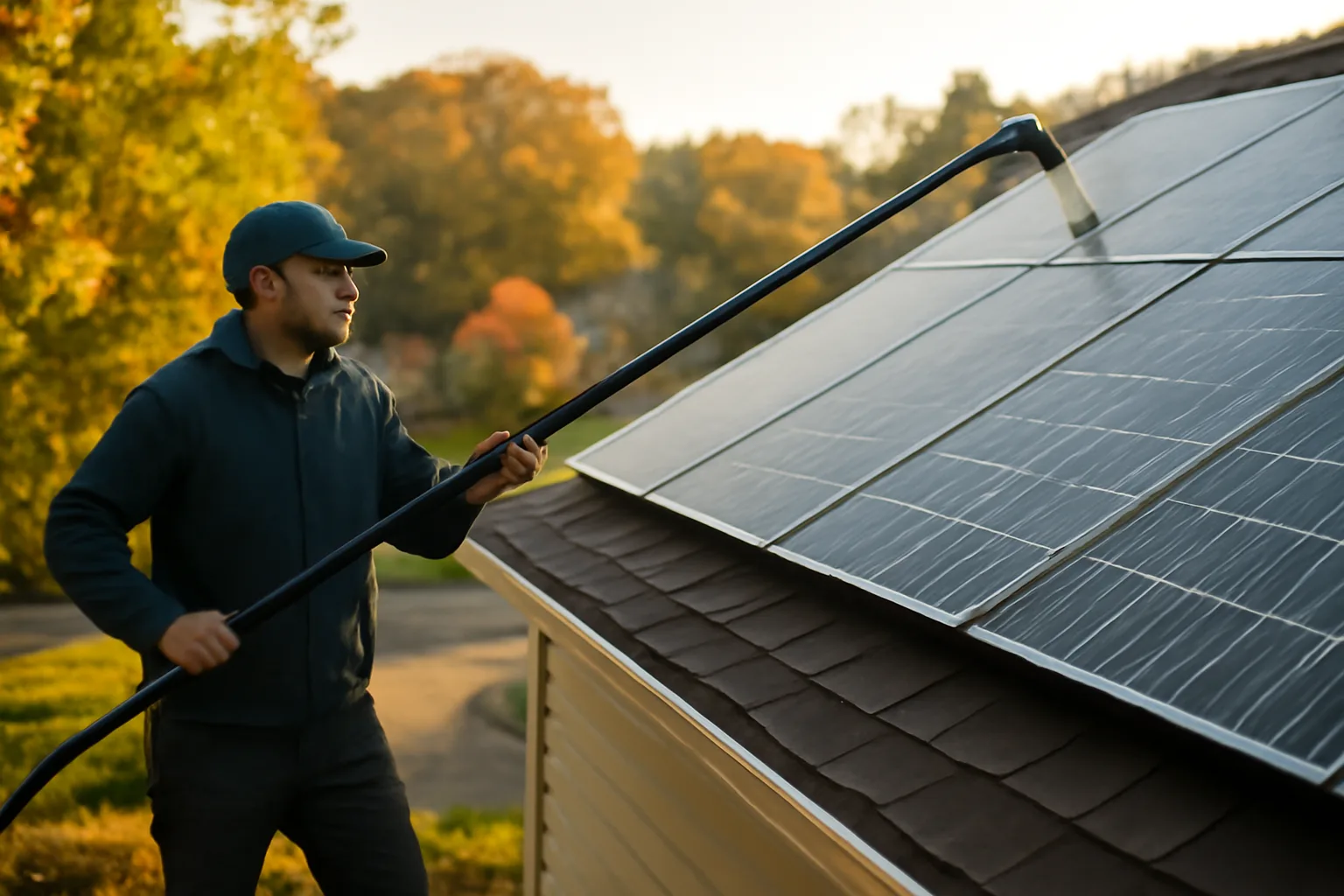
A standard 20-panel residential system takes one to two hours for a single operator using deionized water fed through a water-fed pole. Add another 30 minutes if the system is roof-mounted, once you factor in setup, safety anchoring, and inspection of each panel.
Commercial arrays of 100 or more panels can run four to six hours with a two-person crew. The math scales roughly linearly unless panels sit in multiple orientations or on multiple roof planes, which adds time for repositioning and re-anchoring.
Connecticut weather is the real variable. Hartford averages around 167 sunny days per year [7], on the lower end for the Northeast and nowhere near the Southwest. Your cleaning windows are narrower, and customers may be less motivated to clean often than customers in Arizona or California. Here is the counter-argument you sell with: when Connecticut panels get dirty, the energy loss hits harder because every sunny day counts more.
December through February can make roof work genuinely dangerous from ice and frost. Most Connecticut solar cleaners concentrate bookings between April and October. Budget your annual revenue projections around that.
What insurance do you need to operate in Connecticut?
General liability insurance is the baseline. Most residential clients and all commercial property managers will ask for a certificate of insurance before you set foot on their property. The common threshold is $1 million per occurrence and $2 million aggregate, though some commercial clients require $2 million per occurrence.
If you hire employees, Connecticut law requires workers' compensation coverage. The Workers' Compensation Commission administers this, and coverage has to begin on the first day an employee works [8]. Operating without it when you have employees is a serious violation with heavy fines.
If you work on rooftops, add a commercial umbrella policy over your general liability. Falls are the leading cause of serious injury in the cleaning trades. A $1 million umbrella layer costs $500 to $900 per year for a small operator. Worth every dollar.
Business auto coverage applies if you use a vehicle for work. Personal auto policies exclude commercial use. If your van or truck hauls equipment to job sites, you need a commercial auto policy.
Some larger solar installers and property managers in Connecticut also ask for errors and omissions coverage if you clean panels under a maintenance contract. Less common for small operators, but worth knowing as you grow.
What equipment do you actually need to start?
The minimum setup for Connecticut ground-mounted work: a deionized water system (a portable tank or a filter that connects to a water source), a water-fed pole long enough to reach your panels without climbing, and soft bristle brush heads made for solar glass. Don't use hard brushes. Panel glass has anti-reflective coatings, and scratches cut energy output permanently.
For roof work, add fall protection: a personal fall arrest system (harness, lanyard, anchor) that meets OSHA 29 CFR 1926.502 standards [9]. Connecticut has no state OSHA plan for private-sector workers, so federal OSHA governs. If your employees work at heights above six feet on residential roofs, federal fall protection standards apply.
Deionized water matters more than most new operators realize. Hartford tap water carries enough hardness to leave mineral deposits on panels, which defeats the point of cleaning. A proper DI filter produces spot-free rinses and kills the need for squeegees or drying time. SolarWashPath's $149 DI Water and Roof-Safety Kit is one option for operators just getting started. It covers the core water filtration and basic fall protection components in a single order.
A reliable vehicle with cargo capacity is table stakes. You carry water tanks, poles, and safety gear. Most solo operators start with a used cargo van or a pickup with a topper. Budget $3,000 to $8,000 for a used vehicle in reasonable shape, depending on the market.
For how equipment requirements shift by state, the how to start solar panel cleaning in California guide covers a market where panel density and regulations differ from Connecticut.
How do you find your first customers in Connecticut?
Start with installers. Connecticut has a mature solar market: the Connecticut Green Bank has supported thousands of residential and commercial solar installations since 2011 [6]. Those installers are not in the cleaning business. Call or email the top ten installers in your target geography and offer to be their recommended cleaner. Some refer customers for a small referral fee. Others send you leads free just to have someone to point at.
Google Business Profile is the highest-leverage free tool for a local service business. Set it up with your service area, upload photos of actual clean panels (with permission), and collect reviews from your first handful of customers. Connecticut is small geographically. A strong profile in one county can pull inquiries across neighboring towns.
Direct mail to solar neighborhoods works better than most people expect. You can pull solar permit data from many Connecticut town building departments, or use a solar data aggregator to find addresses with installations. A simple postcard with a clear price range (not 'call for a quote') gets more responses than a vague service pitch.
Homeowner associations in Fairfield County and the Hartford suburbs often have residents with solar and a property manager who controls vendor relationships. A single HOA contract can mean 20 to 50 cleanings a year on a recurring basis. That is a meaningful chunk of annual revenue for a solo operator.
What does Connecticut's solar market look like for a cleaning business?
Connecticut ranks consistently in the top 15 states for residential solar adoption per capita, despite its small land area and not-especially-sunny climate [6]. The driver is economics. Connecticut has some of the highest electricity rates in the country, routinely above $0.20 per kilowatt-hour, which makes solar returns strong and pushes owners to protect the investment [10].
High electricity prices also mean soiled panels are more expensive to ignore. A 5 percent output loss from dirt on a Connecticut system costs more per lost kilowatt-hour than the same loss in a low-rate state. That economic logic is your best argument with a skeptical homeowner.
The Connecticut Green Bank's financing programs and the federal Investment Tax Credit have driven installation volume. The ITC sits at 30 percent for residential systems through at least 2032 under the Inflation Reduction Act [11]. More installations means a growing pool of potential cleaning customers each year.
The competitive field in Connecticut solar cleaning is still thin outside Fairfield County. Most operators are either general pressure washers who tacked on solar cleaning, or part-time solo operators. A professional, insured, DI-water-equipped operator has genuine separation from that pack in most of the state.
What are the real startup costs for a Connecticut solar cleaning business?
Here is an honest breakdown for a solo operator starting from scratch:
| Startup Item | Estimated Cost | Notes |
|---|---|---|
| LLC filing (CT Secretary of State) | ~$120 | Confirm current fee; online filing |
| Trade name certificate (if sole prop) | $10-$25 | Filed with town clerk |
| General liability insurance (first year) | $800-$1,500 | $1M per occurrence; varies by carrier |
| Commercial auto insurance | $1,200-$2,400/yr | Depends on vehicle and driving record |
| DI water system and pole kit | $149-$600 | Entry-level to mid-range setup |
| Fall protection (harness, anchor, lanyard) | $200-$500 | OSHA-compliant system |
| Vehicle (used cargo van or pickup) | $3,000-$8,000 | Wide range based on condition |
| Initial marketing (GBP, postcards) | $200-$500 | First 90 days |
| Total estimated launch | $5,700-$13,600 | Before first revenue |
These are real-world ranges, not optimistic minimums. The vehicle is the biggest variable. If you already own a suitable vehicle, your launch number drops hard.
For how startup costs shift in a neighboring market, the how to start solar panel cleaning in Alabama guide covers a lower-cost-of-entry state with different licensing considerations.
What OSHA rules apply to Connecticut solar cleaners?
Connecticut is a federal OSHA state for private-sector workers, so the federal Occupational Safety and Health Administration's standards govern your operations. Connecticut OSHA (CONN-OSHA) covers public-sector employees only [12].
For roof work, the key standard is OSHA 29 CFR 1926.502, which covers fall protection systems for construction. If you access a residential roof to clean panels, you're doing construction-adjacent work at height, and OSHA expects a personal fall arrest system or a guardrail system. The general industry standard (29 CFR 1910.23) covers elevated work surfaces in non-construction contexts.
What this means in practice: if you have employees and they work at heights above six feet on any surface (roof, ladder, elevated platform), you need documented fall protection. If you're a solo operator with no employees, federal OSHA technically does not cover you, but the safety logic is identical. Falling off a Connecticut rooftop ends your business no matter who writes the citation.
Fall protection is cheap. A complete harness, shock-absorbing lanyard, and roof anchor system runs $200 to $500. The SolarWashPath kit mentioned earlier includes starter safety components. Scale up as you take on more roof work.
Keep equipment inspection records. OSHA expects that fall protection gear gets inspected before each use and that damaged equipment comes out of service. A simple logbook is enough for a small operation.
How do you price solar panel cleaning jobs in Connecticut?
Two pricing models dominate the residential market: per-panel and flat rate by system size tier.
Per-panel pricing (typically $8 to $15 per panel in Connecticut) is transparent and easy for customers to check. A 20-panel system at $10 per panel is $200. Customers can verify it matches their system size. The downside is that it can feel nickel-and-dime if you also charge separately for travel, setup, or a minimum fee.
Flat rate by tier works well when you know your local market. Common tiers look like this: systems under 15 panels at $150, 15 to 30 panels at $200 to $250, 30-plus panels quoted individually. This model is simpler to quote over the phone and rewards you for working efficiently on smaller systems.
For commercial accounts, quote per-panel or by total square footage of panel area, and always run a site visit before you commit to a price. Commercial installations often carry access complications that eat hours.
Annual contracts are your best revenue-stabilizer. Offer a 10 to 15 percent discount to customers who commit to two cleanings a year (spring and fall works well in Connecticut) paid upfront or on automatic billing. Even a modest base of 30 annual contract customers generates $9,000 to $15,000 in predictable revenue before any one-time work.
For how pricing compares in a western state with different conditions, the how to start solar panel cleaning in Colorado guide covers a higher-sun-density market where cleaning frequency and willingness to pay differ.
Frequently asked questions
Do you need a license for solar panel cleaning in Connecticut?
No. Connecticut has no solar panel cleaning license. The Department of Consumer Protection regulates contractors for electrical, plumbing, and home improvement work, but exterior panel washing is not on that list. If you do rooftop work, review the Home Improvement Act (CGS 20-418 to 20-432) with an attorney to confirm your specific scope doesn't trigger registration. Ground-mounted cleaning has no licensing barrier.
How much does solar panel cleaning cost in Connecticut?
Residential solar panel cleaning in Connecticut runs $150 to $350 per visit for a standard 10 to 20 panel system. Per-panel pricing often falls between $8 and $15. Coastal properties near Long Island Sound tend to need cleaning twice a year from salt spray and pollen, which makes annual contracts worth offering. Commercial systems are quoted individually based on panel count and site access.
How long does solar panel cleaning take in Connecticut?
A 20-panel residential system takes one to two hours for a solo operator using a water-fed pole and deionized water. Add 30 minutes for roof-mounted systems that require fall protection setup. Commercial arrays of 100-plus panels run four to six hours with a two-person crew. Winter weather and short daylight limit your productive window roughly to April through October.
Do I need a business license to clean solar panels in Connecticut?
You need a business entity registration (LLC or trade name certificate) with the Connecticut Secretary of State or your town clerk, but there's no specific occupational license for solar cleaning. Some towns require a local business permit. Check with the city clerk in each town where you operate. An LLC costs roughly $120 to file online and is the most practical structure for liability separation.
Is solar panel cleaning profitable in Connecticut?
It can be, given Connecticut's high electricity rates (often above $0.20 per kWh) and a growing installed base of residential and commercial solar supported by the Connecticut Green Bank. A solo operator running 3 to 4 residential jobs per day at $200 average can gross $600 to $800 daily when booked. The real constraint is Connecticut's shorter seasonal window and fewer annual sunny days than southwestern states.
What insurance does a solar panel cleaning business need in Connecticut?
At minimum: general liability insurance at $1 million per occurrence and $2 million aggregate. If you have employees, Connecticut law requires workers' compensation from day one of employment. If you drive a vehicle to job sites, you need commercial auto coverage. Personal auto policies exclude business use. Roof work makes a commercial umbrella policy a smart addition. Most commercial clients require a certificate of insurance before hiring you.
Does Connecticut require workers' compensation for a one-person cleaning business?
If you have no employees and operate as a sole proprietor or single-member LLC with no workers, workers' compensation is generally not required in Connecticut for your own coverage. The moment you hire even one employee, coverage is mandatory from their first day, administered through the Connecticut Workers' Compensation Commission. Misclassifying employees as independent contractors to dodge this carries serious legal risk.
What deionized water setup do I need for Connecticut's water quality?
Connecticut tap water in cities like Hartford and Bridgeport carries meaningful mineral hardness that leaves deposits on solar glass if you use it untreated. You need a deionized or reverse-osmosis filter to produce spot-free water. Portable DI filter tanks that attach to a garden hose are the simplest starting point. The filtered water gives a spot-free finish without squeegees or drying. This is not optional if you want professional results.
Can I clean solar panels on rooftops in Connecticut without a contractor license?
Probably, but verify. Connecticut's Home Improvement Act covers contractors doing remodeling, repair, or alteration on residential property. Cleaning is not remodeling, and most legal readings would exclude panel washing from the registration requirement. The line is not perfectly clear in statute. Confirm with the Connecticut Department of Consumer Protection or a local attorney before marketing rooftop cleaning exclusively.
How do I find solar panel cleaning customers in Connecticut?
Contact local solar installers first. The Connecticut Green Bank has financed thousands of residential installations, and those installers are not in the cleaning business, so many want a vetted referral partner. Set up a Google Business Profile with photos and actively collect reviews. Pull solar permit data from town building departments to find installations for direct mail. Fairfield County and Hartford suburbs have high adoption and are good starting territories.
Does Connecticut have any environmental rules for solar panel cleaning chemicals?
Plain deionized water and mild biodegradable soap do not require special permits in Connecticut. If you use commercial degreasers or any EPA-registered pesticide-class products, the Connecticut Department of Energy and Environmental Protection's regulations on commercial chemical application may apply. The safest and most common approach, pure deionized water, sidesteps all of those questions and gives better results anyway.
What OSHA rules apply to solar panel cleaners in Connecticut?
Connecticut is under federal OSHA jurisdiction for private-sector workers. Rooftop work above six feet with employees requires a personal fall arrest system under 29 CFR 1926.502. Solo operators without employees are not covered by OSHA, but the physical risk is identical. A harness, lanyard, and roof anchor system runs $200 to $500 and is worth every dollar. Inspect gear before each use and keep a simple logbook.
How many solar panels does the average Connecticut home have?
Connecticut's high electricity rates push larger residential systems. The typical Connecticut residential installation is in the 8 to 10 kW range, which translates to roughly 20 to 25 panels depending on module wattage. That's larger than the national average. For cleaners, that means more panels per job and better per-visit revenue than in states where smaller systems are the norm.
Is solar panel cleaning seasonal in Connecticut?
Mostly yes. Hartford averages around 167 sunny days per year, and winter rooftop conditions (ice, frost, snow) make April through October the realistic season for most operators. Spring cleaning after pollen and fall cleaning before winter are the two peak demand periods. Budget your annual revenue around seven to eight productive working months unless you focus exclusively on ground-mounted commercial arrays accessible year-round.
Sources
- Connecticut Department of Consumer Protection, License Services Division: Connecticut DCP lists regulated trades including electrical, plumbing, and home improvement contractors; solar panel cleaning does not appear as a regulated trade.
- Connecticut DEEP, Pesticide Management Program: Connecticut DEEP regulates commercial chemical application; plain water cleaning does not trigger pesticide licensing requirements.
- Connecticut Secretary of the State, Business Services: Connecticut LLC Certificate of Organization must be filed with the Secretary of the State; the filing fee is $120.
- Connecticut Department of Revenue Services, Sales and Use Taxes: Connecticut's sales tax rules on cleaning and maintenance services; operators should verify whether their specific services are subject to tax.
- Connecticut Green Bank: Connecticut Green Bank has supported thousands of residential and commercial solar installations since 2011, creating a growing base of installed systems needing maintenance.
- NOAA National Centers for Environmental Information, U.S. Climate Normals: Connecticut (Hartford) averages approximately 167 sunny days per year based on NOAA climate normals.
- Connecticut Workers' Compensation Commission: Connecticut law requires workers' compensation coverage beginning on an employee's first day of work.
- OSHA 29 CFR 1926.502, Fall Protection Systems Criteria and Practices: Federal OSHA standard 1926.502 governs fall protection system requirements for construction and rooftop work, including personal fall arrest systems.
- U.S. Energy Information Administration, Electric Power Monthly, Table 5.6.A: Connecticut routinely has electricity rates above $0.20 per kilowatt-hour, among the highest in the contiguous United States.