Last updated 2026-08-18
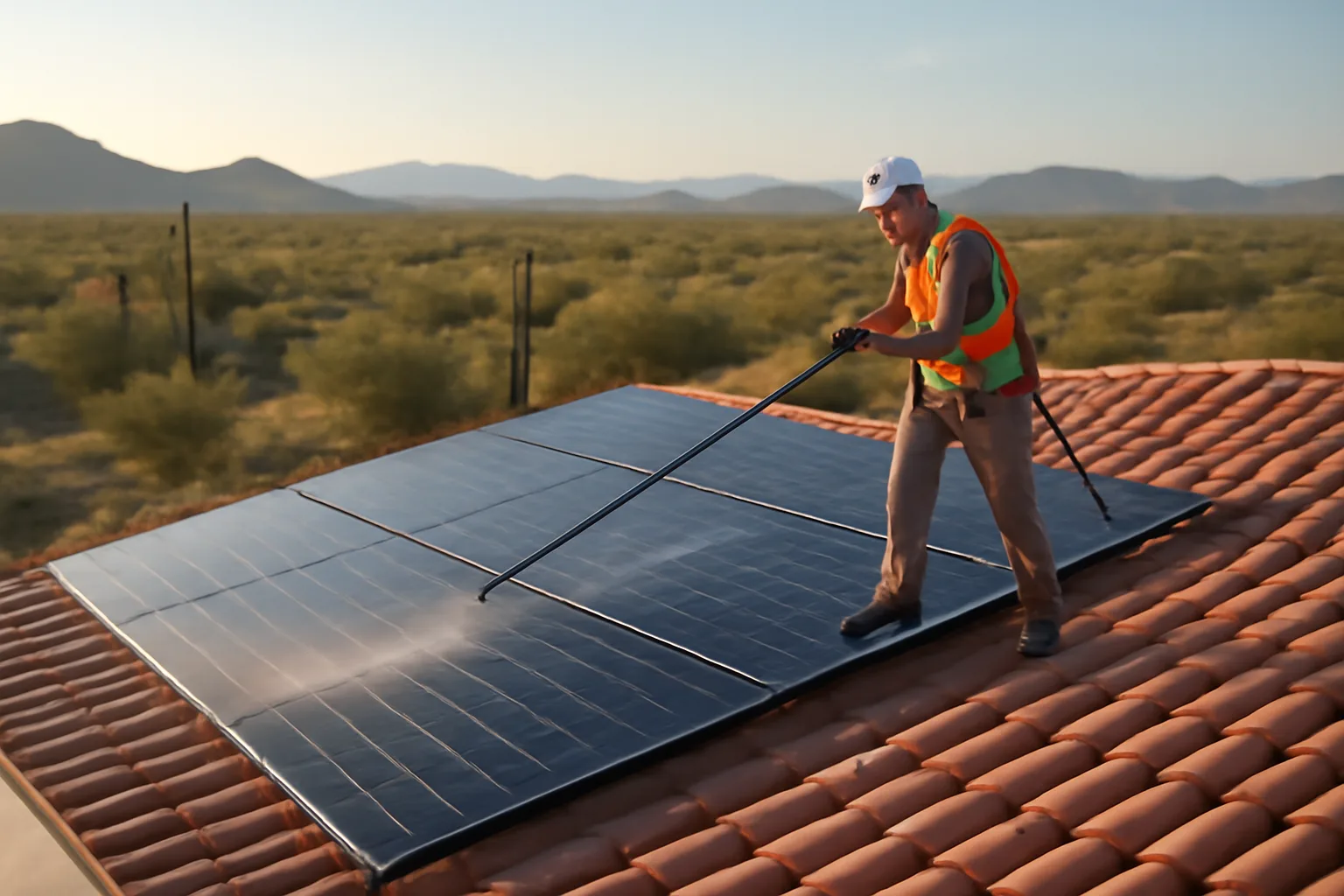
TL;DR
Arizona doesn't require a contractor's license for solar panel cleaning because the state treats it as routine maintenance. You do need a Transaction Privilege Tax (TPT) license from the Arizona Department of Revenue, and it's free. Residential cleaning costs $150 to $350 and takes 1 to 2 hours on a typical 6kW system. Desert dust and monsoon grit make frequent cleaning pay off. The paperwork is short.
Do you need a license for solar panel cleaning in Arizona?
No. Arizona has no solar panel cleaning license, and the state's Registrar of Contractors does not treat routine washing as contracting work. Arizona Revised Statutes § 32-1101(A) defines a contractor as any person who "undertakes to construct, alter, repair, add to, subtract from, improve, move, wreck, or demolish" any building or structure [1]. Washing panels is on none of those lists. It's maintenance.
You still have to register the business, though. Even a sole proprietor needs a trade name certificate with the county recorder if you work under any name other than your own legal name. And anyone who charges for a service in Arizona has to get a Transaction Privilege Tax (TPT) license. That's the one that trips people up, so start there.
Do you need a contractor's license or a TPT license?
You need the TPT license, not a contractor's license. The Arizona Registrar of Contractors (ROC) treats cleaning, painting, and minor repairs as work that doesn't require licensing [2]. Save a copy of that guidance in your business file. It ends the argument fast when a skeptical HOA board or homeowner asks to see your "solar license."
The TPT license is a different animal, and it's mandatory. Arizona's Transaction Privilege Tax is the state's version of a sales tax, and it reaches services. Any person conducting business in Arizona must obtain a TPT license and file returns [3]. The license is free. You apply online at AZTaxes.gov, collect the tax from customers, and remit it monthly or quarterly depending on your volume.
Skipping it is not an option. No TPT license means penalties and interest when the state catches up. You renew the license each January 1, and Revenue mails you a renewal notice before then.
How much does solar panel cleaning cost in Arizona?
Expect to charge or pay $150 to $350 per cleaning on a typical residential system in the 5kW to 10kW range. That matches the national range EnergySage reports, and Arizona sits at the lower end because the market is crowded and volume is high [4]. A small 3kW array might go for $90 to $130. A 15kW ground mount can run $450 or more.
A lot of companies price by the panel. In metro Phoenix and Tucson you'll see $8 to $15 per panel, below the national $10 to $20. The reason is simple. Arizona has one of the largest residential solar bases in the country and a low cost of living, so prices get squeezed. Commercial rooftop work costs more because of safety rules and the frequent need for nighttime or early-morning cleaning.
Watch the low-ball quote. A $99 flat rate usually buys a quick water-only rinse that leaves mineral deposits behind. A deionized (DI) water rinse plus a soft brush costs more and prevents hard-water spots. Phoenix tap water runs hard, with parts of the service area measuring over 200 ppm calcium carbonate, which etches glass over time [12]. Paying an extra $40 for DI water is worth it if you own the panels. If you run the business, build it into your price.
How long does solar panel cleaning take in Arizona?
Plan for 1 to 2 hours on a typical 6kW roof-mounted system, either with two people or one experienced tech. EnergySage says cleaning "can take anywhere from 30 minutes to two hours" depending on system size, roof pitch, and access [4]. Summer changes the math. You work early morning only, because heat stroke is real and hot panels bake water into spots on contact. A crew that finishes in 90 minutes at 7 a.m. will need twice as long at 10 a.m.
Ground mounts move faster, sometimes 30 minutes flat. Most Arizona homes have pitched tile roofs, so you burn time setting up safety gear, moving the ladder, and rinsing the roof edge. Add another 30 minutes if the customer wants a bird-dropping scrub or a pest-guard check. Don't sell a one-hour miracle. Sell a clean array. Homeowners remember the bottom corners you skipped, not the minutes you saved.
What makes Arizona dust so aggressive on panels?
Phoenix and Tucson sit in a desert basin that holds airborne particulates in place. The National Renewable Energy Laboratory's PV soiling research puts annual soiling losses at roughly 1% to 3% for the Southwest desert, higher near farms and construction [5]. A 2% loss on a 10kW system producing 16,000 kWh a year is 320 lost kWh, worth $40 to $50 at current APS or SRP rates.
Dust alone isn't the whole story. The monsoon brings "mud rain." Fine Sonoran clay mixes with summer storm moisture and bakes onto the glass. Once that slurry dries, it forms a cemented crust that ordinary rain won't lift. University of Arizona Cooperative Extension guidance notes that hardened soiling can cut output by as much as 5% in a single season if you leave it [6]. That's why Arizona owners see faster payback on cleaning than owners in a rainy state like Oregon.
How often should you clean solar panels in Arizona?
Twice a year is the baseline for most Arizona homes. Clean once after the spring windy season, around late April, and again after the monsoon, around late September, to clear the crust. That schedule tracks the dust storms and rain. Homeowners near a pool, a farm, or unpaved roads may need a third pass. The U of A Extension guide suggests checking output monthly and cleaning whenever production drops 5% with no weather explanation [6]. No monitoring? Just look. A tan or gray film across the array means it's time.
Commercial solar farms sometimes clean four times a year because the lost kWh adds up quickly at scale. For a homeowner it's a cost-benefit call. Skip the fourth cleaning if your monitoring shows steady production. But in dusty spots like Sun City or Buckeye, twice a year is the floor, not the target.
The right way to clean panels without scratching them
Use a soft brush, a gentle stream of deionized or distilled water, and no soap. Soap leaves a film that pulls in more dust. The brush should be one made for solar panels or RVs. Skip the pressure washer entirely. The force can crack the glass or damage the backsheet. NREL's soiling research warns that aggressive mechanical cleaning can permanently degrade the anti-reflective coating on panel glass [7].
Arizona tap water is a bad final rinse. The minerals dry into spots that act like tiny lenses, concentrating sunlight into hot spots. A DI water system costs a few hundred dollars and pays for itself in results and repeat customers. For a business, a DI tank is not optional. If you're a homeowner doing a one-off job, a few gallons of distilled water from the grocery store does the trick. It's cheaper than a damaged panel.
For the record, the $149 DI Water + Roof-Safety Kit that SolarWashPath sells bundles a commercial-grade DI filtration setup with a tile-roof safety harness. It's a fair starting point if you'd rather not build a water cart from parts.
Safety gear you actually need on an Arizona roof
Fall protection comes first, even when the law would let you skip it on a low-slope roof. OSHA's fall protection standard (29 CFR 1926.501) requires guardrails, safety nets, or personal fall arrest systems for work over 6 feet [8]. Most Arizona residential roofs clear that easily. A harness, a roof anchor, and a lanyard cost under $200 together. That's a fraction of an ER copay.
Arizona tile roofs break. Walk only in the valleys where the underlayment doubles up. One bad step on a sun-baked clay tile snaps it. Carry a few spare tiles or know where to buy a match. Never work barefoot or in worn sneakers. The roof surface can hit 160°F in June, so wear closed-toe boots with solid soles.
Bring a wide-brimmed hat, UV-rated sunglasses, and a long-sleeve shirt. The sun here is brutal, and heat exhaustion moves fast after 9 a.m. Pack a cooler of ice water and bring a buddy who can call 911 if you slip. No solo roof work in July. None.
Starting a cleaning business in Arizona: the paper checklist
You can legally run a solar panel cleaning business in Arizona with a short stack of paper:
- A county trade name registration (if you use a DBA)
- A TPT license from AZTaxes.gov
- General liability insurance (not required by law, but every commercial client demands it)
- A city business license (Phoenix, for example, requires a privilege tax license unless you earn under $500 a year in city revenue) [9]
Skip the contractor's license. The moment you add panel repair, inverter replacement, or pest abatement, you cross into ROC territory and need one. Stay in cleaning and you stay in maintenance land.
Write service agreements that spell out the cleaning method, the price, and who eats the cost if a tile cracks. That's not a government form. It's just how you avoid a bad Saturday in small claims court. Join the local solar network too. Arizona installers and cleaners pass overflow work to people they trust.
Is solar panel cleaning worth the cost in Arizona?
For most residential owners on a dusty site, yes. Here's the math. A $250 cleaning that recovers 2% output on a system worth $1,200 a year in electricity saves you about $24 in year one. On its own, that's a slow payback. The real return is preventing the hardened crust that needs professional remediation. A heavy crust can cut output 5% or more, and that's $60 a year gone. Skip cleanings for three years and the loss buys the cleaning you avoided.
Commercial owners recover cost faster because their systems are bigger and their kWh is worth more. On a 100kW system, a 2% boost is 2,000 kWh a year. At a commercial rate near $0.08/kWh, that's $160. A $500 cleaning recovers its cost in a bit over three years.
Nobody has a clean, published study on residential payback in Arizona. The working consensus among installers here is that twice-yearly cleaning costs less than the degradation it prevents. On a PPA or lease, read your contract first. The solar provider may already owe you the cleaning.
HOA rules and solar panels in Arizona
Arizona law protects solar access hard. ARS § 33-439 bars a homeowners association from prohibiting the installation of solar energy devices or imposing unreasonable restrictions on them [10]. That protection carries into maintenance. An HOA cannot stop you from cleaning your panels or hiring someone to do it.
What they can do is regulate appearance and safety. Some HOAs require hired cleaners to carry a minimum insurance amount, or limit cleaning to certain hours to head off noise complaints. Ask the HOA for the architectural guidelines before you quote a job. And when a client waves you off with "just go ahead, the HOA won't care," get that in writing. A neighbor's complaint turns into a fine for the homeowner, and the homeowner will point at you.
Insurance: what you need and what you don't
Arizona doesn't mandate general liability insurance for a cleaning business. Commercial contracts, shopping-center property managers, and HOAs will, though. A basic $1 million per occurrence policy runs roughly $500 to $800 a year for a sole proprietor [11]. Treat it as a fixed cost of getting through the front gate.
Workers' compensation is required only once you have employees. A single-member LLC with no employees can skip it. Hire even a part-time helper and you must carry it. The Arizona Industrial Commission enforces this without much patience [13].
Check your auto policy too. A personal policy usually won't pay a claim from a wreck you have while driving to a job with ladders strapped to the roof rack. Get the business-use rider before you need it.
Getting your first cleaning job in Arizona
Start with the people you already know. Offer to clean a friend's panels at a discount and record the before-and-after output with a monitoring app. That real production data is your best sales tool, better than any brochure. A lot of Phoenix cleaners found their first ten clients through Nextdoor posts and neighborhood Facebook groups.
When you're ready to turn this into a real business, SolarWashPath's /start page lays out a step-by-step plan for your first 90 days. It covers pricing, kit selection, and how to explain Arizona's soiling problem to a customer who thinks rain does the job. You'll also find templates for service agreements and liability waivers.
Frequently asked questions
Do you need a license for solar panel cleaning in Arizona?
No specific solar panel cleaning license exists. Arizona does not treat routine cleaning as contracting work. You do need a Transaction Privilege Tax (TPT) license from the Arizona Department of Revenue, and you may need a city business license depending on where you operate.
How much does solar panel cleaning cost in Arizona?
Residential cleanings typically run $150 to $350 for a 5kW to 10kW system. Per-panel rates are $8 to $15. Commercial jobs cost more because of safety requirements and scale. Always ask whether deionized water is included, since hard tap water leaves damaging mineral spots.
How long does solar panel cleaning take in Arizona?
A two-person crew cleans a standard 6kW residential array in 1 to 2 hours. Ground mounts go faster, around 30 minutes. Arizona's summer heat shrinks the safe working window to early mornings, which adds time when crews have to slow down to avoid scorching-hot panels.
Can an HOA stop me from cleaning my own solar panels?
No. Arizona law (ARS § 33-439) prohibits HOAs from banning solar energy devices or their maintenance. An HOA can set reasonable rules on hours, on insurance for hired cleaners, or on safety, but it cannot deny you the right to clean your panels.
What insurance do I need to start a solar panel cleaning business in Arizona?
Arizona does not mandate general liability insurance, but nearly every commercial client, HOA, or property manager requires it. A $1 million policy runs $500 to $800 per year. Workers' compensation is required once you have any employee. Business auto coverage matters too.
How often should I clean my solar panels in Arizona?
Twice a year is the recommended minimum: once after spring winds in late April and once after monsoon season in late September. Panels near agriculture, construction, or unpaved roads may need three or four cleanings. Monitor production and clean whenever you see a 5% output drop.
Does Arizona require a contractor's license for solar panel cleaning?
No. The Arizona Registrar of Contractors treats panel cleaning as routine maintenance, not construction or alteration. You need no contractor's license. Adding repair services moves you into licensed territory, so stay in cleaning only if you want to keep the ROC out of your business.
Can I use tap water to clean solar panels in Arizona?
Not for the final rinse. Arizona tap water is hard, often over 200 ppm calcium carbonate. The mineral spots it leaves can etch the glass and cause hot spots. Use deionized or distilled water for the rinse. An initial tap-water wet-down is fine if you rinse thoroughly afterward.
Is a pressure washer safe for solar panels?
No. High-pressure spray can crack the glass or break the seal between the glass and frame, and it can force water into junction boxes. Use a soft brush and a gentle water stream instead. Skip soap too, because it leaves a film that attracts more dust.
What safety gear is required by law for roof work in Arizona?
OSHA requires fall protection for work over 6 feet (29 CFR 1926.501). A harness, roof anchor, and lanyard are the minimum. Arizona's tile roofs need extra care. Walk only in the valleys, wear closed-toe boots, and never work alone on a hot roof. Carry water and a phone.
Do I need a business license to clean panels in Phoenix?
Phoenix requires a privilege tax license for businesses earning more than $500 per year in city revenue. Cities like Tucson and Mesa may have similar rules. Check with the city clerk where you operate. This city license is separate from the state TPT license.
How do I get a TPT license in Arizona?
Apply online at AZTaxes.gov. The license is free. You'll need your business name, EIN or SSN, and a description of your services. After approval you file returns and remit collected tax monthly or quarterly. You renew the license every January 1.
What's the payback for professional solar panel cleaning in Arizona?
A $250 cleaning that recovers a 2% soiling loss on a typical 10kW system saves about $24 in the first year. Preventing hardened crust that cuts output 5% or more shortens payback to roughly 20 months. Commercial systems return faster because of larger scale and higher kWh value.
Can I clean solar panels myself?
Yes, but get on the roof safely. Use a soft brush, deionized water, and never a pressure washer. If heights make you nervous or the roof is steep, hire a professional. The money you save on a DIY cleaning disappears fast in medical bills or a broken panel.
Sources
- Arizona State Legislature: Definition of 'contractor' in ARS § 32-1101(A), listing construction services that do not include routine cleaning.
- Arizona Registrar of Contractors: FAQ page states that cleaning, painting, and minor maintenance do not require a contractor's license.
- Arizona Department of Revenue: Any person conducting business in Arizona must obtain a TPT license and file returns.
- EnergySage: National solar panel cleaning cost range $150 to $350, typical cleaning time 30 minutes to 2 hours.
- University of Arizona Cooperative Extension: Extension guidance notes hardened monsoon soiling can reduce output by up to 5% per season and recommends cleaning when output drops 5%.
- Occupational Safety and Health Administration: 29 CFR 1926.501 requires fall protection for employees working at heights over 6 feet.
- City of Phoenix: Phoenix privilege tax license is required for businesses with over $500 in annual city revenue.
- Arizona State Legislature: ARS § 33-439 prohibits HOAs from banning solar energy devices or imposing unreasonable restrictions on installation and maintenance.
- U.S. Small Business Administration: General liability insurance costs average $500 to $800 annually for a small business and is often required by commercial clients.
- Arizona Industrial Commission: Workers' compensation insurance is mandatory for any business with one or more employees, enforced by the Industrial Commission.