Last updated 2026-08-21
TL;DR
Solar panel cleaning is washing PV modules so dust, pollen, and mineral film don't steal production. You start with a legal entity, local registration, and a check on whether your state treats this as contracting. Most work uses deionized water and a water-fed pole from the ground. Roofs add OSHA fall rules at 6 feet in construction. No national cleaning license exists. Confirm every fee with the issuing board.
What is solar panel cleaning?
Solar panel cleaning is washing photovoltaic modules so dirt, pollen, bird droppings, and mineral film don't block light. It is not electrical work. It is not a roof replacement. Most residential jobs use deionized water, a soft brush, and a water-fed pole. Frequency follows local dust and rain, not a national calendar.
You're removing soil from glass (and sometimes from frames and the gaps between modules) so more photons hit the cells. A 2019 Joule assessment treated soiling as a real production drain worldwide, with much worse losses on dry, dusty sites than on rainy ones [13]. That paper is not a quote for your customer's roof. A canal-adjacent array in July is a different job than a wet-coast array in March.
The work sits next to exterior building cleaning. The Census Bureau's 2022 NAICS 561790 (Other Services to Buildings and Dwellings) is the code most operators put on forms that ask for one [10]. Window cleaning has its own habits and sometimes its own local card. Don't assume a window card covers a PV array.
Good cleaning is boring. Pure water, low mechanical force, no walking on glass, no surprise chemicals. Bad cleaning cracks cells, scratches coatings, and leaves white mineral rings that bake in. If a method needs a disclaimer every time you use it, it's a bad method.
I'd treat bird-heavy arrays and agricultural dust as real production problems. I'd treat a once-a-year rinse on a wet climate roof as optional. Say that on the sales call. People can tell when you're inventing urgency.
How do you start solar panel cleaning?
You start on paper, then on the ground, then on a roof only if you have fall gear and a reason to be up there. Pick a legal structure, get a free IRS EIN if you need one, register locally, and confirm whether your state treats this as contracting. Then run deionized water through a water-fed pole on low, simple arrays before you ever clip into an anchor.
The SBA walkthrough on choosing a structure is enough for week one. Sole proprietorship, LLC, or corporation. That's the menu [9]. IRS Publication 334 is the tax guide sole proprietors actually use, including Schedule C reporting [8]. An IRS EIN is free on the IRS site. Don't pay a reseller [7].
No federal solar panel cleaning license exists. Cities still want a business tax receipt or equivalent. Counties still want to know you're real. If your state contractor board claims this trade, you deal with that board before you take a deposit. If it doesn't, don't buy a four-week school that pretends otherwise.
I would not open with a trailer, a pressure washer, or a crew. Ground-only water-fed work on single-story homes teaches you water use, time per array, and whether you even like the job. Skip the $8,000 pump skid until the calendar is full.
Tap water quality is a first-week equipment decision, not a later upgrade. Hard water leaves spots. The USGS hardness classes in the chart below are why operators move to deionized water instead of arguing with a squeegee on hot glass [5].
Do you need a license to clean solar panels?
Usually you need a local business registration. Sometimes you need a contractor license. You never need a mythical national solar panel cleaning card, because it doesn't exist. Confirm the rule with the city clerk and, if your dollar volume or scope looks like contracting, with the state contractor board.
California is the example people copy badly. Contractors' State License Board rules kick in around construction and alteration work, with a small-job exemption in Business and Professions Code 7048. The dollar figure in that section has moved before. Confirm the current threshold with CSLB before you treat a residential wash as unlicensed work [11]. If you already hold a related card, solar panel cleaning renewal in California is the paper you check next.
Florida defines contractor in section 489.105. Cleaning is not automatically that trade. It becomes a problem when you start promising repairs, rack work, or electrical disconnects [14]. Confirm with DBPR and the county. For the renewal path people mix up with market entry, see solar panel cleaning renewal in Florida.
Arizona, Colorado, Georgia, and Alabama follow the same pattern: local business paper first, contractor board only if the statute actually names the work or the dollar amount. Don't import California folklore. Read solar panel cleaning renewal in Arizona, solar panel cleaning renewal in Colorado, solar panel cleaning renewal in Georgia, and solar panel cleaning renewal in Alabama if you already have something to renew. Day-one operators still start at the city.
If you apply pesticides or any EPA-registered biocide, you may trip a pest-control license. Plain deionized water almost never does. Stay on water unless a client and a label force you off it.
What OSHA roof rules apply to solar panel cleaning?
If you have employees on a construction walking or working surface with an unprotected edge 6 feet or more up, OSHA requires fall protection. General industry uses a 4-foot trigger. Cleaning an existing array for a building owner can land in either bucket. I treat every roof edge at 6 feet as a harness and anchor job anyway.
OSHA's construction rule is blunt. 29 CFR 1926.501(b)(1) says: "Each employee on a walking/working surface (horizontal and vertical surface) with an unprotected side or edge which is 6 feet (1.8 m) or more above a lower level shall be protected from falling by the use of guardrail systems, safety net systems, or personal fall arrest systems." [1] General industry duty is in 29 CFR 1910.28, which uses 4 feet for many unprotected edges [2]. Personal fall arrest gear has its own criteria in 1910.140 [15].
Training is not optional once you put workers on roofs. 29 CFR 1926.503 requires a training program before employees are exposed to fall hazards [12]. OSHA's Protecting Roofing Workers booklet (OSHA 3755) is the plain-language version of how holes, edges, and ladders actually hurt people [3]. Read it. Then buy anchors that match the roof, not a $40 harness from a bargain aisle.
Sole proprietors with no employees sit in a gray zone under federal OSHA. State plans differ. Clients will still require fall protection in the contract. A hospital or school will not accept "it's just me." Budget the class and the gear if roofs are in your plan.
Ladders on stucco and tile wreck more first-year operators than chemistry does. Ground poles exist so you can refuse bad access. Use that refusal.
What equipment do you actually need?
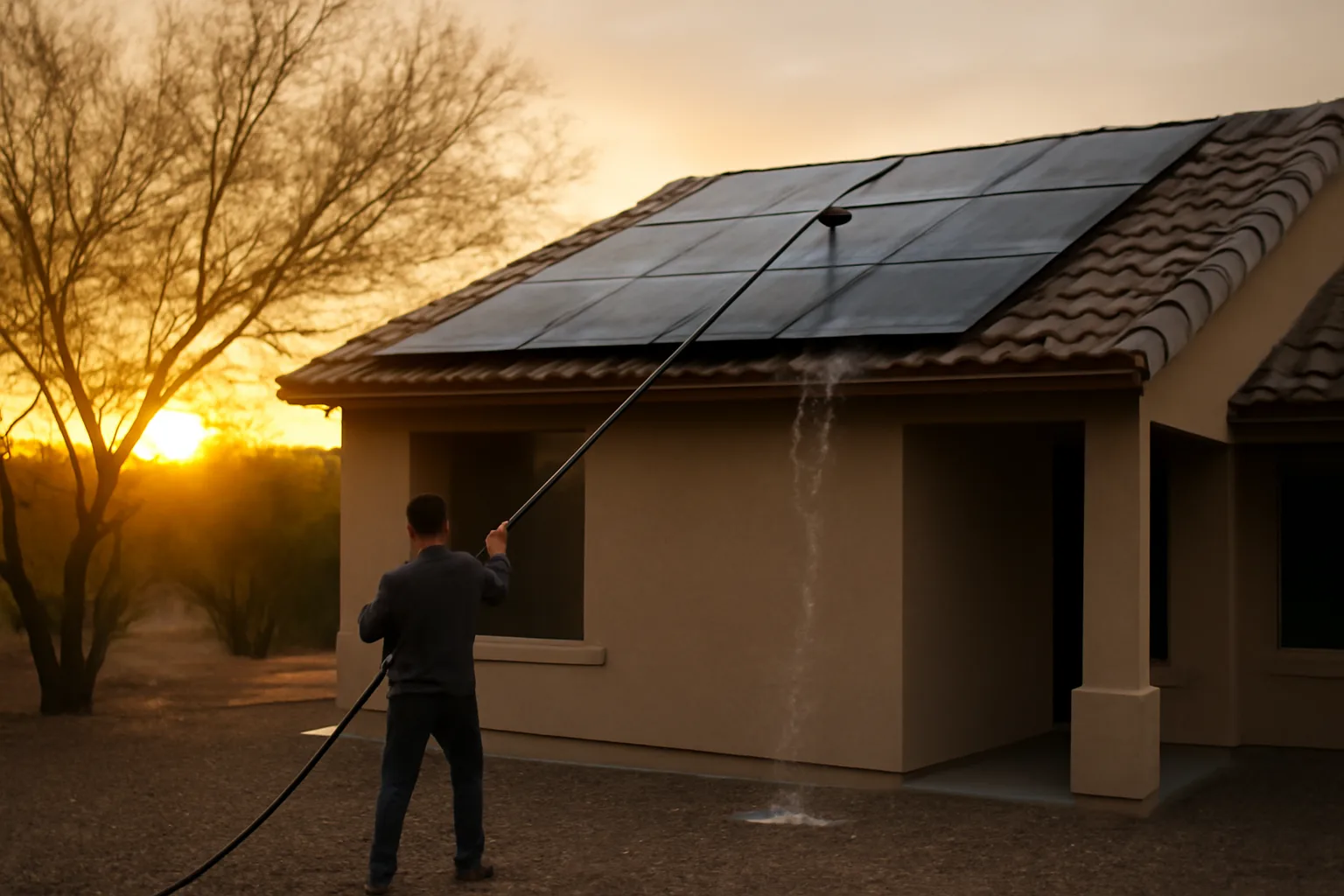
You need a way to deliver very pure water onto glass without standing on the modules. For most houses that's a deionized or reverse-osmosis tank, a water-fed pole, a soft brush head, hoses, and a way to measure total dissolved solids. A pressure washer is not on the list.
NREL's PV and storage O&M best-practices report treats cleaning as site-specific maintenance, not a stunt, and it is the federal lab document operators should read before copying social media methods [4]. High pressure, abrasives, and walking on glass are how you buy a warranty fight. Module makers publish O&M sheets. Those sheets beat forum advice.
A handheld TDS meter costs little and tells you when resin is dead. If the rinse water isn't near zero TDS, you're depositing scale. USGS hardness classes (soft through very hard) explain why municipal tap water fails on glass [5]. EPA's secondary drinking-water list puts a 500 mg/L TDS figure on tap water as a nuisance standard, which is already a spotting problem on hot modules [6].
I would buy used poles and new resin. I would not buy a trailer in month one. If you want a starter bundle instead of hunting parts, SolarWashPath sells a $149 one-time DI Water + Roof-Safety Kit on the /start page. Skip that kit if you already have a pole and a tank.
Roof kit, if you go up: full-body harness, energy-absorbing lanyard or SRL, rated anchor, helmet, non-slip shoes. Practice on the ground. An untested harness is costume jewelry.
Why does deionized water matter for solar panel cleaning?
Deionized water matters because minerals in tap water dry into spots, and those spots become baked-on film. Pure water (very low TDS) sheets off and dries clear, so you can clean from the ground without hand-squeegeeing every module.
USGS classifies hardness like this: "soft, 0 to 60 mg/L; moderately hard, 61 to 120 mg/L; hard, 121 to 180 mg/L; and very hard, more than 180 mg/L." [5] Hard and very hard bands are normal across large parts of the United States. That water is fine in a glass. It's ugly on tempered PV glass in July.
EPA's secondary standard for total dissolved solids is 500 mg/L [6]. Secondary standards are nuisance numbers, not health limits. Spotting is a nuisance until it is a callback. Callbacks kill first-year margins.
RO plus deionizing resin is the usual train. Resin is a consumable. Budget it like fuel. When the TDS meter climbs, change the resin. Don't finish the Saturday route on dying beds.
Soap is mostly a waste on this trade if your water is actually pure. Film-forming surfactants can void a warranty and attract more dust. If a module maker allows a named mild cleaner, follow that name. Don't invent a cocktail.
How often should solar panels be cleaned?
Clean when soiling is costing more than the visit, or when the owner has a contract that already priced the visits. No honest national interval exists. Deserts, ag dust, pollen belts, and bird roosts need more. Rainy coasts need less.
NREL's O&M best-practices report frames cleaning around site conditions and production data, not a calendar myth [4]. The Joule soiling paper makes the same geographic point at global scale: dry, dusty places lose more than wet ones [13]. If the client has monitoring, use it. A 2% drop that tracks a dust storm is a job. A 2% drop that tracks inverter clipping is not your wash.
Residential default in mixed climates is often one or two visits a year. I wouldn't sell monthly washes on a clean suburban roof just because you need route density. That's how you get one-star reviews from engineers.
Bird droppings and heavy soil can pit glass if you let them sit and then grind them. Spot-clean those. Don't wait for the annual pass.
Never promise a kWh guarantee you can't measure. FTC advertising rules still apply to small trades when you claim energy savings, and you still need proof. Stick to "we'll remove the soil we can see and rinse with pure water."
What paperwork comes first for a new operator?
Entity, EIN, local business registration, and a bank account that is not your rent account. Then insurance certificates the property manager will actually accept. Tax paper follows the IRS small-business guides, not a TikTok accountant.
Choose a structure with the SBA page as a map [9]. IRS Publication 334 walks sole proprietors through income, expenses, and the annual return pattern [8]. Apply for an EIN yourself at IRS.gov. The fee is $0 [7].
NAICS 561790 is the census code to try first on registrations that demand one [10]. If a clerk rejects it, ask which building-services code they want. Don't fight the clerk on day one.
Insurance is not optional if you want commercial work. General liability, commercial auto (personal auto policies often exclude business use), and workers' compensation once you have employees. Inland marine for poles and tanks is cheap compared with a stolen bed. I will not quote premiums. They move by state and by your record. Get numbers from a licensed agent.
Written scope matters. "Clean accessible glass with deionized water from the ground. No rack repair. No electrical. No tile walking." That paragraph keeps the job from turning into unlicensed contracting.
How should a first-year operator price solar panel cleaning?
Price by access, stories, array size, water haul, and bird load. Not by a national average, because nobody publishes a clean one. Quote the site you saw, not the site you hoped for.
I have not seen a federal price series for this trade. Anyone giving you a single dollar-per-panel number for the whole country is guessing. Pull three local invoices if you can. Watch how they treat steep tile, third-story poles, and locked backyards.
Flat internet coupons are how you go broke. Drive time is the silent cost. So is resin. So is the extra 40 minutes when the dog, the HOA, and the side-yard padlock all show up.
Commercial work wants a certificate of insurance, a W-9, and sometimes prevailing-wage awareness on public sites. It also waits 30 to 60 days to pay. Don't fill a month with net-60 school-district jobs if your resin supplier is cash on delivery. I would keep a mix.
Put a rewash window in the invoice (spotting from your water is on you, new dust the next afternoon is not). Then honor it.
What first-year mistakes waste money?
Buying a pressure-washer trailer, walking on modules, skipping fall gear, and selling a fake national certification. Those four show up constantly. They all cost more than resin.
Pressure washers feel productive. They also drive water under frames, lift edge seal, and anger warranty desks. NREL's O&M manual is the opposite of that mindset [4]. Soft brush, pure water, patience.
Walking on modules creates microcracks you won't see until summer. Stay off the glass. If you can't reach it with a pole or a proper walkway, decline the job.
A $40 harness with no anchor plan is theater. OSHA 3755 and 1926.503 exist because falls are the expensive injury [3][12]. Pay for a class if roofs are real in your plan.
"Certified solar panel cleaner" certificates from random websites are not licenses. Boards do not honor them. Spend that money on the city business receipt and on resin.
Underbidding to get reviews trains customers to pay 2020 prices. You'll hate the route by August.
Can you clean solar panels from the ground?
Yes, on a lot of single-story and many two-story arrays, if you have enough pole and a clear swing path. Ground work is how I'd start every operator. Roofs are for the leftover modules, not for ego.
Water-fed poles in the 20-foot to 40-foot class cover most tract homes. Trees, fences, and low eaves steal reach. Walk the site. If you need the roof, say so before you quote.
Ground work still has hazards: overhead lines, wet sidewalks, ladder-like overreach with a long pole. Keep poles off service drops. If you don't know the clearance, don't extend.
Commercial ground mounts are the easy version of this trade, until they aren't. Tracker rows, wildlife, and mud will eat a passenger car. Quote the site visit.
If a homeowner wants you on tile because they saw a video, explain breakage risk in writing. Some jobs you want to lose.
Where do you confirm the rules before you take money?
Confirm licenses with the city and the state contractor board, fall rules with OSHA or the state plan, water discharge with the sewer or stormwater utility, and tax identity with IRS.gov. SolarWashPath is an independent publisher, not a law firm and not a service company. No article, including this one, can bless your job.
Boards change dollar thresholds. OSHA interpretations of construction versus general industry stay fact-specific. I will not invent a processing time, a quota, or a current fee. If a number lives on a board fee schedule, read that schedule the morning you apply.
Wash water into a storm drain is a local fight. Many cities treat mobile washing as an illicit discharge. Ask public works. Capture or route to sanitary where they tell you to. Guessing is how you get a fine that wipes a month of routes.
If you want the physical starter bundle, the /start page is the only product mention I'll make here. The paper path still starts at the clerk and the IRS, kit or not.
Print your scope. Carry the COI. Keep the TDS log. That's the grown-up version of this trade.
Frequently asked questions
What is solar panel cleaning?
Solar panel cleaning is washing PV module glass so dust, pollen, bird droppings, and mineral film don't block light. It is maintenance, not electrical contracting, when you stay on water and don't touch wiring or racks. Most residential work uses deionized water and a water-fed pole. Frequency depends on local soiling and rain, not a national calendar.
How do you start solar panel cleaning?
Form a legal entity, get a free IRS EIN if you need one, register with the city, and ask the state contractor board whether this trade is licensed there. Start with deionized water and ground-only poles on simple homes. Add roof fall protection only when access demands it. No national cleaning license exists. Confirm every fee with the issuing board.
Is there a national solar panel cleaning license?
No. The United States does not issue a national solar panel cleaning license. You still need local business registration, and some states pull the work into contractor law above a dollar threshold or when you alter equipment. California's small-job exemption lives in B&P Code 7048, but the dollar figure can change. Confirm with CSLB or your state board.
Can rain replace paid solar panel cleaning?
Sometimes, in wet climates with little dust. Rain does a poor job on sticky pollen, diesel film, and bird droppings, and it can leave mineral rings if the rain itself is dirty. Arid and agricultural sites still soil between storms. Use production data when the client has it. Don't sell fear on a roof that already gets frequent rain.
Do I need fall protection if I work alone?
Federal OSHA mainly covers employers and employees. A true sole proprietor with no employees may sit outside that duty, depending on the state plan. Property owners and general contractors will still require fall protection in the contract. Construction rules in 29 CFR 1926.501 use a 6-foot trigger on unprotected edges. I would not get on a roof without a rated anchor plan.
Will a pressure washer void a solar panel warranty?
It can. Many module O&M sheets limit pressure and ban abrasives. High-pressure water can drive moisture under frames and lift seals. NREL's PV O&M best-practices report treats cleaning as careful maintenance, not a blast job. Read the maker's sheet for that array. If it states a PSI cap, follow it. I would not open a business on pressure washers.
What NAICS code do solar panel cleaners use?
Most operators try 561790, Other Services to Buildings and Dwellings, on the Census Bureau's 2022 NAICS list. That industry includes exterior building services on a contract basis. Clerks sometimes want a different building-services code. Use what the form accepts. NAICS is a statistics label, not a license.
How hard does tap water have to be before deionized water is worth it?
If your tap water is in the USGS hard band (121 to 180 mg/L as calcium carbonate) or very hard (more than 180 mg/L), spots are likely on hot glass. Even moderately hard water can ring in full sun. EPA's secondary TDS figure of 500 mg/L is already a spotting problem. A TDS meter on your rinse stream is the practical test. Near-zero TDS is the target.
Do I need an EIN as a sole proprietor with no employees?
Not always. Sole proprietors can often use a Social Security number until they hire, form an LLC, or need the EIN for a bank or a client W-9. The IRS issues EINs at no charge on IRS.gov. Don't pay a third-party site. IRS Publication 334 is the tax guide to keep next to that decision.
Is solar panel cleaning the same as window cleaning for licensing?
No. The work looks similar (pure water, poles, glass) but the paper path can differ. Some cities lump them. Some contractor boards care about roofs, dollar amount, or whether you touch racks. Window cards do not automatically cover PV arrays. Ask the clerk and the contractor board using the words "rooftop photovoltaic module cleaning."
Can I discharge wash water to a storm drain?
Often no. Many cities treat mobile wash water as an illicit stormwater discharge, even when you only used deionized water, because the water picks up dirt and bird waste on the way down. Ask public works or the stormwater utility for the local rule. They may want sanitary discharge, capture, or a specific BMP. Don't guess.
How do I know if OSHA construction or general industry rules apply?
New construction and much alteration work falls under 29 CFR 1926, including the 6-foot fall trigger in 1926.501. Cleaning an existing array for a building owner can be general industry under 1910.28, which uses 4 feet for many edges. The facts of the site control it. I treat 6 feet as the working number and carry fall gear either way.
Should I buy a truck-mount system in month one?
No. A tank, resin, a water-fed pole, and a TDS meter cover early residential work. Truck-mounts and trailers make sense when route density and commercial contracts pay for them. Until then they are a loan payment looking for a job. Run 20 ground-only houses first. You'll know what water volume you actually burn.
Sources
- OSHA 29 CFR 1926.501 Duty to have fall protection: Construction employees on unprotected edges 6 feet or more up must use guardrails, safety nets, or personal fall arrest systems.
- OSHA 29 CFR 1910.28 Duty to have fall protection and falling object protection: General industry fall protection duties include a 4-foot trigger for many unprotected sides and edges.
- OSHA Publication 3755 Protecting Roofing Workers: OSHA's roofing booklet describes fall hazards on roofs, including edges, holes, and ladders.
- U.S. Geological Survey Water Science School, Hardness of Water: USGS classifies water as soft 0 to 60 mg/L, moderately hard 61 to 120 mg/L, hard 121 to 180 mg/L, and very hard more than 180 mg/L as calcium carbonate.
- EPA Secondary Drinking Water Standards guidance for nuisance chemicals: EPA lists a secondary maximum contaminant level of 500 mg/L for total dissolved solids.
- IRS Apply for an Employer Identification Number (EIN) online: Businesses can apply for an IRS EIN online at no charge on the IRS website.
- IRS Publication 334 Tax Guide for Small Business: IRS Publication 334 is the tax guide for small businesses including sole proprietors using Schedule C.
- U.S. Small Business Administration, Choose a business structure: SBA outlines sole proprietorship, partnership, LLC, and corporation as the core structure choices when launching.
- U.S. Census Bureau 2022 NAICS definition for 561790: NAICS 561790 covers other services to buildings and dwellings, including exterior building services on a contract or fee basis.
- California Business and Professions Code section 7048: California contractor licensing includes a small-job exemption in B&P Code 7048 whose dollar threshold must be confirmed with CSLB.
- OSHA 29 CFR 1926.503 Training requirements (fall protection): Construction employers must train employees before exposing them to fall hazards.
- Ilse et al., Joule (2019), techno-economic assessment of PV soiling losses: A 2019 Joule paper assessed soiling as a material global PV production loss, worse in dry dusty regions than in wet ones.
- Florida Statutes section 489.105 (2023), contractor definitions: Florida contracting law defines contractor in section 489.105, which is the statute to check before assuming cleaning is or is not licensed work.
- OSHA 29 CFR 1910.140 Personal fall protection systems: OSHA sets criteria for personal fall protection systems used in general industry.