Last updated 2026-08-18
TL;DR
Arkansas issues no "solar panel cleaning license." No state board regulates the trade. What you actually need: a local business license if your city requires one, general liability insurance for roof work, and a contractor license only if a bundled job hits $50,000. Residential cleans run $150 to $350 per visit. Commercial arrays run $1.50 to $3.50 per panel. Most residential jobs take 45 to 90 minutes.
do you need a license for solar panel cleaning in arkansas?
No. Arkansas has no occupation-specific license for cleaning solar panels. There is no "Solar Panel Cleaner Board" at the state level. The Arkansas Contractors Licensing Board licenses commercial contractors doing work valued at $50,000 or more, and routine panel washing almost never hits that number [1].
What you will run into is local business registration. If you operate inside a city that requires a privilege license or business permit, you need that. Fayetteville requires a business license from the City Clerk's office [2]. Little Rock has similar rules. Call the clerk in your target city and ask two questions: do I need a local business license for exterior maintenance services, and is there a window cleaning or soft-wash category I should list under. Often there isn't, and they slot you under general services.
Insurance is the real barrier, not licensing. Anyone working on a ladder or roof should carry general liability coverage. Clients with larger systems, particularly commercial farms, will ask for a certificate showing $1 million per occurrence and $2 million aggregate. If your work touches electrical components, a pollution or environmental rider is worth a look, though deionized-water-only cleaning sidesteps chemical drift arguments completely.
The practical order operators follow: get your local license, get your certificate of insurance, start on ground-mount and low-roof residential jobs before you touch membranes. No one from a state board is going to stop you washing panels on a single-story house. But a city code officer might ask to see your local permit if a neighbor complains. Keep your paperwork in the truck.
There is one edge case. If you install walkways, catwalks, or modification mounts during a clean, that structural work can trigger the $50,000 contractor threshold when the whole project scope is counted [3]. Pure cleaning with no structural change stays out. If the job scope shifts, talk to a construction attorney in Little Rock before you quote.
how much does solar panel cleaning cost in arkansas?
Residential cleans run $150 to $350 per visit. A standard 20 to 30 panel home system in Fayetteville or Jonesboro lands between $180 and $250 with pure-water pole cleaning from the ground. Ladder work pushes prices toward $300, especially on steep pitches. Roof-mounted arrays on two-story homes in Northwest Arkansas often reach the high end, $280 to $350, because pitch and valley complexity add time [4].
Commercial work runs $1.50 to $3.50 per panel. A 500-panel ground-mount field in the Delta can go as low as $1.50 per panel when access is open and water is on site. A tilted roof-mount on a metal building, where you trailer your own water, often ends up at $2.50 to $3.50 per panel. The reason commercial per-panel pricing beats residential is simple: commercial gives you 8 to 10 hours of repetition with little reset time.
Size changes the math. Many Arkansas solar farms are sub-5 MW, often 4,000 to 12,000 panels. At that scale price per panel compresses. Operators report $0.80 to $1.20 per panel on large utility ground-mount sites, but those jobs need crew coordination, water trailers, and insurance minimums that shut out solo operators who are not incorporated.
The SolarWashPath $149 DI Water + Roof-Safety Kit matches entry-level residential pricing for operators running ground-only cleans with deionized water. A brand new operator doing a 22-panel house for $199, covering water, labor, and the kit amortized over six jobs, keeps the effective per-visit cost in the $140s.
Three pricing variables hit Arkansas harder than most states:
- Pollen load. Spring pollen runs March to mid-May and it is heavy. A panel with a cured yellow-green pollen film can take twice the rinse passes, adding 25 to 40% time. Price it in or add a spring premium.
- Red dirt. Much of the western part of the state sits on iron-rich clay. Field dust leaves a fine red film that needs a first-pass rinse just to break surface tension before the real pass. Don't bid Oklahoma-style flat rates near Fort Smith.
- Well water hardness. Many rural homes run hard well water, so spotting risk is high. Build deionized water into every quote, or you'll leave mineral residue and kill your referrals.
how long does solar panel cleaning take in arkansas?
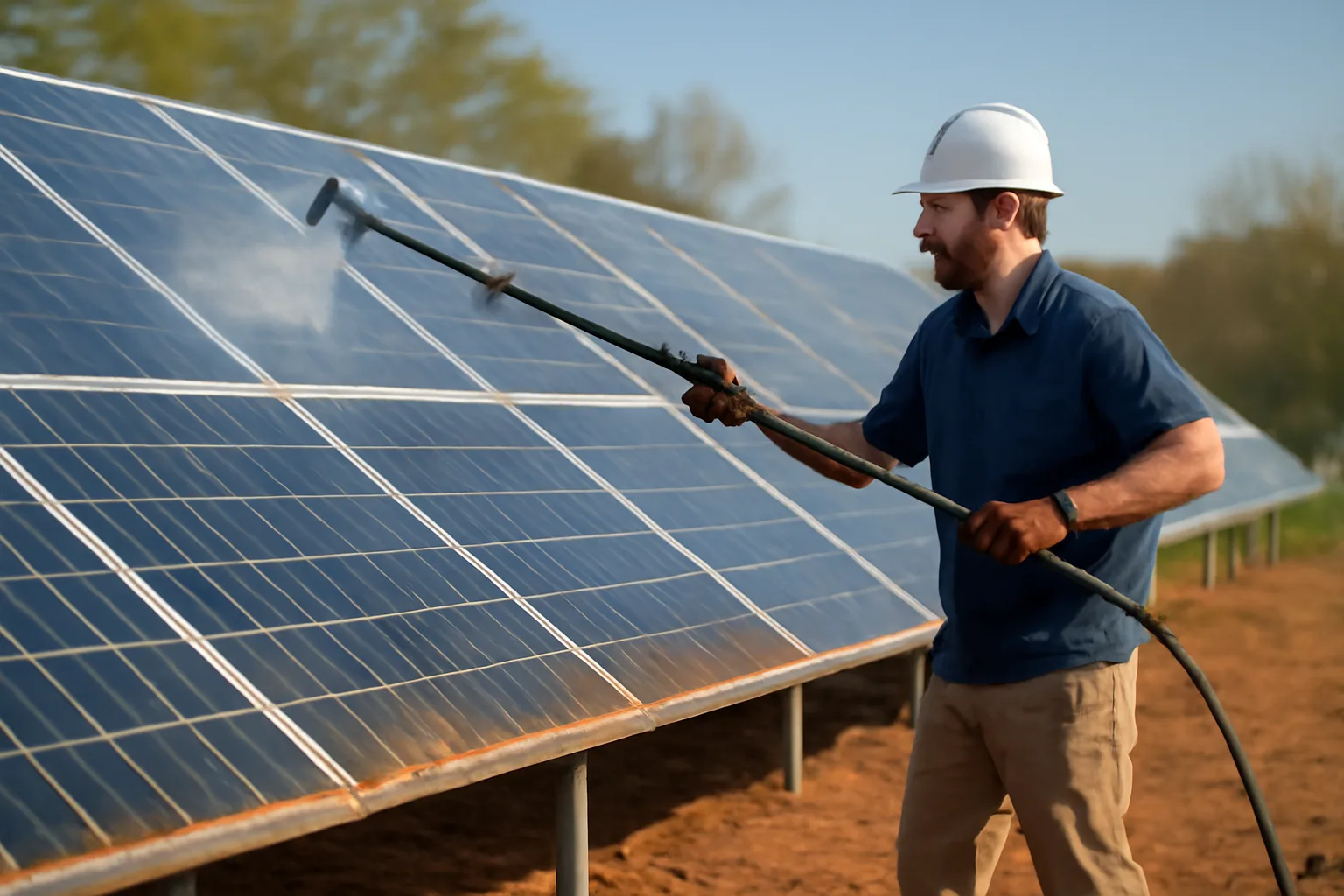
A residential 22-panel array takes 45 to 75 minutes from arrival to pack-up, assuming a deionized water system, a carbon-fiber pole, and ground access. Add 15 to 25 minutes if you have to ladder onto a one-story roof because the panels sit deep on a low-slope membrane [5].
A 40-panel array on a steep metal roof runs 90 to 120 minutes. The pitch is the bottleneck. On a lifeline and harness, your rinse pattern slows by half. Days with dew or light frost in the Ozarks in November can stretch a 30-panel job to two hours because the surface film takes longer to sheet off.
A 500-panel commercial ground-mount in the Delta, open flat site with water access, takes 5 to 7 hours solo with no crew breaks. A two-person team gets it under 4. The real constraint is heat. Mid-July full sun pushes operators off the field by noon or 1 PM, so your effective windows are 6 to 10 AM and 4 to 7 PM [6].
A 4,000-panel utility array takes 2 to 3 days with a crew of four running mechanized brushes and a DI water trailer. Nobody on a solo pole rig should take a field over 1,000 panels without a crew contract. Fatigue drives the error rate, and errors cost you in broken panels and missed spots.
Timing factors specific to Arkansas:
- Spring pollen: rinse passes go from 2 to 4, adding roughly 30% time per array.
- Red clay dust in western counties: a dry brush pass before the wet rinse adds 10 to 15 minutes to residential jobs.
- Ground-mount versus roof: ground-mount residential in central Arkansas (Cabot, Conway) is the fastest work in the state. Twenty-five panels from a truck in 40 minutes is a real number when everything is flat and open.
- Drying margin: leave 5 to 10 minutes for a spot-check walkaround after rinse, especially if the homeowner is going to inspect. Do not pack the pole before you walk the array in full sun.
do you need a contractor license for solar panel cleaning in arkansas?
For cleaning-only work, almost always no. The Arkansas Contractors Licensing Board requires a commercial license only for projects where total cost of labor, materials, and equipment is $50,000 or more [1]. A single cleaning visit never hits that, even on a commercial array. Even an annual contract totaling $48,000 stays below the line unless the scope includes installation or repair.
Bundle cleaning with maintenance that involves panel removal, rail repair, or inverter work, and the math changes. A repair-and-clean package totaling $55,000 across a commercial site likely needs a license. Ask the board: (501) 372-4661. They answer the phone. Tell them the county, the total dollar figure, and whether you touch anything beyond rinsing. You get a yes or no that holds up if a client audits you later.
Homeowners insurance demands are the quiet vetting mechanism. Many high-end solar clients around Little Rock use insurers who require written proof that anyone on the roof carries workers' compensation or a signed liability waiver. Arkansas does not mandate workers' comp for sole proprietors with no employees, but hire even one part-time helper and you need coverage [7]. Skip this and you are exposed. A helper who falls off a ladder creates a liability no typed disclaimer will cover.
Here is the full paper trail for an Arkansas operator:
- Local business license from the city or county clerk
- General liability certificate, $1M per occurrence, $2M aggregate
- Workers' comp if you employ anyone
- No state-level solar panel cleaning license or board registration
what local permits or rules apply city by city in arkansas?
Arkansas leaves business licensing to cities and counties. There is no uniform state rule. Here is the pattern from operators working these areas:
| City/County | Local License Required? | Notes |
|---|---|---|
| Fayetteville | Yes, City Clerk | $35 annual privilege license [2] |
| Little Rock | Yes, City Clerk | Apply as general services (no category) |
| Fort Smith | Yes, City Clerk | Confirm inspection exemption for exterior cleaning |
| Jonesboro | Yes, City Finance | Same routing as window cleaning |
| Springdale/Rogers | Yes, each city separate | Operating across both means getting both |
| Unincorporated areas | Usually no county license | Call the county clerk to confirm |
Smaller towns like Mountain Home, Arkadelphia, and Magnolia may have no formal business license at all. Call city hall. Two minutes on the phone prevents a violation letter six months out.
No Arkansas city has a specific solar panel cleaning permit category. The closest bucket is window cleaning, exterior maintenance, or contract cleaning services. Ask the clerk what they call it and use their exact category language on your application.
One practical note on dry years. Some Northwest Arkansas counties issue burn bans and water advisories. Run a tank with potable or DI water and you are almost never restricted. Plan to pull from a municipal hydrant and you have to check the local water district rules. Springdale Water Utilities has simple hydrant meter permits for temporary use. Start there if you are chasing high-volume commercial work.
what insurance do you need to start?
General liability is the floor: $1 million per occurrence, $2 million aggregate. Most commercial clients in Arkansas want that exact certificate before they issue a purchase order. Any major business insurer writes it. For new operators, a Business Owners Policy bundling liability with equipment coverage costs roughly $600 to $1,200 a year, depending on your revenue projection and whether roof work is included [8].
Workers' compensation kicks in the moment you employ anyone, part-time included. Arkansas requires it [7]. Sole proprietors with zero employees can file an exemption form with the Arkansas Workers' Compensation Commission. Do not hire a helper on a 1099 and call them independent when they work under your direction, on your schedule, with your gear. Arkansas tests contractor classification hard, and misclassification penalties are steep.
Inland marine, also called an equipment floater, covers the gear a standard auto policy ignores. Your DI water system, pole, brushes, and trolley live in the truck, and the auto policy covers the truck, not what's inside it. A $5,000 to $10,000 inland marine rider costs about $150 to $300 a year and covers theft or crash damage to your rig [9].
Pollution and environmental coverage is optional but worth a thought if you ever use surfactants or cleaning agents. Pure DI water sidesteps the exposure that triggers pollution claims, but even a mild biodegradable soap can prompt a runoff complaint near a waterway. The Arkansas Department of Agriculture's Natural Resources Division has authority over non-point source pollution, and a chemical runoff complaint reaching a stream could lead to a notice of violation [10]. DI-water-only operators can skip this rider with little risk.
One piece of advice worth following: call an independent agent in your town, not an 800 number. Tell them you wash solar panels on roofs and ground mounts with water only. They build a policy that matches the actual exposure, and you pay less than an automated quote written for a roofing contractor.
how to get your first paying jobs in arkansas
The Arkansas market is small, straight-line, and referral-driven. No giant cleaning-only company dominates the state. Installs flow through three channels: residential solar installers (Arkansas Solar Pro, Seal Solar, Shine Solar in Rogers), utility-scale developers (Entergy Arkansas projects, Today's Power Inc.), and agricultural co-op arrays in the Delta.
Path one is the installers. Call and ask if they offer cleaning as a post-install service. Most do not. Offer to be their referral partner. They send the customer your number, you keep the installer's name clean by never upselling rack work or modifications. Installers want this because it cuts their callback burden for underperforming systems that get blamed on dirt.
Path two is property management firms in Little Rock, Fayetteville, and the retirement communities in Hot Springs Village. These firms run hundreds of homes, some with panels. One relationship with a firm managing 200 properties can generate 15 to 25 annual cleans once you prove reliability and insurance.
Path three is direct mail to homes with visible panels. Arkansas has open county parcel data. Cross-reference property records with a satellite view or a drive-by list. A simple postcard reading "Solar panel cleaning: $199 flat rate, pure water, no roof damage" plus a local phone number works. Response runs maybe 1%, but the list is small and one $199 job pays for 100 cards.
What does not work in Arkansas: broad-match Google Ads for "solar panel cleaning." Search volume is too thin outside Little Rock and Northwest Arkansas to justify the cost per click. Build a Google Business Profile in your target city instead, collect 5 to 8 reviews from your first jobs (offer a $25 discount for a review, which is fine as long as you never demand a positive rating), and let "solar panel cleaning near me" catch the handful of monthly searches. The slow build matches the market size.
Rural is the growth area. Agricultural arrays are going in fast. Poultry farms in western Arkansas and rice and cotton operations in the Delta are adding 50 to 100 kW ground-mounts for pump and barn load. These owners understand dirt. Pitch an annual clean before planting season in March and after harvest in October, matched to their operational calendar. A $400 flat clean on a 100-panel ag mount twice a year is steady, low-complaint revenue.
equipment you need (and what you can skip)
Here is the minimum viable rig for Arkansas conditions:
- Carbon fiber water-fed pole, 24 to 30 foot, with swivel gooseneck and rinse brush head. $400 to $700 from IPC or XERO.
- Deionized water system: a portable DI tank refillable at any Culligan or water treatment shop, or a small RO/DI cart. Arkansas has plenty of Culligan dealers. A refillable tank costs about $100 to $150, with resin refills at $30 to $60 per tank depending on size. Budget $75 a month in resin at 8 to 12 residential jobs.
- Trolley or cart with a 25 to 50 gallon tank for homes with no accessible spigot. $200 to $400.
- Harness, rope, and roof anchor kit for roof work. $200 to $300. No shortcuts here. Some Northwest Arkansas roofs hit 8:12 or steeper.
- Vehicle with a ladder rack and tank tie-downs.
What to skip:
- Pressure washer. Pure water pole cleaning runs under 120 PSI. High pressure damages panel edge seals and roof membranes.
- Chemical soaps for routine cleaning. Arkansas red dirt releases with water and a soft brush. Pollen rinses off in two passes. Soap adds runoff risk and equipment fuss with no real speed gain on standard glass.
- Expensive mechanized brush systems for a solo start. Buy those when you land a 1,000-panel-plus contract.
The SolarWashPath $149 DI Water + Roof-Safety Kit covers the entry point: brush, DI resin starter, and harness basics for new operators working residential ground and low-roof jobs. It is a start kit, not a final rig. Operators hitting 30 jobs a month outgrow the pole and tank within four months and should plan a trailer system upgrade.
One sourcing note. In small towns the local Culligan or water conditioning company is your resin refill partner. Build that relationship early. You want them prioritizing your tank swap during the spring rush when every treatment customer also wants resin.
spring pollen and red dirt: the arkansas cleaning calendar
Arkansas has two distinct dirty seasons, and they look nothing like the Southwest dust cycle or the Southeast mildew pattern. Operators who ignore them lose efficiency or damage panels.
Spring pollen runs March through mid-May. Pine, oak, and hickory pollen coat panels with a sticky yellow-green film. Left more than three weeks it cures in the sun and bonds to the glass. The process shifts: first pass with rinse-only water to loosen the crust, second pass with light brush agitation, third pass rinse to sheet off the residue. That adds roughly 30% time versus a fall clean on the same panel count. Don't skip the brush pass. A pure rinse on cured pollen leaves a haze that costs another 3 to 5% output until the next rain.
Red dirt load hits west of a line running roughly from Fayetteville to Texarkana. Fine iron-oxide clay dust, kicked up by farm and construction traffic, sticks to glass with morning dew and bakes in afternoon heat. The protocol: dry-brush first with a soft nylon head to break the crust, then rinse. A water-only rinse on baked red clay without the dry pass creates mud streaks that need a third rinse. The dry brush step costs 5 to 10 extra minutes but saves two rinse passes.
The fall window runs late October to early December. Leaves and dust, lower humidity, faster drying. This is the fastest cleaning season in the state. A 30-panel ground-mount goes in 35 to 45 minutes with no pollen or clay delays. Most operators push contracted annual cleans to October and November for the speed and the minimal weather rescheduling.
Winter is slow but workable. Days above 40 degrees with sun are fine. Water freezes on panels when the surface temp drops below 32. Watch the panel surface, not the air. A panel reading 28 degrees to the touch ices your rinse water instantly. Most operators in central and northern Arkansas stop from December through February except for urgent commercial calls.
Peak revenue months are March through May for the pollen rush and higher pricing, and October through November for fast volume. A smart operator builds a calendar that skews hard into those two windows and uses summer for commercial field work in the early mornings.
what does arkansas law actually say about water use and runoff?
Panel cleaning with deionized water is low-regulation in Arkansas. The state's water quality rules target point-source discharges and agricultural non-point runoff, not exterior building maintenance [10]. Three rules still matter.
First, the Clean Water Act and NPDES. Arkansas Department of Energy and Environment, Division of Environmental Quality administers stormwater permits. Water-only panel cleaning does not need a stormwater permit because it is not an industrial activity discharge. Use soaps or chemicals that could reach a storm drain or waterbody and you cross into violation territory. Use DI water and stay off that line entirely [11].
Second, local water district hydrant rules. Pull from a fire hydrant or municipal supply to fill a tank and you need a hydrant meter permit from the local water utility. Springdale Water Utilities, Central Arkansas Water, and others issue temporary construction meters. The permit fee usually runs $50 to $100 with a deposit for the meter. Call the utility's engineering department and say you need a temporary hydrant meter for water to clean solar panels, no chemicals, pure water, and ask the fee and deposit. They will have an answer ready.
Third, well water on private land. You can use a client's well water only with explicit permission. Arkansas groundwater law does not restrict small-volume use, but a client watching their well pump run for 90 minutes may object. Hauling your own DI water solves the permission problem and the quality problem at once.
Keep safety data sheets on any chemical you carry, even mild soap, and you can show non-industrial use if a Division of Environmental Quality inspector ever asks. Solar panel cleaning is a maintenance service, not a manufacturing facility, and that distinction is what keeps you clear of the stormwater permit rules.
forming your business entity in arkansas
The Arkansas Secretary of State handles business formation. For a panel cleaning business, two options cover most operators.
An LLC is the one most roof-access operators want. File online at the Secretary of State. Filing fee is $45 online, $50 by mail [12]. Annual franchise tax runs a $150 minimum for LLCs. Turnaround is roughly 2 to 3 business days online. An LLC separates your personal assets from business liability, which matters the moment you work on roofs. Nearly every operator taking residential roof jobs should form an LLC before the first paid clean.
A sole proprietorship needs no state filing beyond your local business license. Simpler and cheaper, but your personal assets are exposed if a claim or lawsuit lands. For ground-mount-only operators working low-height residential arrays, this is a workable start. Add the LLC when you move to roof work or hire help.
On naming, Arkansas does not restrict cleaning business names the way some states restrict contractor names. Avoid anything implying a government license, like "Solar Panel Cleaner Board." Call the business what it is: Ozark Solar Wash LLC, or Delta Panel Cleaning.
Sales tax rarely applies. Cleaning services are generally not taxable in Arkansas unless bundled with taxable property repairs. Pure cleaning is a non-taxable service. The Arkansas Department of Finance and Administration treats services as non-taxable unless a statute specifically names them [13]. Don't charge sales tax on cleaning-only invoices unless your accountant says otherwise after reviewing your exact service package.
building a repeat revenue model in a small market
Arkansas solar panel cleaning is a low-volume market, and you should plan around that instead of fighting it. Total residential installations run an estimated 8,000 to 12,000, with commercial and utility arrays at a few hundred sites. A solo operator can serve a real share of their local area, but nobody scales to 1,000-plus annual clients here without expanding into related services.
The model that works is the annual clean. Residential: one clean a year at $199 to $299, with spring pollen driving peak demand. Commercial: two cleans a year, post-pollen in May and pre-winter in October, at negotiated per-panel rates. Ag arrays: two cleans, pre-plant and post-harvest. Cover a 60-mile radius and that gives a solo operator 150 to 250 annual jobs.
What adds revenue without adding license complexity:
- Site inspection reports with thermal imaging. A FLIR smartphone attachment runs $200 to $400. Offer a clean-and-report package at $349 that includes drone inspection stills showing panel condition and hotspot detection. Commercial clients with warranties value this.
- Gutter cleaning add-on. Same pole, same visit, $50 to $75 extra. High take rate on residential jobs.
- Snow removal on ground-mount commercial arrays in January and February. Use a foam rake, never a metal edge. Charge $75 to $100 an hour for sites that need production restored fast.
Stay out of electrical and structural work. Every time you touch a rail, an inverter, or a disconnect, you slide closer to the contractor licensing threshold and the liability that rides with it. Stay in the wash lane. Build a name for clean panels, clear invoices, and no roof damage. In a state this size, that reputation beats any marketing budget.
comparing arkansas to neighboring states for operators
Border operators should know the differences. The table summarizes licensing triggers in Arkansas and its neighbors for solar panel cleaning only.
| State | License Required? | Threshold/Category | Local Business License? |
|---|---|---|---|
| Arkansas | No state license | Below $50,000 commercial trigger | City/county dependent |
| Missouri | No state license | No specific cleaning license | Often required in cities [14] |
| Oklahoma | No state license | No specific board regulation | City dependent |
| Tennessee | No state license | $25,000+ requires contractor license [15] | City dependent |
| Texas | No state license | No cleaning-specific board | City dependent |
| Louisiana | No state license | $50,000 commercial threshold | Parish/city dependent |
| Mississippi | No state license | $50,000 commercial threshold | City dependent |
For a Texarkana operator working both sides: on the Arkansas side, get the Miller County or city privilege license. On the Texas side, get the Bowie County or city permit. Neither state has a solar panel cleaning board. One LLC can cover both if you register in Arkansas as domestic and file a foreign qualification in Texas. Two local licenses, one entity, simple.
For an operator near West Memphis working toward the Memphis suburbs, it is the same split. Arkansas side: Crittenden County and city if required. Tennessee side: any improvement over $25,000 can trigger the contractor license [15]. Cleaning under $25,000 is exempt, but watch your total invoice if it gets bundled with other maintenance.
learning more and staying current
Arkansas has no solar panel cleaning association or trade group. The nearest industry body is the Solar Energy Industries Association, which covers federal policy and national standards but not state-level cleaning rules [16].
The knowledge sources worth using:
- The Arkansas Contractors Licensing Board site for threshold updates [1].
- City clerk offices for renewal dates and fee changes.
- Other operators. A small Facebook group of about 30 Arkansas solar panel cleaners trades pricing and water-source tips informally. Search "Arkansas Solar Cleaners" and request access if it is active when you read this.
- Manufacturer cleaning guidelines. LG, Panasonic, and Canadian Solar publish plain PDFs on cleaning frequency and method. Download the one from the panel maker whose installs you see most locally. Hand it to a client who asks if your method is panel-safe. A manufacturer document ends the debate.
One habit for operators serious about compliance: once a year, call the Arkansas Contractors Licensing Board at 501-372-4661 and ask whether any rule or law has changed in the last 12 months that would require a solar panel cleaner to hold a contractor license for pure-water cleaning only. Record the date and the name of the person who answered. Keep that note in the glove box. If a client or competitor ever claims you need a license, you have dated confirmation you don't.
A useful starting point for state-by-state comparisons is the full set of solar panel cleaning licensing guides organized by state. If you work near the Arkansas border, read the adjacent state's article too.
Frequently asked questions
Is there a solar panel cleaning board in Arkansas?
No. Arkansas has no occupation-specific board for solar panel cleaning. The Arkansas Contractors Licensing Board handles large commercial contractors on projects of $50,000 or more, but routine panel cleaning does not fall under its jurisdiction. Local cities may require a business privilege license, but that is a city clerk function, not a state board.
Do I need a business license to clean solar panels in Arkansas?
It depends on your city or county. Fayetteville, Little Rock, Fort Smith, and Jonesboro all require a local business license. Unincorporated areas often have no requirement. Call the city clerk in your target market and ask if exterior maintenance or window cleaning services need a privilege license. The answer is usually yes with a small annual fee.
How much do solar panel cleaners charge in Arkansas?
Residential cleans run $150 to $350 per visit based on array size and roof access. A standard 22-panel home costs $180 to $250. Commercial per-panel rates run $1.50 to $3.50. Large utility farms compress to $0.80 to $1.20 per panel at crew scale. Spring pollen season frequently carries a 20 to 30% premium.
How long does it take to clean solar panels on a house in Arkansas?
About 45 to 75 minutes for a 22-panel ground-accessible array. Add 15 to 25 minutes when ladder work is needed. Steep roof arrays at 8:12 pitch or steeper can take 90 to 120 minutes for a 40-panel system. Spring pollen adds roughly 30% time because of the extra rinse passes.
What equipment do I need to start solar panel cleaning in Arkansas?
A water-fed carbon fiber pole (24 to 30 foot), a deionized water system (a portable DI tank refillable locally), a rinse brush head, and a harness kit for roof work. Budget $700 to $1,200 for a start rig. Skip pressure washers and chemical soaps. Pure DI water handles Arkansas pollen and red clay.
Do I need workers' comp for a solar panel cleaning business in Arkansas?
Sole proprietors with no employees are not required to carry workers' compensation and can file an exemption with the Arkansas Workers' Compensation Commission. Hire any employee, even part-time, and coverage is mandatory. Misclassifying helpers as independent contractors triggers penalties.
Can I use well water to clean solar panels in Arkansas?
You can with the client's permission, but hard Arkansas well water often leaves mineral spotting. Deionized water removes that risk and avoids disputes over pump run time. Hauling your own DI water is the safer route for both quality and permission.
Is a pressure washer safe for solar panels?
No. High pressure damages panel edge seals and roof membranes. Pure-water pole cleaning operates under 120 PSI, which is safe for standard glass panels. All major manufacturers warn against pressure washing in their care guidelines.
What insurance do solar panel cleaning clients ask for in Arkansas?
General liability at $1 million per occurrence and $2 million aggregate is the standard commercial requirement. Residential clients rarely ask for a certificate, but any management firm or commercial site will. An inland marine rider covers your gear in the truck.
Does Arkansas require a license for roof access during cleaning?
No roof access license exists. The $50,000 contractor licensing threshold does not apply to maintenance cleaning. Roof safety compliance, such as OSHA harness and anchorage rules for pitches above 4:12, is a safety standard, not a state license requirement.
Can I operate across the Arkansas border into Texas or Missouri?
Yes, but each side needs its own local licenses where cities require them. Neither Texas nor Missouri has a state-level solar panel cleaning board. You may need a foreign LLC qualification in the second state if you operate there regularly. Check each city clerk's rules.
Is there an Arkansas solar panel cleaning association?
No formal state-specific association exists. Operators share information informally through small Facebook or Reddit groups. SEIA covers national standards but nothing specific to Arkansas cleaning regulations. Your best compliance check is an annual phone call to the Contractors Licensing Board.
Sources
- Arkansas Contractors Licensing Board: Commercial contractor license required for projects $50,000 and above; cleaning-only services do not typically reach this threshold.
- Arkansas Code Annotated § 17-25-101: Arkansas defines contractor licensing scope; structural modifications can trigger the $50,000 threshold.
- EnergySage - Solar Panel Cleaning Guide, 2024: A typical residential solar panel cleaning takes 45-90 minutes for a trained operator with water-fed pole equipment.
- Arkansas Workers' Compensation Commission: Sole proprietors with no employees can file exemption; any employee triggers mandatory workers' comp coverage in Arkansas.
- Insureon - Small Business Insurance Costs, 2025: Business Owners Policy (BOP) for small service businesses averages $600-$1,200 annually depending on risk class.
- The Hartford - Inland Marine Insurance Overview: Inland marine coverage protects equipment in transit, costing $150-$300 annually for small equipment schedules.
- Arkansas Department of Agriculture - Natural Resources Division: Non-point source pollution enforcement authority covers runoff complaints; chemical cleaning runoff can trigger violation.
- Arkansas Department of Energy and Environment - Division of Environmental Quality: Stormwater permits apply to industrial activity discharges; water-only cleaning is not industrial activity and needs no stormwater permit.
- Arkansas Secretary of State - Business Services: LLC filing fee $45 online, $50 by mail; annual franchise tax minimum $150.
- Arkansas DFA - Sales Tax Information for Services: Services are not taxable in Arkansas unless specifically enumerated by statute; cleaning is a non-taxable service.
- Missouri Secretary of State - Business Licensing: Missouri has no state-level solar panel cleaning license; local city business licenses are common.
- Tennessee Board for Licensing Contractors: Tennessee contractor license required for projects $25,000 and above; cleaning under threshold is exempt.
- Solar Energy Industries Association (SEIA): SEIA is the national trade association for solar; provides policy resources but not state-specific cleaning regulations.