Last updated 2026-08-18
TL;DR
Colorado has no state license for solar panel cleaning. You register your business with the Colorado Secretary of State ($50 for an LLC), get a local business license from your city or county, and carry general liability insurance. Rooftop work may trigger a county roofing contractor registration. Most operators are cleaning panels within 30 to 60 days of starting the paperwork.
Do you need a license for solar panel cleaning in Colorado?
No state license exists specifically for solar panel cleaning in Colorado. The state does not treat panel washing as a licensed trade the way it licenses electricians or plumbers. Your barrier to entry is lower here than in California, but you still cannot skip paperwork.
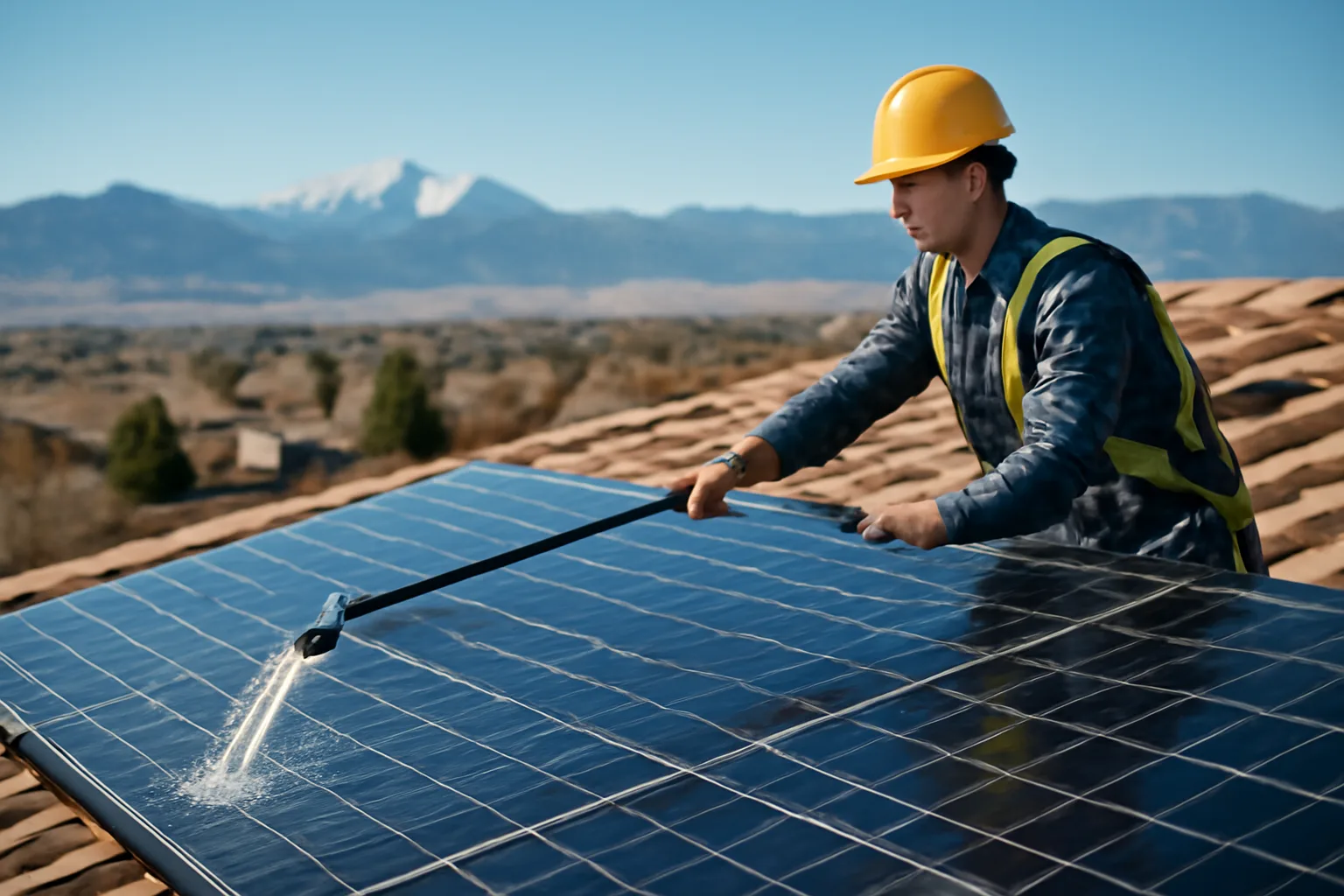
What you actually need depends on how you work. Stay on the ground, clean ground-mounted or low-slope residential panels with a soft brush and a pole, and your path is short: business registration, a local business license, and insurance. Go on rooftops and the math changes. Colorado's Division of Professions and Occupations oversees contractor licensing, and some counties and municipalities require a roofing contractor registration before anyone works on a roof commercially, even for cleaning [1]. Check with your specific city or county before your first rooftop job.
The Colorado Secretary of State is where every business entity registration starts. An LLC costs $50 to file online and keeps your personal assets separate from business liability [2]. That step takes about ten minutes. A sole proprietorship is cheaper but gives you no liability shield, and given the rooftop exposure in this work, the LLC fee earns its keep.
Local business licenses vary a lot. Denver charges a general business license fee. Smaller cities like Fort Collins or Colorado Springs run their own schedules. Confirm the current fee and renewal period with your city's licensing office directly, because these numbers move year to year.
What business structure and registrations do you need in Colorado?
Start at the Colorado Secretary of State's online business filing system. You can form an LLC, register a sole proprietorship under a trade name, or file a corporation. For a one-person cleaning operation, the LLC is the practical pick. It files as a single-member LLC, costs $50 [2], and separates your personal finances from any claim that comes out of a cracked panel or a ladder accident.
After state registration, you get a Colorado Account Number from the Department of Revenue if you will collect sales tax. Cleaning services in Colorado are generally not taxable, but tangible goods you resell (a cleaning solution, say) may be [3]. Confirm your service mix with the Department of Revenue or a CPA before your first invoice.
Next is a local business license. Denver, Aurora, Colorado Springs, Fort Collins, Boulder, and most other incorporated cities require a business license or an occupational privilege tax registration before you operate within city limits. Fees and renewal cycles differ. Phone the city clerk or check the city's online business portal. Do not guess.
Hire employees and you need a federal Employer Identification Number from the IRS (free, instant online) plus a registration with the Colorado Department of Labor and Employment for unemployment insurance [4]. That step waits until you actually have staff.
What insurance does a solar panel cleaning business need in Colorado?
Two policies matter right away: general liability, and workers' compensation if you hire anyone.
General liability covers third-party property damage and bodily injury. In this trade the common claims are a cracked panel, a broken skylight, or a customer who slips on a wet walkway after you finish. A $1 million per-occurrence / $2 million aggregate policy is the standard ask from residential and commercial property managers. In Colorado, annual premiums for a single-operator cleaning business run about $500 to $1,500, depending on your revenue, the surfaces you work on, and the carrier. Get quotes from at least three carriers, because the spread is real.
Workers' compensation is mandatory in Colorado for any business with one or more employees, including part-time employees [5]. Sole proprietor with no employees? You are not required to carry it for yourself, but you can elect coverage. On rooftops, that election is worth the cost.
Some commercial accounts, HOAs, and solar installers who subcontract cleaning will ask for a certificate of insurance before they book you. Have your agent ready to issue one fast. A few will also ask to be listed as an additional insured, which most carriers do at no extra charge.
Vehicle insurance is easy to overlook. Your personal auto policy likely excludes commercial use. If your truck or van carries equipment and you drive it to job sites as a business, you need a commercial auto rider or a separate commercial policy.
How much does solar panel cleaning cost in Colorado, and how should you price your work?
Colorado customers typically pay $8 to $15 per panel for a single residential cleaning, and most operators land around $10 to $12 per panel when the system is accessible and no special equipment is needed [6]. A standard residential system in Colorado is 20 to 30 panels, so one job generates $200 to $450. Larger commercial arrays and steep-roof systems command higher per-panel rates because time and risk go up.
Flat per-visit pricing is common too. Many operators charge a minimum trip fee of $150 to $200 regardless of panel count, which protects you on small systems and short drives. For commercial clients with 100-panel rooftop arrays, per-panel pricing reads as more transparent and competitive.
Colorado's climate feeds the pricing conversation. The state averages about 300 sunny days per year, a genuine selling point for solar output, but the Front Range also picks up serious dust, pollen, and bird activity from spring through fall [7]. Soiling rates and production loss vary by region and system tilt. One National Renewable Energy Laboratory analysis found soiling-related production losses in the western U.S. can reach several percent per month during dry periods, depending on local conditions [8]. That range is useful when you talk cleaning frequency with a customer.
Most residential customers clean once or twice per year. Twice a year, spring and fall, is the cadence most operators recommend and most customers accept. Commercial clients with larger arrays and stronger production incentives often want quarterly service.
| Pricing tier | Typical job | Rate range |
|---|---|---|
| Small residential (10-20 panels) | $150 to $200 flat | or $10-$12/panel |
| Standard residential (20-30 panels) | $200 to $360 | $10-$12/panel |
| Large residential (30-50 panels) | $330 to $600 | $11-$12/panel |
| Commercial (100+ panels) | Quoted per job | $8-$10/panel |
| Rooftop premium (steep pitch or 2+ story) | Add $50-$150 | to base price |
How long does solar panel cleaning take in Colorado?
A standard 20-panel residential system on a single-story roof takes one experienced operator about 45 minutes to an hour, including setup, washing, and rinse. A 30-panel system on a two-story roof runs 1.5 to 2 hours, because ladder repositioning and safety anchoring add time. Ground-mounted systems of the same size go faster, often 30 to 45 minutes, since you skip rooftop access entirely.
Commercial jobs scale differently. A 200-panel flat commercial roof can take a two-person crew 3 to 4 hours. If you bid commercial work, time your setup and breakdown carefully on your first few jobs. Those non-cleaning minutes add up, and they belong in your quote.
Drive time is real cost in Colorado. The Front Range corridor from Pueblo to Fort Collins runs about 200 miles, and rural customers east of the mountains can sit 45 to 90 minutes from your base. Build a service zone and price accordingly. Operators who cluster jobs by geography on the same day run the most profitable routes.
Job time sets your daily revenue ceiling. If each residential job takes one hour of actual cleaning plus 30 minutes of drive and setup, a solo operator can realistically finish 4 to 6 jobs per day. At $250 average per job, that is $1,000 to $1,500 in a full day, a reasonable target once you have a route.
What equipment do you actually need to start?
The core list is shorter than most people expect. You need a deionized (DI) water system, a soft-bristle brush or microfiber pad on a water-fed pole, and a way to carry and pressurize the water. That is the whole cleaning setup for most residential jobs.
DI water separates a professional result from a streaky mess. Tap water in Colorado, especially along the Front Range, carries moderate to high mineral content. Wash panels with hard tap water and you leave mineral spots that can cut output and earn you a callback. DI water rinses clean and leaves no residue. A portable DI tank and resin system is the starting purchase that pays off on the first job.
A water-fed pole lets you clean second-story panels from the ground on many homes, which removes the rooftop access question for a big share of your work. Poles run from $50 for a basic aluminum unit to $400 and up for a carbon fiber telescoping setup. Start with what you can afford. Upgrade when the revenue supports it.
Rooftop work means fall protection gear. OSHA standard 1926.502 governs fall protection requirements for workers on roofs and elevated surfaces [9]. A basic anchor, harness, and lanyard kit runs $200 to $400. Do not skip this.
SolarWashPath offers a $149 DI Water + Roof-Safety Kit that covers the core starting equipment for new operators. You can check it at /start. Buy it or build your own list. The equipment is not proprietary. Just make sure you have everything before your first paid job.
A van or truck with a water tank (50 to 100 gallons to start) rounds out the setup. If you already own a pickup, a plastic IBC tote or a dedicated bed tank works fine early on.
How do you find customers in Colorado?
Colorado's solar adoption rate is high enough that demand exists, but you still have to build a customer base actively in year one. The state had over 171,000 solar installations as of 2023 according to the Solar Energy Industries Association [10], and that number climbs every year. Those are your potential customers.
Google Business Profile is the highest-leverage free tool you have. Set it up before you take your first job. Reviews on that profile drive more inbound calls than almost anything else for a local cleaning service. Ask every satisfied customer to leave one.
Door-to-door in neighborhoods with visible solar panels sounds old-fashioned, and it works. You can see the panels from the street, you know the homeowner has a system, and a short conversation or a door hanger converts at a useful rate in year one when you need to fill your schedule.
Commercial accounts (school districts, municipalities, agricultural operations with big arrays) take longer to land but pay more predictable revenue. Many put cleaning services out for informal quotes. A professional bid on a clean proposal form, delivered fast, wins a lot of that work.
Partnering with local solar installers is worth the effort. An installer who fields cleaning calls but does not offer the service will often hand those calls to a cleaning operator they trust. Offer to leave your cards at their office and do a free demo clean on one of their recent installs so they can see your work.
What records and contracts do you need to run the business properly?
A written service agreement for every job protects you more than anything else in your first year. The agreement should state what you will clean, what method you will use, what you will not do (no pressure washing on panels, no climbing unless specifically agreed), the price, and the payment terms. Include a damage disclaimer that describes your process and notes that pre-existing micro-cracks or faults in panels are not your liability.
You do not need a lawyer to draft a basic service agreement, but one review is worth the $100 to $200 it costs. Several service-industry template packages exist. Adapt one to your specific work.
For taxes, track every business mile you drive (the IRS standard mileage rate is 67 cents per mile for 2024 [11]), every equipment purchase, every supply cost, and every insurance premium. A simple spreadsheet or inexpensive software like Wave (free) or QuickBooks Self-Employed ($15/month) handles this at your scale.
Colorado requires businesses with employees to file quarterly wage reports with the Department of Labor and Employment [4]. Stay solo and your tax obligations stay simpler: quarterly estimated income tax to the IRS and the Colorado Department of Revenue, plus self-employment tax on net profit.
Keep your certificates of insurance current and handy. When a commercial client asks for one mid-week, you want to send it the same day, not chase your broker for three.
How do Colorado's climate and geography affect the cleaning business?
The Front Range geography creates a natural service season that shapes your calendar. Spring cleaning after pollen season (April through June) and fall cleaning before winter (September through October) are the two peak demand windows. Some customers in lower-elevation areas like Denver or Pueblo want a third cleaning in midsummer after dust storms and monsoon debris, but that is not universal.
Hail is a real factor here. Colorado sits in one of the highest hail-frequency zones in the country [12]. Panels are tested to withstand hail up to a certain size (most carry an IEC 61215 rating), but a severe hailstorm can crack panels or damage frames. You are not a damage inspector, but keep a quick visual checklist and note any pre-existing damage in writing before you start. That record protects you from claims that your cleaning caused damage that hail actually caused.
At higher elevations, especially the mountain communities west of the Continental Divide, panels collect snow and debris differently and the cleaning season is shorter. Some mountain-town operators work a tight spring window. Drive times to those communities change your pricing math a lot.
Water quality varies by municipality. Denver Water's supply runs moderately hard, and some Front Range communities pull from harder aquifer sources. Test the TDS (total dissolved solids) of your local tap water with a cheap meter before you size your DI resin capacity. Higher TDS means your resin depletes faster and costs more to replace.
What does the first 90 days of operation look like?
Days 1 to 14: File your LLC with the Colorado Secretary of State online ($50). Apply for the local business license in whatever city you will operate from. Order or assemble your equipment. Get insurance quotes and bind a policy before you touch a single panel.
Days 15 to 30: Set up your Google Business Profile. Print door hangers or business cards. Contact two or three local solar installers and introduce yourself. Do your first practice clean on a neighbor's or friend's system for free, time yourself, and find your equipment gaps.
Days 31 to 60: Take your first paid jobs. Price them at your target rate, not a discount. Discounting early trains customers to expect low prices, and that is hard to reverse. Ask every customer for a review after the job.
Days 61 to 90: Compare your job times against your quotes. Adjust pricing if your estimates were off. Find which neighborhoods or customer types convert fastest and point your marketing there. By the end of month three, a solo operator working this plan full-time can hold 20 to 40 customers and a route worth $4,000 to $8,000 per month in gross revenue. Part-time operators running weekends can expect $1,000 to $2,500 per month by month three.
Want to see how Colorado's licensing compares to neighbors? Read how to start solar panel cleaning in Arizona and solar panel cleaning license in California, which has a far more complex licensing structure than Colorado.
For more detail on exactly what Colorado's licensing situation covers, the companion piece solar panel cleaning license in Colorado goes deeper on the roofing contractor question and the county-by-county variation.
How does Colorado compare to other states for starting a solar cleaning business?
Colorado is one of the easier states to enter. California requires a C-61/D-63 specialty contractor license for many cleaning operations and runs a full Contractors State License Board process see solar panel cleaning license in California. Arizona has its own contractor registration requirements that vary by county see solar panel cleaning license in Arizona. Alabama and Alaska run simpler frameworks similar to Colorado's but with much smaller solar markets see how to start solar panel cleaning in Alabama and how to start solar panel cleaning in Alaska.
Colorado's advantages: no trade-specific state license, a large and growing solar install base, strong sunshine, and a customer base that already understands why panel performance matters. The tradeoffs against some sunbelt states: a shorter peak-demand season from winter weather, real hail risk that forces careful pre-job documentation, and mountain geography that makes route density harder in some markets.
The opportunity is real. The state added more than 22,000 new residential solar systems in 2022 alone [10], and every one of those systems needs cleaning eventually. Most Colorado metro areas outside Denver proper are not saturated.
SolarWashPath's solar panel cleaning license in Colorado guide covers the roofing contractor angle in detail if that part of your plan raises questions.
Frequently asked questions
Do you need a license for solar panel cleaning in Colorado?
No state license specifically covers solar panel cleaning in Colorado. You need a business registration with the Colorado Secretary of State, a local business license from your city or county, and general liability insurance. If you work on rooftops commercially, some counties require a roofing contractor registration. Confirm with your specific municipality before your first rooftop job.
How much does solar panel cleaning cost in Colorado?
Most Colorado operators charge $8 to $15 per panel, with $10 to $12 per panel being the most common residential rate. A standard 20 to 30-panel home system runs $200 to $360 per cleaning. Many operators add a minimum trip fee of $150 to $200. Commercial rates run slightly lower per panel but higher per visit. Steep roofs or second-story systems add $50 to $150 to the base price.
How long does solar panel cleaning take in Colorado?
A 20-panel residential system takes one experienced operator 45 minutes to one hour including setup. A 30-panel two-story roof runs 1.5 to 2 hours. Ground-mounted systems are faster, often 30 to 45 minutes. A two-person crew can clean a 200-panel commercial array in 3 to 4 hours. Drive time between jobs is real cost; cluster jobs geographically to protect your daily revenue.
How do I register a solar panel cleaning business in Colorado?
File an LLC or trade name with the Colorado Secretary of State online for $50. Then apply for a local business license from your city or county. If you will have employees, register with the Colorado Department of Labor and Employment and get a federal EIN from the IRS. The whole process takes one to two weeks if you move quickly.
What insurance does a solar panel cleaning company in Colorado need?
At minimum, you need general liability insurance, typically $1 million per-occurrence. Expect annual premiums of $500 to $1,500 for a single-operator business. If you hire employees, Colorado law requires workers' compensation for any business with at least one employee. You also need commercial auto coverage if you use a vehicle for business, because personal auto policies typically exclude commercial use.
Is solar panel cleaning profitable in Colorado?
A solo operator completing 4 to 6 residential jobs per day at $250 average generates $1,000 to $1,500 on a full workday. Monthly gross revenue of $4,000 to $8,000 is a realistic target for a full-time operator by the end of the first three months. Operating costs are low: DI water supplies, vehicle fuel, and insurance. Profitability depends heavily on route density and limiting dead drive time.
How often should solar panels be cleaned in Colorado?
Most Colorado residential customers clean once or twice a year. The practical schedule is spring after pollen season (April to June) and fall before winter (September to October). Front Range dust, bird activity, and summer monsoon debris can push some customers to three visits per year. Commercial clients with larger production incentives often want quarterly service. Cleaning frequency is a customer education conversation more than a fixed rule.
Does hail damage affect solar panels in Colorado and should I worry about liability?
Colorado has high hail frequency. Panels are rated to withstand hail up to a standard size (IEC 61215), but severe storms can crack panels or damage frames before you ever arrive. Run a brief visual check before every clean and document any pre-existing damage in writing or with photos. That record protects you from claims that your cleaning caused damage that hail actually caused.
What equipment do I need to start solar panel cleaning in Colorado?
You need a deionized (DI) water system, a soft-bristle brush or microfiber pad on a water-fed pole, a water tank (50 to 100 gallons to start), and a vehicle to carry it. For rooftop work, add a harness, anchor, and lanyard for fall protection. Colorado tap water has moderate to high mineral content, so DI water is essential to avoid spotting. A basic setup costs $500 to $1,500 depending on pole and tank quality.
Do I need a contractor's license to clean solar panels on rooftops in Colorado?
Colorado does not have a statewide roofing contractor license that automatically applies to cleaning, but some counties and municipalities require a contractor registration for anyone working on roofs commercially, even for cleaning. The requirements vary by jurisdiction. Check with your specific county or city before your first rooftop job. The state's Division of Professions and Occupations is the starting point for state-level guidance.
How do I find solar panel cleaning customers in Colorado?
Set up a Google Business Profile before your first job; reviews there drive the most inbound calls. Door hangers in neighborhoods with visible solar installations convert well in year one. Contact local solar installers, who often refer cleaning inquiries they cannot handle themselves. Colorado had over 171,000 solar installations as of 2023, and most of those homeowners have never had their panels professionally cleaned.
What is the best time of year to start a solar panel cleaning business in Colorado?
Start your setup in January or February so you are licensed, insured, and equipped before the spring rush. April through June is the first peak demand window. If you miss spring, fall (September to October) is the second peak. Starting in December or January gives you two to three months to build your systems, find your first customers, and be ready when phone calls pick up.
Does Colorado have any sales tax on solar panel cleaning services?
Cleaning services in Colorado are generally not subject to state sales tax, but rules vary by municipality and by what you sell. If you resell a product (a cleaning solution, for example), that sale may be taxable. Confirm your specific situation with the Colorado Department of Revenue or a local CPA before you send your first invoice. Do not assume you are exempt without verifying.
How does Colorado's solar panel cleaning market compare to California or Arizona?
Colorado is easier to enter than California, which requires a specialty contractor license through the Contractors State License Board. Arizona has county-level contractor registration requirements. Colorado's market is strong: over 171,000 solar installations as of 2023, about 300 sunny days per year, and a shorter operating season than true desert states. The tradeoffs are hail risk and mountain geography that limits route density in some areas.
Sources
- Colorado Department of Regulatory Agencies, Division of Professions and Occupations: Colorado's Division of Professions and Occupations oversees contractor licensing and registration requirements at the state level
- Colorado Department of Revenue, Sales Tax Guide for Services: Cleaning services in Colorado are generally not subject to state sales tax, but tangible goods sold may be taxable
- Colorado Department of Labor and Employment, Unemployment Insurance Employer Registration: Colorado employers must register with the Department of Labor and Employment for unemployment insurance when they hire employees
- Colorado Department of Labor and Employment, Workers' Compensation Coverage Requirements: Colorado law requires workers' compensation insurance for any business with one or more employees, including part-time employees
- Solar Energy Industries Association (SEIA), Solar Market Insight: Colorado: Colorado solar market size and installation data; context for demand and pricing benchmarks
- National Oceanic and Atmospheric Administration (NOAA), U.S. Climate Normals: Colorado's Front Range averages approximately 300 sunny days per year
- U.S. Occupational Safety and Health Administration (OSHA), Fall Protection Standard 1926.502: OSHA standard 1926.502 governs fall protection requirements for workers on roofs and elevated surfaces
- Solar Energy Industries Association (SEIA), Colorado Solar State Profile: Colorado had over 171,000 solar installations as of 2023, adding more than 22,000 new residential systems in 2022
- Internal Revenue Service, Standard Mileage Rates: The IRS standard mileage rate for business driving is 67 cents per mile for 2024
- National Oceanic and Atmospheric Administration (NOAA), Storm Prediction Center hail climatology: Colorado sits in one of the highest hail-frequency zones in the United States