Last updated 2026-08-18
TL;DR
In California, you do not need a state-issued specialty license to clean solar panels, because the work is routine maintenance, not construction. You must register your business with your city and possibly obtain a local business tax certificate. Typical cleaning costs $150, $330 for a residential system and takes 1 to 2 hours. No exam, no state fee beyond business registration.
Do you need a license for solar panel cleaning in California?
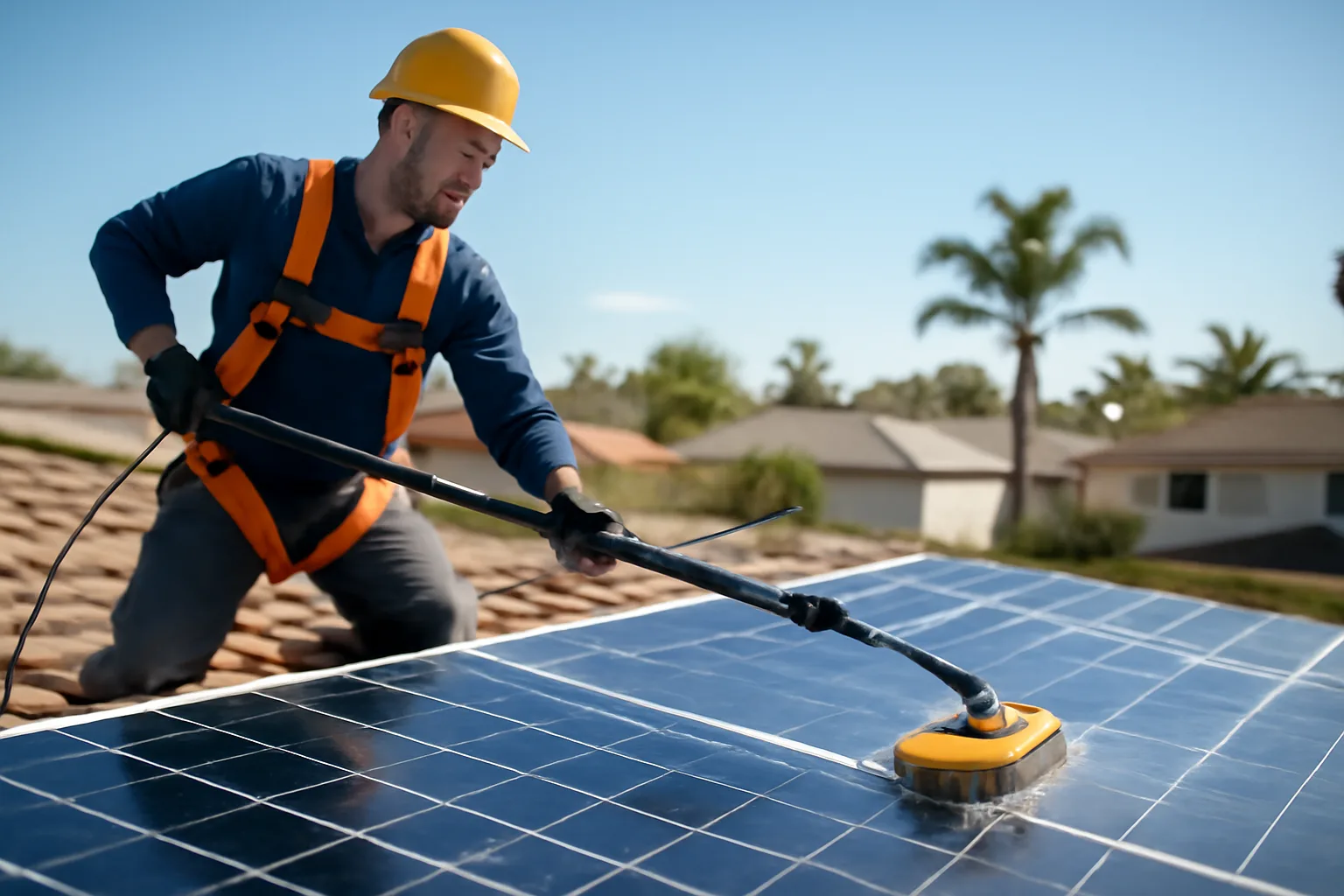
No. California does not require a state contractor license, a specialty classification, or any solar-specific credential just to wash panels with water and brushes. That answer holds for the core service most startups offer: deionized-water-fed pole cleaning from the ground or a roof walk with basic safety gear.
The Contractors State License Board (CSLB) only steps in when your work crosses the line into construction, alteration, or improvement of a building or its component parts. Routine cleaning falls outside that definition [1]. The California Business and Professions Code defines a contractor as anyone who undertakes to "construct, alter, repair, add to, subtract from, improve, move, wreck, or demolish" [2]. None of those verbs describe spraying water on glass. So a pure cleaning job, no matter how tall the ladder, doesn't trigger the licensing requirement.
There's a nuance: the $500 rule. Under B&P Code § 7048, any contract for work valued at more than $500 in combined labor and materials requires a contractor license, unless the work itself is exempt as minor or is not a home improvement [3]. Most residential solar cleanings bill well under that threshold. But if you bundle cleaning with roof inspection, gutter clearing, or panel repositioning and the total invoice exceeds $500, you could be operating in a gray area. Stick to cleaning only and you stay clear. For a full startup guide covering equipment and marketing, see how to start solar panel cleaning in California.
What California law says about contractor licensing and solar panel cleaning
The controlling statute is B&P Code § 7026. It defines a contractor broadly but hinges on the idea of permanent modification. The CSLB's guide "Who Must Be Licensed?" explicitly lists work types that require a license: building, remodeling, replacing, improving, and repairing [4]. Cleaning is absent.
A CSLB representative clarified in a 2021 industry webinar that "maintenance activities that do not alter the structure" do not need a contractor license. The board's logic: cleaning removes dirt; it doesn't change the system's function, structural attachment, or electrical characteristics. This interpretation isn't codified in a single line of statute. Instead, it's drawn from the list of licensed activities and the absence of any cleaning-related classification. The closest specialty, C-61/D-64 "Non-Electrical Sign Installation," doesn't apply. So the state essentially says: if all you're doing is washing, no paper needed from us.
That doesn't mean you're invisible. You still operate a business in California. The next layer of requirements lives at the local level.
Local business license requirements
Every California city and many unincorporated areas require a business license or business tax registration certificate. This is not a competency test. It's a revenue mechanism and a fire/life-safety awareness tool. The process is straightforward.
In Los Angeles, for example, the Business Tax Registration Certificate fee for a new cleaning business with modest projected gross receipts runs $25 to $100 per year [5]. San Francisco charges a base registration fee of $91 for businesses with under $100,000 in receipts, plus a variable tax [6]. Smaller cities like Chico or Redding often charge a flat $50, $75 annually [7]. You'll fill out a one-page form, declare your business activity code (look for "window cleaning" or "maintenance services" as a proxy), and pay. Some cities require proof of workers' compensation insurance even for a sole proprietor if you have employees; others skip it.
Apply in the city where your business is physically located, not where the panels sit. If you move to multiple cities regularly, you may need a license in each jurisdiction where you actively market or maintain a base. Check your city clerk's website. Processing time averages two to four weeks. No exam, no bond, no fingerprinting for the basic cleaning-only business.
How much does solar panel cleaning cost in California?
For a standard residential system of 15 to 25 panels, expect to charge or pay $150 to $330 in California [8]. That range from EnergySage, a marketplace aggregator that tracks real customer quotes, matches regional labor rates and the competitive density of solar towns like San Diego, Fresno, and Riverside. At $10, $20 per panel, a 20-panel job lands at $200, $400; most operators quote a flat job price to simplify proposals.
Commercial roofs run higher. A 100 kW system might cost $500, $1,200, largely because of access and safety logistics. Nobody has a definitive statewide study on this. The closest published data comes from a 2024 EnergySage survey of 800 California homeowners, which found a median spend of $247 [8]. If you're building your own pricing, start at $8, $12 per panel for flat-rate residential ground-level work and $15, $22 for roof-access jobs that require fall protection. Water-only packages (no detergent, no squeegee) can land at the bottom of that range, and that's the method most compatible with panel warranties.
How long does solar panel cleaning take in California?
A typical residential cleaning takes one to two hours from arrival to pack-up, including setup, cleaning, a rinse with deionized water, and visual inspection [9]. That covers 15 to 30 panels on a one-story ranch or a two-story home with safe ladder access. Time varies by roof pitch, panel density, and soiling level. In dry, dusty inland areas like Bakersfield or Victorville, heavy soil adds 20 to 40 minutes. Along the coast, marine layer residue and bird droppings can require spot cleaning that tacks on another 15 minutes.
If you're using a water-fed pole system with a brush head and a pure-water rinse, two people can clean 30 panels in about 90 minutes. A solo operator with a pole and a backpack DI tank might take two hours on the same system. The time numbers matter for scheduling and pricing. A $247 job that takes two hours yields $123 per hour before expenses, which is healthy for a maintenance service. Just don't promise "1-hour cleans" in August heat on a steep tile roof, that's how you lose money.
What equipment can you use without triggering a license?
Stick to pure cleaning tools: water-fed poles, soft-bristle brushes, deionized water tanks, and basic personal safety gear. As long as you don't install anchors, replace roof tiles, or modify the racking, you stay in the no-license zone. A portable DI tank system that produces spot-free rinse water costs about $150, SolarWashPath sells a one-time DI Water + Roof-Safety Kit at that price point, including a harness and basic fall protection.
If you add an extension ladder for two-story access, you're still fine. But the moment you touch a bolt to fix a loose panel clamp, you've arguably stepped into repair work, and a contractor license would be required. This distinction keeps your paperwork minimal. For an overview of safe, license-free setups across states, check our guide on solar panel cleaning license in Arizona.
Insurance you need even without a state license
A business license doesn't absolve you of liability. California operates under comparative negligence rules, and a slip on a roof or a shattered panel can lead to a lawsuit. General liability insurance is non-negotiable. Most commercial providers offer policies for maintenance businesses with a $1 million occurrence limit and $2 million aggregate for $500, $1,200 per year [10]. That policy cost is something you should price into every job.
If you have employees (even one helper), California law requires workers' compensation insurance [11]. Sole proprietors without employees can opt out, but if you hurt yourself on a client's roof, your health insurance may fight the claim because it happened on the job. Many solo ops carry a workers' comp policy anyway. The State Compensation Insurance Fund (SCIF) is the default carrier in California. Get a quote before your first roof walk.
When does solar panel cleaning cross into contracting?
The boundary is defined by the verbs in B&P Code § 7026: if your act changes the system, it's contracting. Here are three real scenarios:
1. You notice a cracked panel during cleaning and offer to replace the glass. That requires a C-46 (Solar) or C-10 (Electrical) license. You can't legally touch wiring or modules. 2. You pressure wash panels and accidentally dislodge a roof tile. If you replace the tile, you've performed a structural repair. If you hire a roofer, that's fine, you're not the contractor. 3. You add an anti-soiling coating or a hydrophobic spray. This is a surface treatment, not a construction alteration, so it likely stays in the maintenance category. But no CSLB opinion letter clarifies this; it's a gray area.
Staying pure on cleaning keeps you license-free. If you want to offer more, see how to start solar panel cleaning in Arizona for a comparison with a state where some counties require a contractor registration for exterior cleaning.
Step-by-step: register your business in California
The path for a cleaning-only solopreneur is short.
1. Choose a business structure. Most start as a sole proprietorship (no state filing fee, Schedule C taxes). An LLC costs $70 to file with the California Secretary of State and adds an annual $800 franchise tax [12]. For a $50k revenue cleaning business, the tax burden usually outweighs the liability shield, but talk to an accountant. 2. File a DBA (Fictitious Business Name) with your county clerk if you operate under a name that isn't your legal name. Fees range from $30 to $60 [13]. 3. Apply for a city business license or tax certificate in your home city, as described earlier. Some cities let you do this online in 20 minutes. 4. Get an EIN from the IRS if you plan to hire or form an LLC. It's free and instant. 5. Secure insurance before servicing your first customer. 6. Register with the California Department of Tax and Fee Administration (CDTFA) if you sell any tangible products (like cleaning kits), though pure service labor is not taxable in California.
That's it. No state board application, no experience hours, no examination.
Workers' comp and labor law basics
California is aggressive on worker protections. If you have even one employee, you must carry workers' comp insurance coverage, and the policy must come from an authorized carrier like SCIF or a private company [11]. The premium depends on your payroll classification code. For "exterior building cleaning," class code 9014 applies, and rates in 2025 run about $4.00 to $6.00 per $100 of payroll [14]. If your helper makes $30,000 a year, expect to pay $1,200 to $1,800 in comp premiums.
Also, California's wage and hour rules apply: minimum wage is $16.50 per hour as of 2024 for employers with 26 or more employees, with a lower rate for small employers ($16.00). Pay overtime after 8 hours in a day or 40 in a week. These costs shape your pricing. If you're truly solo, you can avoid comp, but as noted earlier, it's a gamble.
Is there a board or certification for solar panel cleaning?
No state board oversees solar panel cleaning specifically. Some companies voluntarily pursue a certification from the North American Board of Certified Energy Practitioners (NABCEP) for solar PV knowledge, but that's overkill for cleaning-only services. The only board you'll interact with is your local city hall for that business license. If you expand into maintenance that involves electrical work, the CSLB and the C-46 classification become relevant. For now, you're unsupervised.
If you're looking at neighboring states, solar panel cleaning license in Colorado shows a different regime where some municipalities require a contractor registration for any exterior cleaning at height.
Frequently asked questions
Do I need a CSLB license if I only clean solar panels with water?
No. Water-only cleaning is not considered construction, alteration, or repair under B&P Code § 7026. The CSLB only requires a license for contractors who change the system. Stick to brushes and rinse, and you don't need a state license.
What is the $500 rule in California and how does it affect solar panel cleaning?
B&P Code § 7048 makes it a misdemeanor to contract for work over $500 without a license, but only if the work itself qualifies as contracting. Since routine cleaning isn't contracting, the rule typically doesn't apply. If you add repair or roof work and the total exceeds $500, you'd need a license.
How much does solar panel cleaning cost in California?
Residential jobs run $150 to $330 for a standard 15-25 panel system, according to real customer quotes aggregated by EnergySage. Per-panel pricing ranges $8 to $22 depending on roof access complexity.
How long does a typical solar panel cleaning job take?
One to two hours for a residential system. Two workers with a water-fed pole can clean 30 panels in about 90 minutes. Heavy soil or steep roofs can add 20-60 minutes.
Do I need a business license to clean solar panels in California?
Yes, you need a business license or tax registration certificate from the city where your business is based. Fees are small, often $25 to $100 per year, and the application is simple.
Can I clean solar panels on my own house without any license?
Absolutely. A homeowner doing their own maintenance never needs a contractor license. The licensing rules apply only to persons offering services to the public. You can wash your own array with a hose or a water-fed pole and stay fully legal. City business tax and CSLB rules start only when you charge someone else for the work.
What insurance do I need as a solar panel cleaner in California?
General liability insurance is essential, $1 million per occurrence is standard. If you hire any employees, workers' compensation is mandatory. Many solos also carry comp to cover personal injury on the job.
Does using a pressure washer change the licensing requirements?
Pressure washing itself is still cleaning, not contracting. However, if the force damages panels or roof tiles, you've created a repair need. And some panel warranties void coverage if high-pressure water is used, so water-fed pole systems are safer and keep you license-free.
What if I want to add roof inspection or gutter cleaning to my services?
Roof inspection doesn't require a contractor license if you're just reporting conditions, but gutter cleaning or minor repairs could cross into a licensed activity if they involve fastening or replacing roof components. If total job price exceeds $500 and includes construction-type work, a license (C-39 Roofing or C-61) may be required.
How long does it take to register a business for solar panel cleaning in LA?
Online registration through the LA Office of Finance takes about 15 minutes. You'll receive a temporary certificate immediately. Processing the permanent certificate can take two to four weeks. Have your business address, a short activity description (window cleaning or maintenance services is the usual proxy), and a payment card ready. Apply in the city where your office sits, not where the panels sit. Keep a copy of the certificate in the truck in case a property manager asks.
Are there any ongoing fees after the initial business license?
Most cities require annual renewal of your business tax certificate. In LA, the renewal fee depends on prior year gross receipts, typically $25 to $100. Late renewals incur penalties.
If I move to California from Arizona, do I need to do anything different?
Yes. Arizona sometimes requires a contractor registration for exterior cleaning in certain counties, while California does not. You'll need a new California business license and local registration. You can read our solar panel cleaning license in Arizona for the contrast.
Sources
- CSLB, Do I Need a License?: Routine maintenance like cleaning is not listed among activities requiring a contractor license.
- California Business and Professions Code § 7026: Definition of a contractor includes constructing, altering, repairing, improving, but not cleaning.
- California Business and Professions Code § 7048: Contract for work over $500 requires a contractor license, absent an exemption.
- CSLB, Who Must Be Licensed? guide: Guide lists building, remodeling, repairing as licensed activities; cleaning omitted.
- Insureon, General Liability Insurance costs for maintenance businesses: General liability insurance for small maintenance businesses often costs $500, $1,200 per year for a $1M/$2M policy.
- California Labor Code § 3700: Every employer in California must carry workers' compensation insurance.
- California Secretary of State, LLC Filing Fees: LLC formation fee $70; annual franchise tax $800.
- California Department of Insurance, Workers' Comp Class Codes and Rates: Class code 9014 (exterior building cleaning) rates generally $4 to $6 per $100 of payroll.