Last updated 2026-08-21
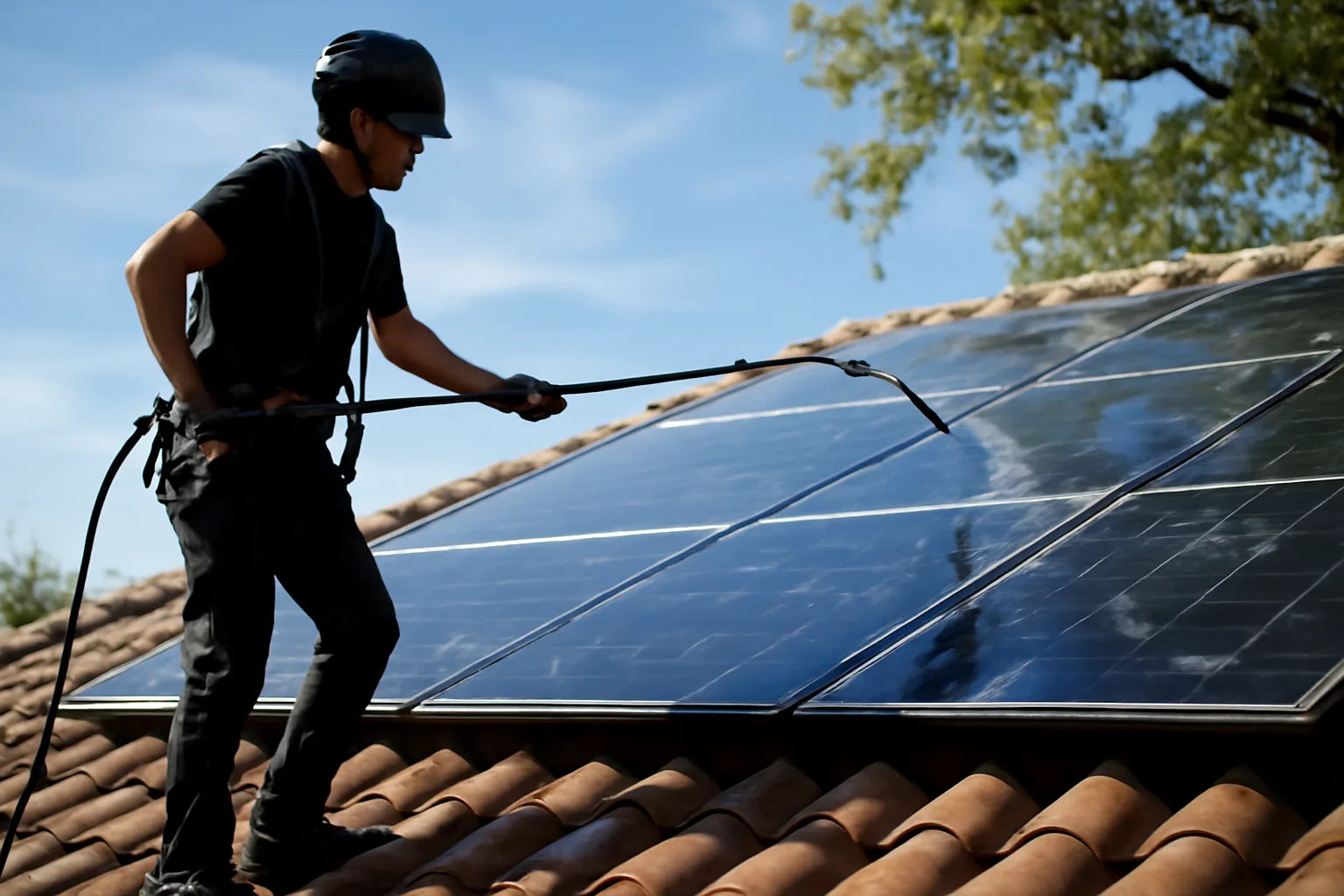
TL;DR
Solar panel cleaning is washing dust, pollen, droppings, and film off PV glass so more light hits the cells. Start by checking your state contractor board, getting an EIN and local licenses, buying fall gear and deionized water tools, and writing a simple safety and wash-water plan. Confirm every fee and license class with the board that actually issues it.
What is solar panel cleaning?
Solar panel cleaning is the physical removal of dust, pollen, bird droppings, soot, and mineral film from the glass face of a photovoltaic module so more sunlight reaches the cells. That is the whole job. You do not repair inverters. You do not install racking.
A photovoltaic device turns sunlight into electricity inside semiconductor material. The U.S. Department of Energy puts it plainly: "Photovoltaic (PV) devices generate electricity directly from sunlight via an electronic process that occurs naturally in certain types of material, called semiconductors." [1] Dirt on the glass blocks part of that sunlight. The loss reverses if you clean the glass without scratching it.
How big is the loss? Ilse et al., writing in Joule in 2019, estimate that soiling reduces current global solar power production by at least 3% to 4%. [2] Dry, agricultural, and desert sites run much higher. A farm array next to a dirt road is not the same plant as a rainy Seattle roof.
NREL's operations and maintenance handbook treats cleaning as a site-specific O&M task. There is no national calendar that says wash every April. [3] Soiling is also not the same thing as module degradation. Jordan and Kurtz, in an NREL analytical review, reported a median degradation rate around 0.5% per year for PV modules. [4] Degradation stays. Soil you wash off.
Here is how I describe the work to a customer. You restore light to the cells by lifting film off the glass, then you leave. If a pitch, a cracked module, or a live combiner box is outside your skill, you walk.
What roof safety rules apply to solar panel cleaning?
Step onto a roof to clean panels and OSHA fall rules apply to you the same way they apply to any other paid person on that surface. Plan around the number, not around a vibe.
OSHA construction fall protection starts at 6 feet on an unprotected edge (29 CFR 1926.501). [5] The regulation reads: "Each employee on a walking/working surface (horizontal and vertical surface) with an unprotected side or edge which is 6 feet (1.8 m) or more above a lower level shall be protected from falling by the use of guardrail systems, safety net systems, or personal fall arrest systems." [5] General industry walking-working surfaces trigger at 4 feet under 29 CFR 1910.28. [6] Cleaning contractors get argued both ways. I treat 4 feet as the planning floor and I harness on any sloped residential roof. Guessing your industry classification after a fall is a bad plan.
Ladders have their own number. When a portable ladder reaches an upper landing, the side rails must extend at least 3 feet above that landing (29 CFR 1926.1053). [7] OSHA also published a short fall bulletin for solar work that walks through roof edges, skylights, and fragile surfaces. [9] Read it before you buy rope you will not inspect.
Electrical contact is the other way people get hurt. 29 CFR 1910.333 tells employers to deenergize live parts before anyone works on or near them unless deenergizing creates a greater hazard or is infeasible. [8] Cleaning glass is not electrical work, but wet people, metal poles, and damaged junction boxes share a roof. I do not open combiners. I do not probe conductors. If a module is shattered, I stop and tell the owner to call their electrician.
| Trigger | Duty | Source |
|---|---|---|
| 4 ft | Fall protection on a general industry walking-working surface | 29 CFR 1910.28 |
| 6 ft | Fall protection on a construction unprotected edge | 29 CFR 1926.501 |
| 3 ft | Ladder side rails above the upper landing | 29 CFR 1926.1053 |
What I buy in month one: a fitted harness, a shock-absorbing lanyard or SRL rated for the roof, an anchor the structure can actually hold, and ladder stabilizers. What I skip: a $2,000 rope kit that stays in the bag because nobody trained you on it. Practice on a low porch roof you control. Then take paid work.
How do you start solar panel cleaning?
You start solar panel cleaning by proving you can get on and off a roof without a claim, then by filing the paper your state and city already require for any small trade. The wash is the easy part.
Read your state contractor board and your city business-tax desk first. Some places treat roof cleaning as unlicensed labor. Some fold it into a contractor class. California writes a small-project exemption into Business and Professions Code 7048. The licensing chapter does not apply below a dollar cap printed in that section. Read the live statute and confirm the current cap with CSLB before you treat a job as exempt. [12] Do not copy a blog number. Boards move the figure.
Second, form something the IRS and your bank recognize. The SBA's register-your-business guide is the clean federal walkthrough for structure, state registration, and tax IDs. [11] Apply for an EIN yourself. The IRS says, "Applying for an EIN is a free service offered by the Internal Revenue Service." [10] Skip the sites that charge for that form.
Third, buy the boring controls. General liability, commercial auto if the personal policy excludes business use, and workers' compensation the day you hire. Confirm coverages and exclusions with a licensed agent. I will not invent a premium here. Nobody should.
Fourth, pick a tiny service area and a tiny offer. Ground mounts and one-story low-slope roofs. Decline two-story tile until your tie-off is real. Write a one-page method: deionized or very low-mineral water, soft brush, no walking on glass, morning work so you are not shocking hot modules with ice water. Keep a TDS meter in the truck and log the reading.
Fifth, price in public and keep records. Local going rates move with roof height, access, and soil. Use the state cost notes on this site as a starting map, then call three nearby operators and listen. California and Arizona books do not look alike. Read solar panel cleaning cost in California and solar panel cleaning cost in Arizona before you print a postcard.
I would not lease a van wrap in month one. I would not buy a trailer RO plant. A hose, a resin vessel or two, a water-fed pole, a harness, and a notebook will teach you whether the work fits. If it does, you scale the water system later.
Do you need a license to clean solar panels?
Maybe. There is no single federal license for solar panel cleaning. The answer sits with your state contractor board, your city or county business license desk, and sometimes a water board if you discharge wash water.
Contractor law turns on the work, the dollar amount, and whether you touch electrical systems. Washing glass is usually not C-10 electrical work. Selling a repair, rewiring an optimizer, or pulling a module often is. Stay on the cleaning side of that line or get the class the board names.
California is the example people misuse. BPC 7048 carves small projects out of the Contractors State License Law below a statutory dollar cap. [12] That cap is not a national rule. It is not a promise you can stack invoices to stay under it. Confirm the current figure and the stacking language with CSLB. Other states have no equivalent, or they use a different number, or they regulate the advertising instead of the brush.
City hall still wants a business tax certificate in a lot of towns even when the state board does not want a contractor card. HOAs and property managers will ask for a license number and a certificate of insurance whether the statute requires one or not. Give them what they ask or skip the account.
My opinion: call the board and ask two questions. Is washing rooftop PV, with no electrical repair, inside a licensed classification? If I stay under the small-job number, what still requires registration? Write down the name of the person and the date. Boards do not pre-approve your business plan, and nobody here can guarantee a yes.
What water and tools do you need for solar panel cleaning?
You need water that dries without leaving minerals, a brush that cannot scratch tempered glass, a way to reach the array without standing on it, and fall gear if the array is on a roof. That kit is smaller than vendors imply.
Hard tap water spots. The spots are minerals, and they become the next soiling layer. Deionized or reverse-osmosis water is the standard answer on utility O&M sites, and NREL's O&M handbook frames cleaning as an operations choice you match to the site, not a soap recipe. [3] I run a TDS meter on every fill. If the reading climbs, I change resin. I do not guess.
Skip dish soap. Skip window mix. Skip pressure washers aimed at a module. Manufacturers write their own cleaning notes, and they rarely bless abrasives or high pressure. Read the data sheet for that brand. If the owner cannot find it, rinse with pure water and a soft brush only.
Ground-mount kit: hose, filter or DI vessel, pole, brush head, squeegee if you like, TDS meter, five-gallon backup. Roof kit: all of that plus harness, anchor plan, ladder helpers, and shoes that belong on that surface. SolarWashPath lists a $149 one-time DI Water + Roof-Safety Kit if you want those pieces in one box. You can also buy a meter, an empty pole, and a harness from any supplier and do fine.
Waste of money in year one: ceramic "never clean" coatings, robot cleaners for residential roofs, and a branded trailer you still have to park. Spend on resin and on a class that teaches you to tie off.
How often should you clean solar panels?
As often as the site soils enough to pay for the visit. That is the only honest schedule.
Ilse et al. put a global production hit of at least 3% to 4% on soiling, with much worse pockets. [2] NREL does not hand you a national interval. The O&M handbook treats frequency as a local operations decision. [3] Rainy climates sometimes self-rinse enough that a homeowner never calls. A Central Valley almond orchard can film a module in weeks during bloom and harvest.
I would not sell a 12-visit residential contract until I have seen that roof through a year. Start with a one-time clean and a photo log. If summer output dives after a dust month, you have a reason to return. If winter rain keeps the glass honest, you look greedy pushing quarterly visits.
Utility plants use soiling stations and wash when the lost energy costs more than the truck roll. You will not have that instrumentation on a 12-panel garage roof. Use the owner's production app if they have one, plus a before-and-after photo in the same light. Do not promise a fixed percent gain. You cannot know the gain until you measure that array.
Bird droppings and heavy soot are different. Those are spot jobs, not calendar jobs. Clean the mess and check the glass for etching. Etched glass is not a cleaning sale. It is a module conversation for their installer.
What first-year paper should you keep?
Keep the paper that proves you exist, that you are allowed to take money, and that you can show a claim adjuster what you did. A file cabinet beats memory every time.
From the federal side: an EIN confirmation letter, your chosen business tax classification, and a way to track ordinary and necessary expenses. IRS Publication 535 is the plain-language map for what a trade can deduct. [14] Resin, pole heads, harness inspection, fuel, and business insurance land there when they are ordinary for this work. Confirm the year's rules with the publication or a CPA. I am not your tax preparer.
From the state and city side: formation papers, the business license or tax certificate, any contractor card if the board says you need one, and sales-tax registration if your state taxes this service. Confirm each item with the desk that collects it. Processing times change. I will not invent one.
From the job side: a one-page service agreement, a photo set (access, array, close-ups of existing damage), a TDS reading, and a note that you did not walk the glass. If the owner has a warranty packet, photograph the cleaning page. Your file should show you followed it.
From the people side: if you hire, the Fair Labor Standards Act still applies to wages and overtime for covered employees. Read the SBA's business guide on hiring and payroll before you call someone a contractor because they brought their own brush. [11]
I keep a simple binder in the cab. License copies, insurance cert, SDS for any resin, and blank contracts. Inspectors and property managers ask at the curb. Fumbling through email looks like you do not do this for a living.
How do you price solar panel cleaning jobs?
Price the access, the height, the soil, and the time to do the job without stepping on glass. Do not price a fantasy national average. I have not seen a tight federal survey of residential wash prices, and I will not invent one.
Utility-scale soiling has real economics in the Joule paper. Residential driveways do not. [2] What you can do is build a local book. Time a ground mount. Time a one-story. Time a steep two-story (or decline it). Add water, resin, fuel, insurance, and the hour you spend on paper. Then look at nearby quotes.
State pages on this site collect local cost notes you can read next to your own timing. Start with solar panel cleaning cost in Florida, solar panel cleaning cost in Colorado, solar panel cleaning cost in Hawaii, and solar panel cleaning cost in Georgia. Those markets do not share a number. Hawaii access is not Georgia access.
| Setting | What drives the price | First-year note |
|---|---|---|
| Ground mount, easy access | Water, walking time | Best classroom you will get |
| One-story low slope | Setup, rinse, hose management | Most honest residential work |
| Two-story or steep | Fall gear, slower pace, more refusal risk | Charge for the risk or say no |
| Commercial carport | Traffic, height, scale, extra insureds | Do not bid this in month one |
I would rather lose a steep tile job than buy a claim. Flat per-panel prices look tidy on a website and then fail on a 12/12 pitch with no tie-off. Quote the site you stood on. If you cannot stand on it yet, do not quote it.
Can you put wash water in the storm drain?
Often no, and the answer is local even when the federal hook is clear. Storm drains lead to creeks. They are not sinks.
The Clean Water Act's National Pollutant Discharge Elimination System (section 402) is the federal permit program for point-source discharges to waters of the United States. [13] Cities run municipal separate storm sewer systems under that frame. Many of them print a simple rule: only rain in the drain. Soap, degreaser, and even dirty wash water can be a violation if it enters the storm system.
Pure deionized rinse on a residential roof is a gray zone that local inspectors treat differently. Some want you to keep water on the lawn. Some want capture on commercial lots. Some do not care until a neighbor films bubbles in the gutter. Confirm with the city stormwater desk or the state water board for the site you are washing. Do not take my word as a permit.
My practice: no detergent on any job I cannot fully control. Keep rinse water on vegetated soil when the site allows it. On a tight urban lot that sheets to a grate, I ask the owner where they want the water and I walk if the only path is the storm inlet. A lost job is cheaper than an illicit-discharge file.
What cleaning mistakes void a solar warranty?
The mistakes that void warranties are the ones the module maker already banned in writing. Walking on the glass, abrasives, harsh chemicals, and high-pressure spray show up again and again. I will not invent a universal psi cap because brands do not share one number.
Ask the owner for the cleaning page in the warranty packet. Photograph it. Follow it. If they cannot find it, stay at deionized or RO water and a soft brush, and write that limit into your contract. You are not the warrantor. You are the person who can look like the cause when a cell string dies next month.
Microcracks from foot traffic are the expensive error. The module can look fine and still lose a substring. Never step on a panel to reach the next row. If you cannot reach it with a pole from the roof plane or the ground, redesign the job or decline it.
Thermal shock is the quiet error. Very cold water on a module that has been baking can stress glass. I work mornings. I do not blast a 140 F array with well water from a shaded hose. Nobody has a perfect public dataset on residential thermal breaks. The closest honest move is to stop doing the thing every installer warns you about.
Keep the before photos. If a crack is already there, your file is what stands between you and a chargeback.
What should a first year of operations look like?
A first year of solar panel cleaning should look like a short service area, a written safety method, a thin tool list, and a binder that would survive a claim. It should not look like a franchise brochure.
Q1 is paper and practice. EIN, local license, insurance binder, harness time on a roof you control. Confirm every board item. No one here can promise an approval date.
Q2 is ground mounts and easy one-stories for people you already know. Time the work. Log TDS. Take photos. Sharpen the contract when a customer asks a question you did not expect.
Q3 is the first real soil season across most of the country. This is when you learn whether your resin budget and your summer calendar match. It is also when you will be tempted to climb a roof you should decline. Decline it.
Q4 is renewal conversations and tax files. Publication 535 is how you sort the year's ordinary costs from the personal ones. [14] Keep the logs. If the book of work is still tiny, that is information. The trade is real. Your town may not want it yet.
Want a first-steps checklist after you finish this page? Use /start. SolarWashPath is an independent publisher, not a law firm and not a service company. Nothing here is a license, a permit, or a promise that a board will take your money this week.
Frequently asked questions
What is solar panel cleaning?
It is washing dust, pollen, droppings, and mineral film off photovoltaic glass so more sunlight reaches the cells. You are restoring light, not repairing electronics. Ilse et al. in Joule (2019) estimate soiling cuts global solar production by at least 3% to 4%. Site dirt can run much higher. Confirm the module maker's cleaning notes before you add any chemistry.
How do you start solar panel cleaning?
Check your state contractor board and city business desk, get a free IRS EIN, buy liability and fall gear, and limit early jobs to ground mounts and low one-story roofs. Write a deionized-water method and a wash-water plan. Confirm every license class and fee with the board that issues it. Nobody can guarantee approval time.
Is solar panel cleaning a good first business?
It can be if you already like roofs, early mornings, and thin margins that grow with route density. It is a poor first business if you need a wide service area, hate heights, or plan to hire before you can tie off. There is no honest national profit study I trust. Time ten local jobs before you quit other work.
Do you need deionized water to clean solar panels?
You need water that dries without mineral spots. Deionized or reverse-osmosis water is the usual way to get there. Hard tap water leaves film that becomes the next soiling layer. Carry a TDS meter and change resin when the number climbs. Read the module warranty. Some makers specify low-mineral water in writing.
Can you use dish soap on solar panels?
I would not. Soap is extra chemistry you then have to keep out of the storm drain, and most module sheets do not ask for it. Film and droppings come off with pure water and a soft brush on a cool array. If something will not move, stop and photograph it. Do not invent a cleaner the warranty never named.
Do you have to shut the inverter off?
Usually no for a simple glass rinse, because you are not opening electrical parts. Wet poles and damaged junction boxes still deserve respect. 29 CFR 1910.333 is about deenergizing live parts before work on or near them. Stay off conductors. If a module is shattered or a cable is exposed, stop and send the owner to their electrician.
How long does a typical residential job take?
A small ground mount can be under an hour once the hose is live. A one-story roof with easy tie-off often runs one to two hours including setup and photos. Steep or two-story work is slower and sometimes not worth taking. Your first ten jobs will teach your real pace. Quote the site, not a website timer.
Can you clean solar panels from the ground?
Yes, when the array is a ground mount or a low roof you can reach with a water-fed pole without standing on glass. That is the work I want in month one. Tall two-story arrays, steep tile, and carports usually need roof access and a real fall plan. If you cannot reach a row safely, decline that row.
Do you need workers' compensation for solar panel cleaning?
The day you have an employee, you almost certainly need it under your state workers' comp law. Owner-only shops sometimes have an exemption. Confirm with your state workers' comp bureau and your agent. Do not take a property manager's vendor packet seriously if you cannot produce the certificate they named.
Is bird mess different from ordinary dust?
Yes. Droppings are acidic, heavy, and local. They are a spot job, not proof the whole roof needs a quarterly contract. Clean them with pure water and a soft brush. If the glass is already etched, that is damage, not soil. Photograph it before you start so the etch is not blamed on your visit.
Where can I see local price notes?
There is no tight federal average I trust for residential washes. Read local notes and then time your own work. Start with the California, Arizona, Florida, Colorado, Hawaii, and Georgia cost pages on this site, and compare those to three nearby operators. Access and height move the number more than a national myth.
Does a small California job need a contractor license?
Not always. Business and Professions Code 7048 keeps small projects under a printed dollar cap outside the Contractors State License Law. Read the live statute and confirm the current cap and stacking rules with CSLB. City business tax certificates can still apply. A license class is required if you cross into electrical repair.
Sources
- U.S. Department of Energy, How Does Solar Work: PV devices generate electricity directly from sunlight via an electronic process in semiconductors
- Ilse et al., Joule (2019), Techno-Economic Assessment of Soiling Losses: Soiling reduces current global solar power production by at least 3% to 4%
- OSHA, 29 CFR 1926.501 Duty to have fall protection: Construction employees on an unprotected edge 6 feet or more above a lower level must be protected from falling
- OSHA, 29 CFR 1910.28 Duty to have fall protection and falling object protection: General industry fall protection is required at 4 feet on an unprotected walking-working surface
- OSHA, 29 CFR 1926.1053 Ladders: Portable ladder side rails must extend at least 3 feet above the upper landing surface
- OSHA, 29 CFR 1910.333 Selection and use of work practices: Live parts must be deenergized before work on or near them unless deenergizing creates a greater hazard or is infeasible
- OSHA Publication 3433, Green Job Hazards: Solar Energy, Falls: OSHA documents fall hazards specific to solar work on roofs, edges, and fragile surfaces
- IRS, Apply for an Employer Identification Number (EIN) Online: Applying for an EIN is a free service offered by the Internal Revenue Service
- U.S. Small Business Administration, Register your business: Federal walkthrough for choosing a structure and registering a new business with state and tax authorities
- California Business and Professions Code section 7048: California contractor licensing chapter does not apply below the small-project dollar cap set in BPC 7048
- U.S. EPA, Clean Water Act Section 402 NPDES: NPDES under CWA section 402 is the federal permit program for point-source discharges to U.S. waters
- IRS Publication 535, Business Expenses: Ordinary and necessary trade or business expenses may be deductible as described in Publication 535