Last updated 2026-08-21
TL;DR
Solar panel cleaning is washing PV glass so dust, pollen, and droppings don't cut output. NREL defaults soiling loss at 2%. A 2019 Joule paper estimated at least 3% to 4% global production loss in 2018. Starting means business paper, insurance, OSHA-style fall protection at 6 feet, and a non-abrasive water method. License rules vary. Confirm with your contractor board before you bid.
What is solar panel cleaning?
Solar panel cleaning is washing photovoltaic glass so dust, pollen, soot, mineral film, and bird droppings stop blocking light. That is the whole job. You are not swapping inverters. You are not installing an array. You are lifting soil off a live electrical surface that happens to sit on a roof, a carport, or a ground rack.
Rain is not a wash. A storm knocks off loose grit and leaves a film behind. Agricultural silt, pollen, and traffic soot stick hard. Bird droppings shade individual cells and can hurt a string worse than an even coat of dust. Coastal salt dries into a crust. None of this is mysterious. It is dirt on glass.
The method that matches most module care sheets is deionized or reverse osmosis water and a brush that won't grind grit into the coating. Hard well water spots. Close-range pressure peels gaskets. Dish soap leaves residue. If the manufacturer wrote a cleaning note, that note beats any forum thread.
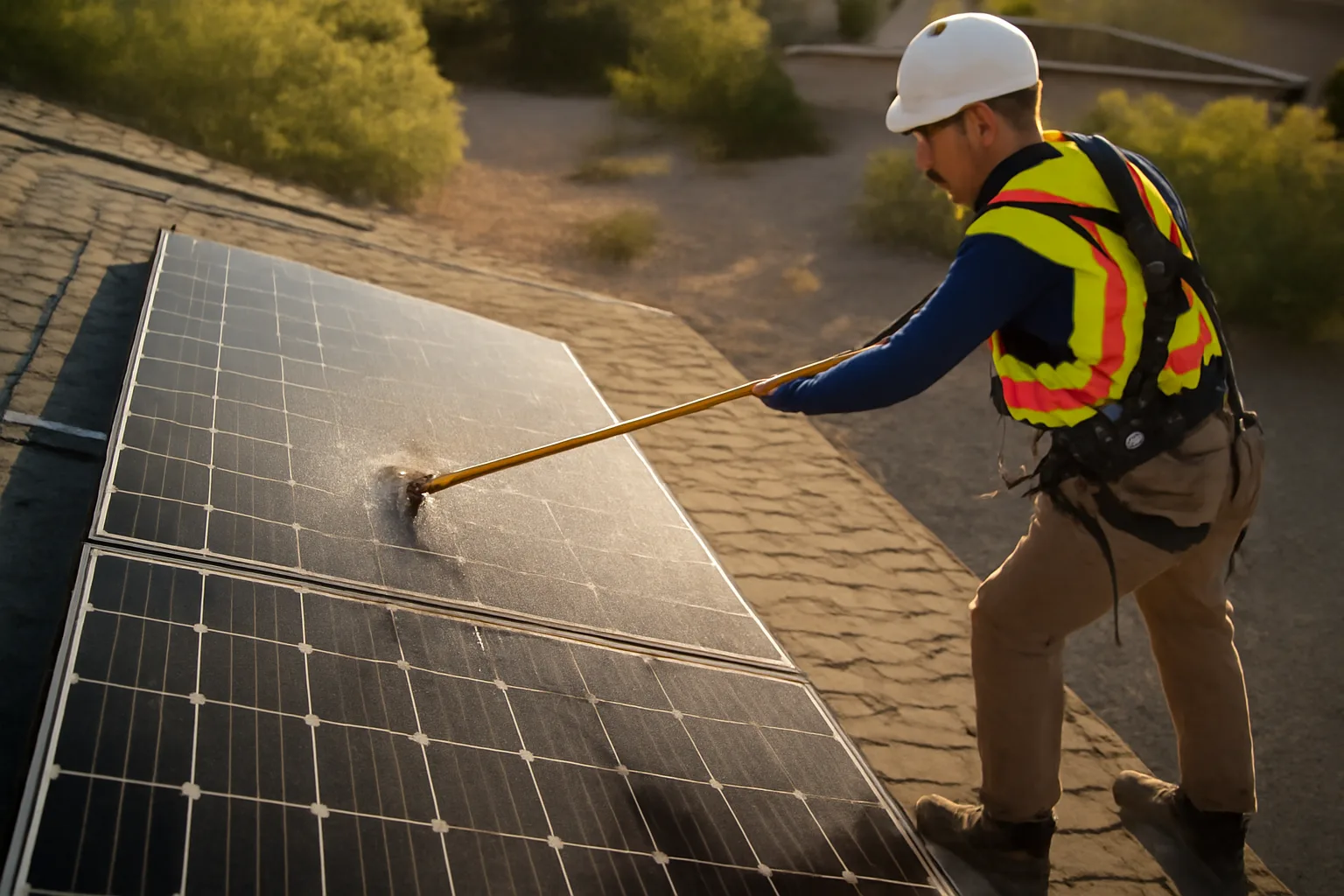
You can handle a lot of residential work from the ground with a water-fed pole. Second-story eaves and steep pitches put feet on shingles. Then it is roof work with fall rules, not a driveway hobby. Walking on the glass is how cells crack. Frames and designated walk points only, and only if the racking was built to hold a person.
People mix this trade with window cleaning, pressure washing, and solar installation. Window technique carries over. Pressure washing habits do not. Installation licensing may or may not apply, which is a board question, not a branding question. Keep the scope boring: wet the glass, lift the soil, leave the electrical parts closed.
How much power do dirty solar panels lose?
Dirty glass cuts kilowatt-hours, and the honest answer is that it depends on soil, tilt, rain, and how long the array sat. A default model is not your customer's roof.
NREL's PVWatts Version 5 Manual sets the default soiling loss at 2%. [1] That figure is a modeling input used when nobody enters a better local number. It is not a field test of a dusty farm road in August.
A 2019 Joule paper by Ilse and coauthors estimated soiling cut global solar power production by at least 3% to 4% in 2018. [2] That is a planet-wide estimate, not a promise you should print on a door hanger. I would never tell a homeowner their bill drops 4% after one rinse. Show monitoring. Show photos. Then wash, if the glass is actually dirty.
PVWatts also books other losses that people blame on dirt by mistake. Shading defaults at 3%. Snow defaults at 0% unless you change it. Mismatch, wiring, and availability sit in the same table. Cleaning does not fix a tree, a tripped inverter, or a failed optimizer.
Bird droppings and heavy agricultural dust are the cases where a wash is obvious without a spreadsheet. A thin even film in a rainy county may not pay for the truck roll. Nobody has a national soiling tariff that tells you what to charge. The closest public planning number most estimators keep bumping into is that 2% PVWatts default. [1] Dry counties run higher. Confirm with the array's own production, not a brochure.
How do you start solar panel cleaning?
You start on paper, not on a roof. Form the entity if you want that liability wall, get an EIN from IRS when you need one, and register where your state and city tell you to. [7][8] Buy insurance before the first ladder. Then ask the contractor board whether wash work is licensed work in your state. Equipment comes after that stack, not before it.
That is the order I would actually use. A carbon pole does not make an illegal bid legal. IRS runs a free online EIN application for responsible parties. [7] SBA's register-your-business page is a plain map of the usual pile: entity, tax IDs, licenses, and local permits. [8] None of it is solar-specific. It is the same stack a window cleaner hits.
Write the method into the work order. Deionized water. No pressure wand on modules. No walking on glass. Photos before you wet anything. Gate codes, dogs, and who is home belong in the same notes. If a property manager wants a certificate of insurance, you get that from the carrier, not from a state board.
I would not wrap a van in month one. A tank, a pump, a pole, fall gear, and a written contract beat a lease payment you cannot feed. If you hire, payroll tax and workers' compensation show up the same day. If a helper is not an employee, put it in writing and expect someone to argue about it later. Misclassification fights cost more than stained glass.
License shopping before you know whether your board even cares is money down a drain. Confirm with the board. Then spend.
Do you need a license to clean solar panels?
Maybe. It is a state and city question. There is no national solar-wash card, and people who talk like there is are selling a course.
California is the example everyone quotes, and even there you confirm with CSLB rather than a blog. Business and Professions Code 7026 defines who is a contractor. [14] BPC 7028 is the unlicensed contracting statute. [9] BPC 7048 is the small-job exemption, and legislatures edit dollar thresholds. [10] Confirm the current number and the classification with the board. Do not tattoo an old $500 story on your invoice.
Some states treat exterior washing as unlicensed janitorial work as long as you don't touch electrical parts or racking. Some cities still want a business tax receipt. Public and HOA sites may demand a license number even when the state board would not. If the bid form has a license blank, fill it with a real number or walk away.
I would not buy a general contractor exam school until the board says this work sits in a named classification. That school is a common way to light money on fire. If the board says you need a limited specialty or a cleaning classification, take that path. If they say no, get the city license and move.
Never invent a processing time or a quota. Boards change packets. Call them. Screenshot the page. Keep the PDF with the job file.
What equipment does solar panel cleaning actually take?
You need clean water, a way to put it on the glass, and a way not to fall. Most residential work does not need a trailer skid in month one.
Deionized or RO water is the usual spot-free method. A water-fed pole with a soft brush reaches many one-story arrays from the ground. On roofs you want a harness that fits, a real anchor plan, and shoes that do not chew shingles. NREL's PV O&M best practices handbook treats cleaning as part of operations, not as a stunt. [5] Read a document like that before you invent a method.
Skip the close-range pressure washer. Module packets do not read like a driveway flyer. High pressure near junction boxes and frame seals is how you buy a claim. Soap is a maybe only if the maker said so.
Tank, pump, hose, DI resin, spare brushes, cones, and a plan for backflow at the hose bib. Well water with high TDS will eat resin fast. Budget resin by a TDS meter, not by hope. I would not finance a trailer-mounted RO skid until weekly commercial yards are actually on the calendar.
If you want parts bundled instead of shopping them one by one, SolarWashPath sells a $149 one-time DI Water + Roof-Safety Kit. Piecing it out works too. Water quality and fall gear matter more than the shopping cart you used.
Cheap impulse-aisle harnesses are a waste with a body attached. If you cannot name the standard on the label, don't clip it to a roof.
How do you clean solar panels without damaging them?
Work top down so dirty water does not dry on a panel you just rinsed. Keep the brush moving. Stay off the glass. Use deionized or RO water unless the manufacturer wrote a different method. Photograph damage and stop if you see cracked cells, lifted frames, or chewed connectors.
Daylight modules are energized. OSHA 1910.333(a)(1) says: "Live parts to which an employee may be exposed shall be deenergized before the employee works on or near them, unless the employer can demonstrate that deenergizing introduces additional or increased hazards or is infeasible due to equipment design or operational limitations." [4] A PV array in sun is the textbook infeasible case. You still treat every cable as live. You do not open combiner boxes to "be safe" on a rinse.
Metal poles near damaged wiring turn a wash into an incident. Look first. Do not yank MC4s. Do not lean a wet pole into a service drop.
Manufacturer manuals beat generic advice. If the packet says deionized water and a soft brush, that is the method. If it forbids abrasive pads, the green scouring pad stays on the truck.
Ground-mounts are kinder. Roofs are not. On a roof your feet belong on decking or designated walk points, never on the laminate. If a customer asks you to hop across modules to save time, you say no. Time is cheaper than a broken cell string.
What fall protection rules apply on solar roofs?
If your feet leave the ground, construction fall rules are the ones people will quote after a drop. OSHA 1926.501(b)(1) requires fall protection at 6 feet on construction walking/working surfaces with an unprotected side or edge. [3]
The text is blunt. 29 CFR 1926.501(b)(1) says: "Each employee on a walking/working surface (horizontal and vertical surface) with an unprotected side or edge which is 6 feet (1.8 m) or more above a lower level shall be protected from falling by the use of guardrail systems, safety net systems, or personal fall arrest systems." [3] Residential solar jobs almost never have a guardrail. That leaves a harness system and an anchor that can actually hold, not a rope around a vent pipe.
Ladders sit in 1926.1053. Side rails need to extend at least 3 feet above the upper landing when you use a portable ladder for access. [6] Set the angle. Tie it off when you should. OSHA's residential construction fall publication (OSHA 3625) is the readable version of the same idea. [13] General industry walking-working surfaces at 1910.28 can apply when the work is framed as maintenance. [12] I am not your lawyer. The practical habit: 6 feet is the construction trigger most roof work gets measured against, and you still need a system that holds.
I would not write a "low pitch, no harness" policy because a pitch looks friendly. Gravity does not grade on a curve. Train the helper before the helper climbs. If you cannot name the anchor, you are not ready to step off the ladder.
How often should solar panels be cleaned?
It depends on soil and rain. There is no universal calendar that fits Maine and a dry canal road in the same sentence.
Wet climates with regular rain may need a wash once a year, or when monitoring dips after you account for weather. Arid sites, pollen belts, and farms may want seasonal washes. Bird problems are local. A default 2% soiling number from PVWatts is a planning aid, not a route schedule. [1]
Use production data. If the array tracks a couple percent under its clean baseline after weather and clipping, a wash is a conversation. If output is down hard and the glass is brown, schedule it. The Joule global estimate of at least 3% to 4% production loss in 2018 is not your drive time. [2]
I would not sell monthly residential washes as a default. It is usually overkill, and it trains people to ignore you when you later tell the truth. Commercial yards next to dirt roads are a different product. Price the soil you can see, not a slogan.
NREL's O&M handbook is a better frame than a seasonal postcard: cleaning is maintenance you do when soiling costs more than the truck roll. [5] That math is local. Nobody has good public data for every ZIP code. The closest study still sitting in plain view is that Joule global estimate, and it is not a work order.
What first-year paper does a solar wash business need?
First-year paper is the job. Entity documents, an EIN letter if you got one, the local business license, a contractor card if the board says you need it, insurance certificates, written contracts, photo logs, invoices, and a mileage log. [7][8] None of that is glamorous. All of it shows up the first time a property manager or a tax letter asks.
Sales tax on services is a state revenue question. Some states tax the wash. Some don't. Confirm with that department. W-9s if you subcontract. 1099s if you pay them. If you have employees, payroll withholding is not optional.
Write exclusions in the same document as the scope. Rinse modules with deionized water. No interior work. No electrical repair. Customer supplies site water unless noted. Do not promise a kWh boost on paper. Promise a clean surface. Let monitoring speak. Energy-savings claims are how advertising trouble enters a wash ticket.
Site photos before and after matter more than a charming thank-you text. If a shingle tears, you want the timestamped before shot.
| Paper item | Confirm with | What it is for |
|---|---|---|
| Entity or DBA | State SOS or county clerk | Contracts and banking |
| EIN | IRS | Tax and payroll [7] |
| Contractor license | State contractor board | Bid legality if they say this is contracting [9][10][14] |
| Local business license | City or county | Separate from a state contractor card [8] |
| Insurance certificate | Your carrier | Site access, not a government license |
Fees and forms change. Confirm with the office that issues the paper. For the insurance certificates that property desks actually request, see general liability questions and certificate and additional insured requests.
What insurance do solar panel cleaners need?
You carry general liability because you are on other people's roofs with water. You carry commercial auto because a personal policy will fight a claim that happened between jobs. You look at inland marine for the pole and pump. Employees trigger workers' compensation in most states. Solo operators still ask an agent about occupational accident coverage rather than pretending risk vanished.
I am not quoting premiums. They move by state, roof admissions, and claims history. Confirm with a licensed commercial agent who has written window or solar wash accounts. Never treat a forum number as a binder.
Certificates and additional insured endorsements are normal the first time an HOA office picks up the phone. Read the extra wording before you say yes. A leak claim is a water claim until someone proves it is not. Keep roof work exclusions and what a leak claim looks like in your reading pile before you write a cute "fully insured" line on a postcard.
If you hire, workers compensation questions stop being theoretical. If you drive a tank of water, commercial auto for wash work is the policy that matches the van. Job-site hold harmless language shows up in property-manager packets. None of those pages replace an agent. They stop you from walking into a meeting blank.
What first-year mistakes waste money?
Buying a pressure washer "just in case" for modules. Walking on glass. Skipping fall gear on a small house because the pitch looks friendly. Quoting a 20% production bump. Ignoring the contractor board. Pumping well water with no DI. Paying a helper as a 1099 because it felt easier.
Wrap jobs, franchise pitch decks, and exam schools for a license class you do not need are the other money fires. A cheap harness from the impulse aisle is not a savings. Underbidding a commercial yard to "get the logo" is how you work nights for free and still owe a COI.
I would keep year-one capex small. Nobody publishes a clean national average for a solar panel cleaning startup, and viral "under $500" threads are entertainment. Your number is the state filing fee (confirm with SOS), the insurance down payment (quote it), water gear, poles, fall kit, tank, fuel, and enough cash to fix a scuffed roof.
Do not invent a first-year revenue target either. Route density, gate time, and whether you can work from the ground decide the day more than a motivational spreadsheet. If commercial work shows up, then you can talk RO skids. Not before.
Should you DIY solar panel cleaning or hire it out?
Homeowners can rinse many ground-mounts and some first-story arrays with a hose and a soft brush. Hard water will spot. Two-story steep roofs are how DIY becomes an ER visit. Hire that. OSHA's 6-foot construction trigger is written for employers, but the drop is the same height for a homeowner. [3]
DIY should still skip pressure washers and dish soap. Same glass. Same coatings. If the array is under warranty, read the packet before you invent a method.
| Situation | DIY from the ground | Paid crew |
|---|---|---|
| One-story, low pitch, hose access | Reasonable | Optional |
| Two-story or steep roof | Poor idea | That is the job |
| Deionized, spot-free finish | Only if you buy or rent DI | Standard method |
| Warranty-sensitive commercial site | Usually not | Written method and COI |
If you are the operator, price the roof work like roof work. If you want a bundled deionized and fall-gear start instead of shopping parts, the kit path is at /start. SolarWashPath is an independent publisher, not a law firm and not a service company. Confirm licenses and insurance with the board and the carrier. No one can honestly guarantee approval or a processing time.
Frequently asked questions
What is solar panel cleaning?
Solar panel cleaning is washing PV glass so dust, pollen, soot, mineral film, and bird droppings don't block light. It is maintenance, not installation. The usual method is deionized or RO water and a soft brush, with no walking on modules. Rain helps in wet climates and still leaves film after dry spells.
How do you start solar panel cleaning?
Start with entity paper, an EIN if you need one, local registration, and insurance, then ask the contractor board whether wash work is licensed in your state. Equipment comes after that. IRS hosts a free EIN application. SBA maps the usual registration stack. Confirm every fee with the office that issues it.
Can I use a pressure washer on solar panels?
I wouldn't, not at close range. High pressure near frames, gaskets, and junction boxes is how seals lift and glass etches. Module care sheets point to soft brushes and clean water. A surface cleaner that makes sense on concrete does not belong on a laminate. If a manufacturer packet clearly allows a pressure limit, follow that packet, not a driveway habit.
Do I need deionized water?
For a spot-free finish, yes, or reverse osmosis. Hard well water leaves mineral dots that become new soil magnets. Some rural jobs can rinse with site water and accept spotting, but that is a written customer choice, not a default. Resin life tracks TDS. Measure it. Don't guess.
Do I need a contractor license?
Only if your state board and city say the work is contracting. California's BPC 7026, 7028, and 7048 are the statutes people cite there, including a small-job exemption whose dollar figure gets edited. Confirm classification and the current threshold with CSLB or your own board. Never treat a national myth as a license.
At what height does OSHA want fall protection?
For construction walking/working surfaces with an unprotected side or edge, 29 CFR 1926.501(b)(1) sets the trigger at 6 feet. Guardrails, nets, or personal fall arrest. Ladders used for access need side rails at least 3 feet above the landing under 1926.1053. Maintenance work can also pull in 1910.28. I am not your lawyer. Use a real anchor plan.
Will cleaning void a module warranty?
Abrasive pads, harsh chemicals, walking on glass, and close-range pressure are the usual ways people get into warranty fights. Soft water and a soft brush match most care sheets. Read the packet for that brand. Photograph existing cracks before you wet the array so you are not blamed for old damage.
Should the system be shut off before washing?
Modules still make voltage in daylight even if a house inverter is off. OSHA 1910.333 wants live parts deenergized unless that is infeasible. Sunlit PV is the classic infeasible case. Treat cables as live, leave boxes closed, and don't tug connectors. Follow the site owner's lockout rules on commercial yards.
How often should residential panels be cleaned?
When they are dirty enough that monitoring or a photo justifies the truck roll. Rainy counties may sit near a yearly rinse. Dusty farms and pollen belts may want seasonal work. NREL's PVWatts default soiling loss is 2%, which is a model input, not a monthly contract. Monthly residential washes are usually a waste.
Can I clean solar panels from the ground?
Often, on one-story low-pitch arrays, with a water-fed pole. Second-story eaves and steep pitches put you on the roof, which means fall gear. Ground-mounts are the easy version of this trade. If you cannot reach the top row without standing on glass, you don't have the right tool yet.
Do I need workers compensation if I work alone?
Employees trigger workers' compensation in most states. A true solo operator may not have a policy requirement, but hospital bills don't care. Ask a licensed agent about occupational accident coverage rather than copying a forum. If you hire a "helper" as a 1099, expect a misclassification fight after an injury.
Is rain enough to clean solar panels?
Not reliably. Rain knocks off loose grit and still leaves silt, pollen film, salt, and droppings. PVWatts still books a 2% default soiling loss even when users don't enter a custom number. Dry stretches make it obvious. If monitoring is flat and the glass looks clean, don't wash just to wash.
Sources
- Ilse et al., Joule (2019), soiling techno-economic assessment: Estimated soiling reduced global solar power production by at least 3% to 4% in 2018.
- OSHA 29 CFR 1926.501 Fall protection: Construction employees on walking/working surfaces with an unprotected side or edge 6 feet or more above a lower level must be protected by guardrails, safety nets, or personal fall arrest.
- OSHA 29 CFR 1910.333 Selection and use of work practices: Live parts shall be deenergized before work on or near them unless deenergizing is infeasible or creates additional hazards.
- OSHA 29 CFR 1926.1053 Ladders: Portable ladders used for access to an upper landing must have side rails extending at least 3 feet above that landing.
- IRS, Apply for an Employer Identification Number (EIN) online: IRS provides an online EIN application for business responsible parties.
- U.S. Small Business Administration, Register your business: SBA outlines registering an entity, tax IDs, licenses, and local permits when launching a business.
- California Business and Professions Code § 7028: California statute addressing contracting without the required license.
- California Business and Professions Code § 7048: California small-job exemption from contractor licensing; dollar threshold must be confirmed with CSLB.
- OSHA 29 CFR 1910.28 Duty to have fall protection and falling object protection: General industry walking-working surfaces rule that can apply when work is framed as maintenance rather than construction.
- OSHA Publication 3625, Fall Protection in Residential Construction: OSHA guidance on fall protection methods used in residential construction roof work.
- California Business and Professions Code § 7026: California statutory definition of contractor used to decide whether a trade needs a CSLB license.