Last updated 2026-08-21
TL;DR
Solar panel cleaning is washing photovoltaic modules so dirt and film stop blocking sunlight. You start with entity papers, a free IRS EIN, insurance, and a safety plan, then deionized water and fall gear. OSHA general industry fall protection starts at 4 feet. Licensing is state-specific. Confirm classes and fees with your board. Skip national myths.
What is solar panel cleaning?
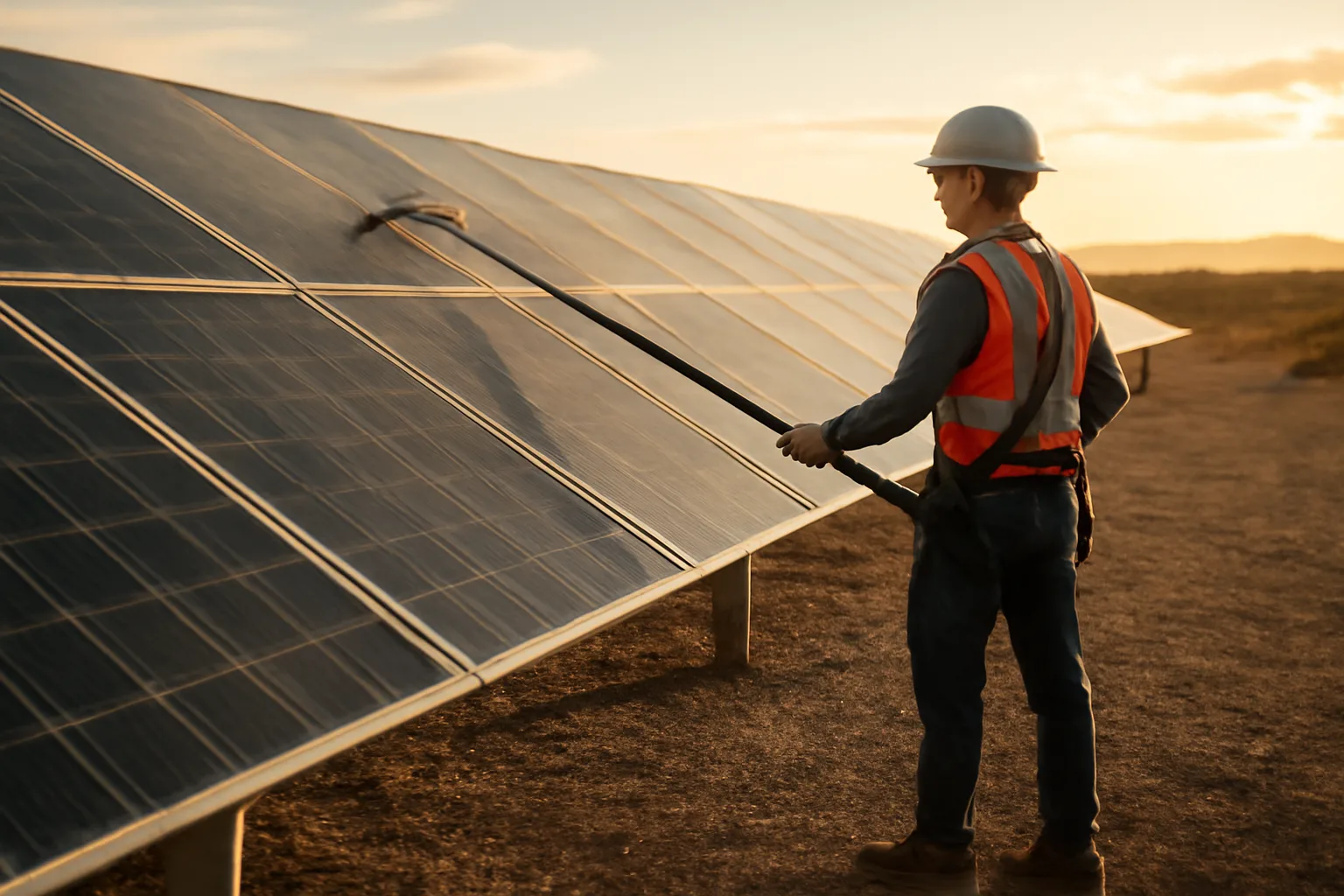
Solar panel cleaning is removing dust, pollen, bird droppings, soot, and mineral film from photovoltaic modules so more sunlight hits the cells. That is the whole job. You are not repairing inverters, and you are not a solar installer.
Dirt sits on glass and scatters light. A 2016 review in Renewable and Sustainable Energy Reviews collected study after study of soiling losses on PV. Reported losses swing with climate and how long the dirt sits, which is why a single national wash calendar is a bad plan [11]. The U.S. Energy Information Administration puts the conversion plainly: photovoltaic cells turn sunlight into electricity [10]. Block the sun, you cut the watts. Energy.gov walks the same photon-to-electron path [4].
Most residential arrays still get rain. In a wet climate, rain does a lot of the work and a paid wash is occasional. In a dry, agricultural, or high-pollen belt, film builds for months. Bird droppings are a different mess. They shade small cells hard. I still would not promise a customer a magic production bump. Output also depends on tilt, trees, inverter clipping, and weather. Cleaning fixes dirt you can see and film you can compare on a dirty-versus-rinsed test.
The work looks simple from the driveway. It is washing glass on a live electrical system, often on a sloped roof, often in heat. That mix is why the paper path and the fall gear matter more than a logo on a tank.
Methods split fast. Water-fed pole from the ground or the eave. Soft brush on an extension. Rinse of ground-mount rows. I would stay off the glass. I would not start with a pressure washer. Module makers differ on pressure, and I have not seen a federal rule that blesses high pressure on PV glass.
Who hires this? Homeowners with visible gunk, HOAs, farms with ground mounts, and some O&M shops that subcontract wash days. Commercial rooftops often mean extra insurance, site training, and a GC who wants a certificate of insurance with additional-insured language. Price and paper change with that.
How do you start solar panel cleaning?
You start on paper, not on a roof. Form the business your state allows (sole prop or LLC), get a free EIN from the IRS, buy insurance, write a simple safety plan, then buy water gear and fall gear. Licensing is local. Confirm the class with the board that actually issues it. Do not copy a national checklist and call it done.
The IRS gives you an EIN online at no charge. The agency says, "Applying for an EIN is a free service offered by the Internal Revenue Service. Beware of websites on the Internet that charge for this free service." [5] Publication 334 is the tax guide I would actually read for a sole proprietor filing Schedule C [12].
Then the city or county business tax certificate. Then, if you hire anyone, workers' compensation through your state system. I cannot quote your premium. Carriers price roof work like other height trades, and the number moves. Confirm it with a licensed agent who has written this class before.
Safety is not a poster. OSHA's general industry fall rule is the one most window-style washers get pointed to: protect employees on walking-working surfaces with an unprotected edge 4 feet or more above a lower level [1]. Construction sites use a 6-foot trigger [2]. Your jobs may look like neither on paper. I would still run a 4-foot brain. Ladders have their own OSHA text [9].
Equipment comes after you can legally invoice. Deionized or very low-TDS water, a water-fed pole, PV-safe brushes, a TDS meter, hose-run discipline, and rated fall gear if you leave the ground. Skip a $15,000 trailer in month one. Skip wrapping a van before you have repeat customers.
Pick a lane. Ground-mount agricultural arrays teach water flow and row pacing without a ridge cap. Low-slope residential is the next step. Steep tile and three-story Victorians are a dumb first month. Read a state path before you print door hangers. California is a different animal from Alabama. Start with how to start solar panel cleaning in California or how to start solar panel cleaning in Arizona if that is your market, and confirm every form with the board, not with a blog.
Do you need a license for solar panel cleaning?
Sometimes yes, sometimes no. The honest answer is the state board's answer, not a national myth. Cleaning is not automatically a solar contractor class. It is also not automatically "just janitorial" because the array sits on a roof. Call the contractor board and the city business desk. Ask about your exact work: rinse only, roof access, commercial height, employees or solo.
California is the example people copy badly. California Business and Professions Code section 7048 sets a $500 aggregate contract price cutoff for a limited contractor-license exemption [6]. That cutoff is not a free pass on a $2,000 HOA contract. The exemption has other conditions, including how you advertise. Confirm the current statute and CSLB class list before you bid. If California is home base, read solar panel cleaning license in California and then still call CSLB.
Other states split. Some want a contractor license once you cross a dollar threshold or once you work on structures. Some want only a local business license for mobile wash work. Some want pesticide or water-discharge paper if you add chemicals. I would not sell "certified solar washer" as if it were a state license. Private certificates are marketing. They do not bind a board.
| Paper | Who issues it | What I'd actually do |
|---|---|---|
| EIN | IRS | File it free on IRS.gov [5] |
| Contractor license | State board | Confirm class. Do not guess from a national list |
| CA small-job cutoff | Cal. BPC §7048 | $500 aggregate, with conditions [6] |
| City business tax | City or county | Pull the form before the first invoice |
| Workers' compensation | State system or carrier | Required once you have employees in most states |
Arizona and Colorado have their own contractor maps. If you work those markets, use solar panel cleaning license in Arizona and solar panel cleaning license in Colorado as a reading list, then confirm with the board. Never treat a processing time you saw on a forum as real.
What OSHA rules apply when you clean panels on a roof?
Leave the ground and fall protection becomes the first rule, not a nice extra. OSHA requires fall protection at 4 feet for general industry walking-working surfaces under 29 CFR 1910.28 [1]. The text is blunt: "The employer must ensure that each employee on a walking-working surface with an unprotected side or edge that is 4 feet (1.2 m) or more above a lower level is protected from falling by one or more of the following:" [1]. Construction work uses a 6-foot trigger in 29 CFR 1926.501 [2]. Your lawyer and your carrier will argue which part applies. Gravity will not.
I would buy a rated harness, lanyard, and anchor plan before a fancy cart. Learn how to inspect webbing. Learn what you can actually tie off to. A vent pipe is not an anchor. Neither is a PV rail unless the maker says it is, in writing, for that load.
Ladders wreck people in this kind of work. OSHA's construction ladder rule in 29 CFR 1926.1053 covers setup, use, and access [9]. NIOSH's ladder-fall publication is the short, ugly version of why three-point contact is not a slogan [14]. Extend the ladder past the eave. Tie it off. Do not carry a pole and a hose and a phone on the same trip.
Heat is the quiet killer on dark roofs. California's outdoor heat rule (8 CCR 3395) requires shade when the temperature goes above 80 degrees Fahrenheit, plus water and rest planning [8]. That is a California employer duty. Federal OSHA still runs a heat campaign and can cite under the general duty clause. I would run water, shade, and a stop-work temperature even if your state has not copied 3395.
No employees? OSHA's employee rules may not fit the same way. You can still fall. Your homeowner customer can still sue. Write a one-page plan: ladder, tie-off, heat, weather, who calls 911. Keep it in the truck.
Why does deionized water show up in every serious kit list?
Because tap water leaves spots. Those spots are minerals. USGS explains hardness as dissolved calcium and magnesium, and it bins water as soft up to 60 mg/L, moderately hard to 120, hard to 180, and very hard above 180 (as CaCO3) [7]. Hard water dries on hot glass and etches a film that looks like you never came.
Deionized (DI) or mixed-bed resin water is the boring fix. You run tap water through resin, watch TDS on a meter, and rinse. I would not chase laboratory Type I water. I would chase a rinse that dries without crust. A cheap TDS meter tells you when the resin is dead. Guessing is how you stain a $20,000 array.
Soap is optional and usually a waste on routine dust. Soap also turns into runoff you may not be allowed to send to a storm drain. I would not start a residential route on dish detergent. If a farm array has compacted clay, test a small row with water only first.
Rain is free DI in some climates (low mineral, frequent storms). The desert is not that climate. Neither is a house under pine pollen for eight weeks. Match the water to the film, not to a YouTube tank build.
What equipment is worth buying in year one?
A water-fed pole, DI resin or an RODI setup you can actually maintain, PV-safe brushes, a TDS meter, garden hoses that do not kink into live combiners, and fall gear if you leave the ground. That is the list. Everything else is theater until you have a book of repeat roofs.
I would not buy a pressure washer to "start cheap." High pressure can drive water into junction boxes and lift seals. It also teaches a bad motion (attack the glass). Soft brush and low-pressure DI rinse are the boring method that matches how modules are built.
Roof-safety gear is not a costume. If the eave is over 4 feet, plan protection [1]. If you cannot name the anchor, you are not ready for that roof. Ground-mount farms let you learn water and pacing with boots on soil. Start there if you can.
If you want a bundled starter, SolarWashPath lists a $149 one-time DI Water + Roof-Safety Kit. You can also piece out a pole, resin, meter, and harness from industrial suppliers. I would not treat any kit as a license, an insurance policy, or a fall plan.
Skip wrap, skip drones, skip a custom app. A phone camera for before-and-after, a written contract, and invoices that match your entity name will get you paid. NREL's PV O&M best-practices guide (3rd edition) treats washing as ordinary plant upkeep set by site conditions, not by gadget count [3].
How often should solar panels be cleaned?
As often as soiling costs more than the wash, and not on a national calendar. Rainy coastal arrays may need a look once or twice a year. Dusty agricultural rows may need a seasonal rinse. Pollen weeks can justify a one-off. Bird problems are local.
Nobody has a clean, current national dataset that says "every 90 days" for every U.S. rooftop. The 2016 soiling review makes that variance obvious: climate and duration dominate [11]. NREL's O&M best-practices text tells plant operators to set cleaning from site soiling, not from a slogan [3]. I would do the same on houses. Ask for a production screenshot. Look at the glass at a low sun angle. Wash a test section if the customer allows it.
Overwashing wastes water and labor. Underwashing on a filthy farm array leaves money on the table. My bias: sell an inspection with a wash option, not a locked 12-visit contract, until you know that roof's dirt cycle.
Snow is not dirt. Do not chip ice off glass. Wait.
What paper do you file before the first paid job?
Entity, EIN, local business tax, insurance certificates, a written contract, and a W-9 if a commercial customer asks. That packet beats a logo. The IRS EIN application is free on the agency's own page [5]. For how the Schedule C year actually works, IRS Publication 334 is the small-business tax guide to read, and you confirm state tax IDs with your state, not with me [12].
Insurance: general liability at a limit the customer will accept (many commercial sites want $1 million per occurrence on the certificate, but I will not pretend that is a law). If you have employees, workers' compensation is usually not optional. Auto policy must match how you haul water. A personal auto policy often excludes business use. Confirm with the carrier. I have no honest public average premium for this trade in 2026.
Contracts: scope (rinse, no electrical work), access, water source, what happens if a tile breaks, weather cancel, payment. Do not claim you will raise production by a made-up percent.
If the job is construction-adjacent or over your state's dollar threshold, the contractor license question comes back. Confirm with the board. California's $500 figure is a statute cutoff with conditions, not a national rule [6].
Keep SDS sheets only if you actually bring chemicals. Water-only work still needs a runoff plan on some sites.
How should you handle electricity, walking on glass, and runoff?
Treat every array as energized in daylight. OSHA's electrical safety-related work practices in 29 CFR 1910.333 exist to keep people from contacting live parts [13]. Cleaning is not troubleshooting. You should not open combiner boxes, land conductors, or "check" a microinverter. If a string is dead, you wash around it and tell the owner to call their electrician.
Stay off the glass. Crystalline modules crack. Walkways on some large commercial roofs are designed for feet. Most residential rails are not. A water-fed pole from the ground or eave keeps you off the laminate. If the only way to rinse is to walk the array, I would decline the job or bring a method that stays on designated paths.
Runoff: dirty water with soap is a stormwater problem on many lots. Even plain water can sheet into a neighbor's wall. Know where the downspout goes. I would not dump a tank into a storm grate as a habit. Site rules win. Farm ground mounts are easier: water hits soil that already sees irrigation, but chemical additives still need a second thought.
Lockout is for people doing electrical servicing. A rinse tech who starts pulling disconnects is doing someone else's trade. Don't.
How do you price solar panel cleaning without a fake national rate?
Price the roof, the height, the water haul, the drive, and the risk. Do not price a national average. I do not have a clean public dataset for residential solar wash rates in 2026. Facebook groups lie in both directions. Anyone quoting one number for the whole country is selling a course.
Build from time. Ground-mount rows are minutes per rack once the hose is live. A two-story tile roof with no tie-off points is a different day. Charge more when you must haul DI because the hose bib is dead. Charge more for bird gunk than for light dust. Charge trip fees for one-off rural sites.
Commercial work often wants prevailing wage, badging, night work, or a GC markup. That is not a 10% bump. It is a different bid.
I would not undercut window cleaners by half just to "get solar clients." Height plus electricity plus glass warranties is not easier than windows. If a bid only works by skipping fall gear, it is not a bid.
Put the scope in writing. Rinse only. No panel removal. No inverter resets. Change orders when the customer points to a second array over the garage.
Where do state startup paths actually differ?
They differ on contractor class, dollar thresholds, city tax certificates, water-discharge rules, and heat rules. They do not differ on gravity. OSHA's 4-foot general industry fall number still sits in federal code wherever you drive [1]. California adds a written outdoor heat standard at 80°F [8]. Other states may not. You still heat-stroke the same way in Arizona in June.
Read the state guide that matches the plates on the truck. How to start solar panel cleaning in Colorado is not interchangeable with how to start solar panel cleaning in Alabama or how to start solar panel cleaning in Connecticut. License essays for those states live next to the startup pieces, including solar panel cleaning license in California.
Confirm fees, class names, and whether cleaning even sits in the contractor law with the board that issues the card. I will not invent a current fee, a quota, or a processing time. Boards change those. Forums lag.
A paper path checklist lives at /start from SolarWashPath, an independent publisher, not a law firm and not a service company. Use it as a reading order. Then call the board.
Frequently asked questions
What is solar panel cleaning?
It is washing photovoltaic modules to remove dust, pollen, droppings, and mineral film so more sunlight reaches the cells. It is not electrical repair or solar installation. Rain does some of this in wet climates. Paid cleaning matters more where dirt sits for months. Stay off the glass and keep chemicals off the job unless a site actually needs them.
How do you start solar panel cleaning?
File entity papers, get a free IRS EIN, get a local business certificate, buy insurance, write a safety plan, then buy DI water gear and fall protection. Confirm any contractor license with your state board. Start on ground mounts or low roofs. Do not treat a national blog as a permit. Confirm fees and classes with the board that issues them.
Do I need a contractor license to clean solar panels?
It depends on the state, the dollar amount, and whether the board treats roof work as contracting. California's BPC 7048 has a $500 aggregate cutoff with conditions. That is not a national rule. Call the contractor board and the city desk with your exact scope. Private "solar washer" certificates are not a substitute for a license the board actually issues.
Is an EIN free?
Yes, if you apply on IRS.gov. The IRS states that applying for an EIN is a free service and warns about sites that charge for it. You still need state tax accounts where your state requires them. Publication 334 is the small-business tax guide most sole proprietors should actually read before tax season.
Can I use a pressure washer on solar panels?
I would not start that way. High pressure can drive water into junction boxes and lift seals, and many module makers restrict it. Soft brushing and a deionized rinse match how the glass is built. If a manufacturer manual for that exact module allows a pressure cap, follow that document, not a generic video.
Do I need deionized water?
If your tap water is hard, yes, if you care about spots. USGS bins hardness from soft (up to 60 mg/L) through very hard (over 180 mg/L as CaCO3). Minerals dry on hot glass and leave film. A TDS meter tells you when resin is spent. Rainy, low-mineral regions can sometimes rinse with less fuss. Test a corner first.
How often should solar panels be cleaned?
When soiling costs more than the wash. There is no honest national interval. Wet climates may need a look once or twice a year. Dusty or agricultural sites may need seasonal rinses. Use the glass, the production app, and a test rinse. NREL's O&M guidance tells plant operators to set frequency from site conditions, which is the right idea on houses too.
What fall height triggers OSHA on this work?
OSHA's general industry walking-working surface rule requires fall protection at 4 feet. Construction fall protection in 1926.501 uses 6 feet. Roof washing can get argued either way. I would plan for 4 feet. Ladders have separate OSHA rules. A personal policy does not replace a harness and an anchor you can name.
Can I walk on the solar panels?
I would not. Crystalline glass cracks, and most residential racking is not a walkway. Use a water-fed pole from the ground or eave. Some large commercial roofs have designated paths. If the only method is walking the laminate, decline or change the method. Cleaning is not worth a broken module and a broken wrist.
Do I need workers' compensation for solar panel cleaning?
If you have employees, usually yes, under your state's workers' compensation law. Sole proprietors sometimes can opt in or out, and that choice is state-specific. Confirm with the state agency and your agent. Roof work is priced like other height trades. I will not invent your premium. Get the certificate before a commercial site asks for it.
Will soap void a solar panel warranty?
It can, if the maker forbids detergents or abrasives. Many residential jobs need water only. Soap also becomes runoff. Read the module manual for that brand, not a generic forum thread. If you cannot get the manual, default to DI water and a PV-safe brush, and put "water only" in the contract so the scope is clear.
How much should I charge to clean solar panels?
There is no trustworthy national rate for 2026 that I can cite. Price time, height, water haul, drive, and bird mess separately. Ground-mount rows and steep tile roofs are not the same bid. Commercial sites may want extra insurance and badging. If a price only works by skipping fall gear, it is not a real price. Put scope in writing.
Is a ground-mount array easier for a first job than a roof?
Yes. You learn water flow, TDS, and pacing with boots on soil. You still have live electricity and row spacing to respect. You skip the 4-foot fall problem if you never leave the ground. I would take farm rows before a three-story Victorian. Steep tile can wait until your ladder and tie-off habits are boring and automatic.
Do I need a special solar cleaning certification?
No state I would trust treats a private solar-washing certificate as the license. Boards issue contractor licenses, cities issue business tax certificates, and OSHA sets safety duties. A course can teach pole technique. It does not bind CSLB or your city hall. Spend the money on fall gear, DI resin, and a call to the board before you spend it on a plaque.
Sources
- OSHA 29 CFR 1910.28 Duty to have fall protection: General industry employers must protect employees on walking-working surfaces with an unprotected edge 4 feet (1.2 m) or more above a lower level from falling.
- OSHA 29 CFR 1926.501 Duty to have fall protection: Construction fall protection is required at 6 feet for unprotected sides and edges.
- U.S. Department of Energy, How Does Solar Work?: Photovoltaic systems convert sunlight into electricity, so anything blocking the glass reduces the light available to the cells.
- IRS, Apply for an Employer Identification Number (EIN) Online: Applying for an EIN is a free service offered by the Internal Revenue Service.
- California Business and Professions Code §7048: California's contractor licensing chapter has a limited exemption when the aggregate contract price is less than $500, with statutory conditions.
- USGS Water Science School, Hardness of Water: USGS classifies water hardness as soft (0-60 mg/L), moderately hard (61-120), hard (121-180), and very hard (more than 180 mg/L as CaCO3).
- California Code of Regulations, Title 8, §3395 Heat Illness Prevention: California outdoor heat rules require shade when the temperature exceeds 80 degrees Fahrenheit, along with water and rest planning.
- OSHA 29 CFR 1926.1053 Ladders: OSHA sets construction ladder setup, use, and access requirements that apply when ladders are the access method to roofs.
- U.S. Energy Information Administration, Photovoltaics and electricity: EIA explains that photovoltaic cells convert sunlight into electricity.
- Maghami et al., Renewable and Sustainable Energy Reviews, Power loss due to soiling on solar panel: A review (2016): Peer-reviewed review of PV soiling studies showing losses vary widely by climate and how long dirt remains on the module.
- IRS Publication 334, Tax Guide for Small Business: IRS Publication 334 is the tax guide for small businesses and sole proprietors, including Schedule C reporting.
- OSHA 29 CFR 1910.333 Selection and use of work practices: OSHA requires safety-related work practices to prevent electric shock from live parts.
- NIOSH Publication 2011-189, Preventing Falls from Ladders in Construction: NIOSH documents ladder-fall hazards and prevention practices for construction-style ladder use.