Last updated 2026-08-21
TL;DR
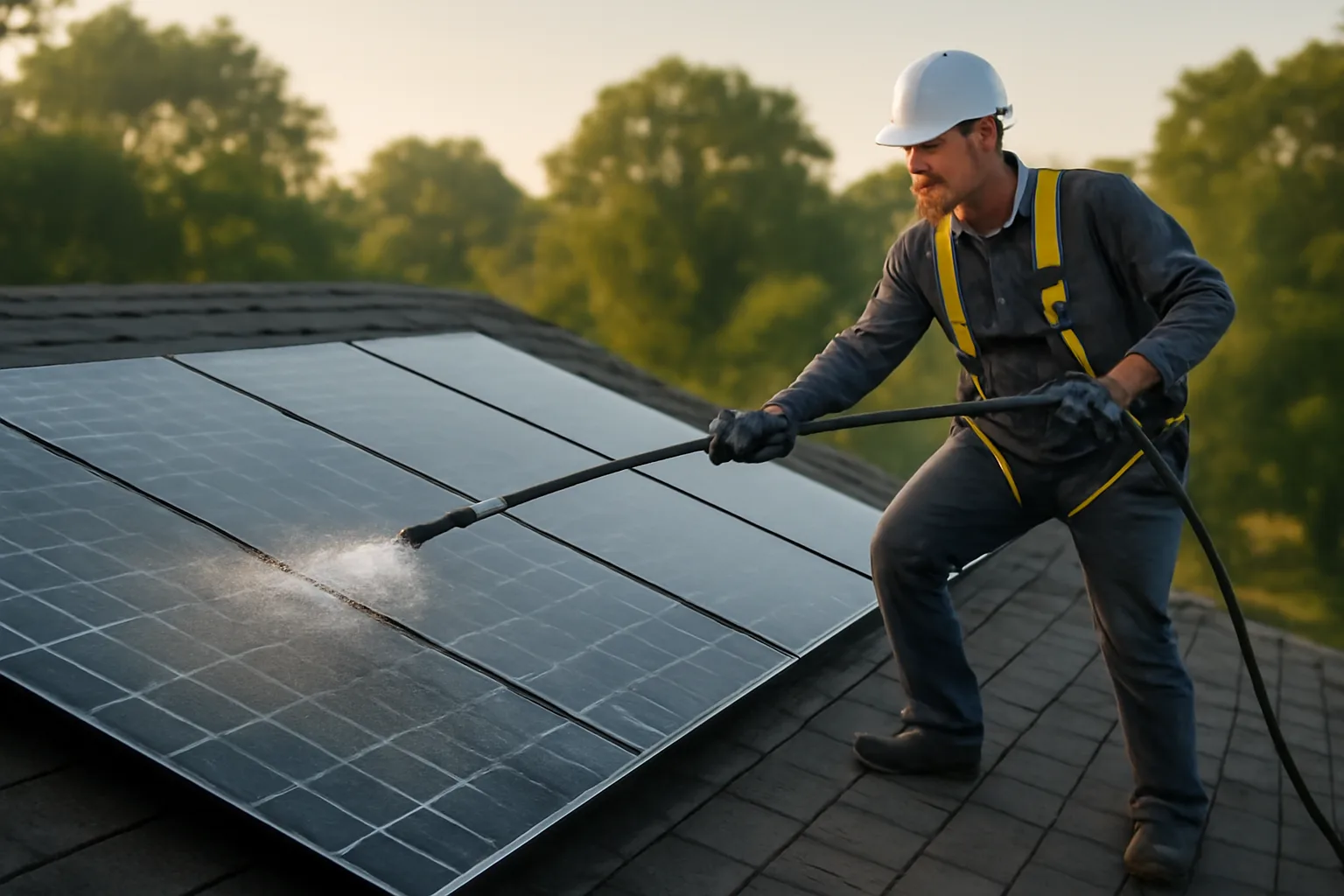
Solar panel cleaning is washing PV glass so dust, pollen, bird droppings, and mineral film stop blocking light. Most operators use purified water and a soft brush from the ground or a secured roof. Starting means business registration, an EIN, insurance, and a local license check. There is no single national cleaning license. Falls and dirty rinse water are the real risks. Confirm every permit with your state board before you take money.
What is solar panel cleaning?
Solar panel cleaning is paid maintenance that removes dust, pollen, droppings, and mineral film from PV glass so more light reaches the cells. It is not electrical repair if you never open a box, land a wire, or move a module.
Soil on glass is ordinary dirt plus a few hard cases. Road dust and pollen spread out. Bird droppings and mortar sit in tight patches and shade whole cells. Tap water dries as a white crust. The job is to lift that load without scratching the anti-reflective coating or walking a module until a cell cracks.
Stay on the glass face and most states still treat you as a washer, not an electrician. Cross into connectors, isolators, or racking repair and you left cleaning. That line is why the paper path matters more than the brush.
No single soiling number fits every roof. A rainy week rinses a steep array for free. A dry farm roof films over in a month. Ilse et al. estimated that soiling reduced global PV energy by about 3% to 4% in 2018 (Joule, 2019). [1]
You sell recovered kilowatt-hours and a roof that looks cared for. You do not sell a miracle coating. Say that out loud on the first sales call.
How do you start solar panel cleaning?
You start by forming a local service business with roof risk, not by buying a franchise story. Pick an entity your state recognizes. Get a free EIN from the IRS if you need one for a bank account or 1099s. [4] Register where your secretary of state and city tell you to. [9] Then call the contractor board and ask whether washing PV glass for pay needs a license class in that county.
There is no federal solar panel cleaning license. Some states leave glass washing alone. Others fold it into a contractor exemption only below a dollar cap. A few treat any roof work as construction. Confirm with the relevant board. A group chat is not a legal opinion.
Same week, quote general liability and ask about workers comp even if you are solo. Fit fall gear you will actually clip. Read the cleaning note from the module brands common in your zip code. Practice on a ground mount or a single-story porch roof before you take a two-story HOA.
The first paid job should be boring. One array. Written scope. Photos before and after. A rinse plan that keeps soapy water out of a storm drain. [7]
Skip the board call and you can do the field work right and still eat a stop-work order. That call costs nothing. Make it.
Does soiling actually cut solar output enough to pay for cleaning?
Yes in dirty, dry, or agricultural air. Sometimes no after a wet spring. The honest published range is a few percent in many climates and much worse in dust belts. Ilse and coauthors put the 2018 global energy hit at about 3% to 4%, with revenue losses on the order of 3 to 5 billion euros. [1]
NREL's Best Practices handbook for PV and energy storage O&M (3rd edition) treats cleaning as an O&M line you schedule from measured soiling, not from a national calendar. [5] The PDF is free. Read the cleaning and soiling sections before you print a flyer.
Do not promise a homeowner a 25% production bump unless you have their monitoring data and a filthy array. Promise clean glass and a short written report. If they run an Enphase or SolarEdge portal, compare two dirty weeks with two clean weeks. That is your proof.
Reversible soiling is not permanent wear. Jordan and Kurtz, in the NREL reprint of their Progress in Photovoltaics review, reported a median module degradation rate of 0.5% per year. [14] Cleaning does not fix that. Do not sell it as if it does.
Bird droppings and cement dust are their own problem. They shade in tight patches and can hot-spot a cell. Those are worth a trip even when the rest of the glass looks fine.
Do you need a license to clean solar panels?
Sometimes. It turns on the state, the job value, whether the array sits on a commercial roof, and whether you touch electrical parts. There is no national card you hang on the van.
California defines a contractor in Business and Professions Code section 7026 as a person who does, or oversees, work to construct, alter, repair, add to, subtract from, improve, or similarly change a structure or project. [12] Glass washing may or may not land in that net. California also has a small-project exemption in BPC 7048. The dollar figure in 7048 has been amended more than once. Confirm the current number with CSLB before you call a job exempt.
Florida, Arizona, and other high-solar states often split ordinary washing from solar contractor work. Isolate a string, pull a connector, or reseat a microinverter and you left cleaning. Start with the state notes for California solar panel cleaning rules, Arizona, and Florida.
City business tax certificates are a second pile. Many cities want that paper even when the state board does not. Ask the clerk. Get the answer in an email if you can.
I would not spend a dollar on a national certification plaque. Boards do not honor those. A license class they issue, or a written exemption, is the only paper that counts.
What water and tools do you actually use?
Purified water and a soft brush beat soap on most residential glass. Tap water carries dissolved minerals. EPA's secondary drinking water standard lists total dissolved solids at 500 mg/L as a spotting and taste guideline. [6] That same mineral load dries as rings on hot glass.
A deionizing resin cylinder, or reverse osmosis plus a DI polish, gets you close to zero TDS. You feed that water through a pole and a brush. Work from the ground on one-story arrays whenever you can. You do not need a 4,000 PSI washer on a house roof. High pressure lifts seals, and that is a warranty fight you will lose. I would not bring one.
Soap is a last resort for grease, and then you need a capture plan. Wash water with detergent is a pollutant if it enters waters of the United States from a point source without a permit. 33 U.S.C. § 1311 makes that discharge unlawful except as the Clean Water Act allows. [7]
| Water | Typical mineral load | What happens on hot glass |
|---|---|---|
| Hose tap | often tens to hundreds of mg/L TDS | white spots when it dries |
| RO only | much lower, not always zero | better, can still spot |
| RO plus DI, or DI only | near 0 TDS | closest to a spot-free rinse |
Starter lists online get silly. You need water, a way to purify it, a pole, a brush that will not scratch, a cheap TDS meter, and fall gear. If you want a single box instead of sourcing a deionizer and a harness separately, SolarWashPath sells a $149 one-time DI Water + Roof-Safety Kit. You can also buy those pieces from any industrial supplier and skip the bundle.
What roof and fall rules apply on day one?
Step onto a house roof and you treat it as construction-height work. OSHA's construction fall rule is blunt. 29 CFR 1926.501(b)(1) says "each employee on a walking/working surface (horizontal and vertical surface) with an unprotected side or edge which is 6 feet (1.8 m) or more above a lower level shall be protected from falling by the use of guardrail systems, safety net systems, or personal fall arrest systems." [2]
That 6-foot trigger is the number I would train to. General industry uses a 4-foot trigger on many walking surfaces. Do not argue the difference on a pitched shingle roof.
Falls still kill. OSHA's Stop Falls page states that falls from elevation accounted for 421 of the 1,102 construction fatalities recorded in 2019 (38.4 percent of all construction fatalities). [3]
Ladders have their own section. 29 CFR 1926.1053 requires that when a portable ladder reaches an upper landing, the side rails extend at least 3 feet above that landing. [8] Tie it off. Have a second person foot it on soft ground.
PPE is not optional because August is hot. 29 CFR 1910.132 requires PPE when hazards are present or likely. [10] A harness you never clip is theater.
I would refuse any job that needs a rope stunt in month one of the business. Learn a simple ridge-anchor kit on a low pitch first.
What paper do you file before the first paid job?
File the boring stack first. Entity with the state. City business license if the city has one. Sales tax permit if your state taxes this service. An EIN if you are not operating solely under your Social Security number. The IRS says, "Applying for an EIN is a free service offered by the Internal Revenue Service." [4]
SBA's register-your-business guide is a decent federal and state checklist, not a trade license. [9] It will not tell you whether your contractor board wants a specialty class. That is a board question.
| Step | What you file | Who confirms it |
|---|---|---|
| Legal entity | Formation papers | Secretary of state |
| Tax ID | EIN (free on IRS.gov) | IRS |
| Local permission | City or county business tax | City clerk |
| Trade permission | Contractor class, or written exemption | State board |
| Proof of cover | Certificate of insurance | Your broker and the site |
Write a one-page scope. Wash glass only. No electrical. No tile repair. Before and after photos. A line for cracked units you already see. Customer signature on water-stain and fall language.
Hire even one helper and worker classification becomes an IRS issue. Read their independent contractor page before you pay a first 1099.
No publisher can honestly post a current processing time that fits every board. Confirm with the relevant board. No approval or timing guarantees.
How do you price the first year without guessing a national rate?
There is no honest national price. Pitch, stories, water access, bird load, and drive time move the number more than any blog average. I would price by module count and by access, then floor it with your real hourly cost.
Build that hourly cost from insurance, resin, fuel, ladder wear, unpaid sales time, and a fall-gear refresh. If the math says $180 and a Facebook thread says $79, the thread is not paying your claim.
Commercial ground mounts are a different product. You can often stay on gravel. Residential two-story tile is where people get hurt and underbid.
Give a written range after a site photo, not a phone quote for "about 20 panels." Count modules. Ask about pets, gates, and whether anyone expects you to kill the array. A rinse usually happens with the system live, so you treat every conductor as energized and you do not touch it. [13]
First year, I would rather do fewer jobs at a number that buys a spare harness than stack cheap HOA work you rush.
State notes differ on paper and on what owners expect to pay. Skim Colorado and Georgia if that is your map.
What should you refuse to do on a roof?
Refuse wet, steep, or crumbling roofs. Refuse broken tile you would have to step on. Refuse any request to "just tighten that connector" unless you hold the license that covers PV electrical work. OSHA 1910.333 requires live parts to be deenergized before work unless you meet the listed exceptions, and it requires safe practices around energized gear. [13] Cleaning is not troubleshooting.
Refuse same-day work in a heat spike if you have no shade, no water, and no stop rule. NIOSH publication 2016-106 (Criteria for a Recommended Standard: Occupational Exposure to Heat and Hot Environments) is the federal review of why heat plus PPE plus a black roof is a medical problem. [11]
Refuse chemical cocktails a customer bought online. Refuse to walk the middle of a module. Frames only, and only if the racking maker says a person can be there.
Refuse HOA bids that demand a license class you do not have. Walk away.
Refuse to dump soapy rinse water into a creek or a storm inlet that leads to one. The Clean Water Act's discharge ban is the federal hook. States add their own rules on wash water. [7]
If a site wants the array disconnected, that is an electrician's job in most states. Hand it off. Keep the wash.
How often should panels be cleaned?
Clean when the dirt costs more than the visit. That can mean twice a year in a dusty valley and almost never on a steep roof that sees regular rain.
NREL's O&M handbook pushes measured soiling and an economic threshold over a fixed national calendar. [5] If the owner has monitoring, use it. If they do not, a spring pollen rinse and a late-summer dust rinse is a reasonable residential default in dry counties. It is still a guess. Say so.
After construction next door, come back. Cement dust bonds. After wildfire ash, wait until the installer or the utility says the site is safe, then treat ash as abrasive. Low pressure. Lots of water. No dry brushing.
Snow is not dirt. Do not scrape ice off glass with a shovel. You will void more than you save.
Agricultural sites near tillage may need a monthly pass in season. Price that as a route, not as one-off heroics.
Bird nests under arrays are a wildlife and fire issue. Do not punch a nest out to upsell a wash. Flag it. Tell the owner to call the installer or animal control.
Coastal salt film is ugly and it holds moisture. Purified water usually lifts it. If it does not, stop before you grind salt into the coating.
What insurance do new operators usually carry?
Most new operators carry commercial general liability. Many property managers will not let you on site without a certificate. Workers compensation depends on whether you have employees and on your state statute. Commercial auto matters the day you put resin tanks in a van.
I will not invent a current premium. Quotes move with roof-work class codes, claims, and whether the underwriter treats you as a window washer or a roofer. Those codes do not cost the same. Ask a broker who already writes window cleaning or gutter work. Tell them you go on roofs. Hide that and the policy may not pay.
An umbrella is optional in year one if the GL limit already meets the HOA minimum. A license bond is a board product in some states, not something you guess from a blog. Confirm with the relevant board.
A tool rider earns its keep once you own a pole kit you cannot replace from petty cash.
Get numbers from a licensed agent in your state. Publishable national averages are marketing, not underwriting.
Where do first-year operators waste money?
They wrap a trailer before they buy a second harness. They pay for a website that ranks for a national phrase and never ranks for their county. They stock five soaps. They skip the board call and then pay counsel.
A waste I see in public ads is a ceramic coating sold as forever-clean. Maybe a lab likes the contact angle. On a sandy farm roof you still have to rinse. Sell rinses.
Another waste is a huge gas pressure washer. You will not use it on modules. A small pump that moves DI water is enough.
A one-day fall class from a local provider is money well spent. A pricey private certificate with a logo no building department recognizes is not.
State quirks are real. If you work the Gulf, read Alabama and Arkansas before you price a route. Island work has its own wind and salt stack. See Hawaii.
Want a simple next-step checklist after you have read this? Use /start. That is a kit path, not a license, and it does not replace the board call.
What records actually protect you after a job?
Keep the signed scope, the photos, a TDS reading if you took one, and the weather. If a customer later claims you cracked a cell, timestamped photos are the whole case. Microcracks can preexist. You will not win a memory fight without pictures.
Keep safety data sheets for any soap you still carry. Keep a short ladder check note. OSHA does not need pretty binders. It needs evidence you took the hazard seriously. [2] [10]
Keep every board email. If someone at the licensing office writes that they do not license panel washing, save that thread. Staffing changes.
Invoices should say photovoltaic glass cleaning, not solar repair. Words on invoices get read in audits and in insurance notices.
If a module is already delaminating, write it on the ticket before you rinse. Water can track into a failed edge seal. That is not your defect. It becomes your problem if you did not note it.
Keep a simple site map. Which roof planes you stood on. Which you cleaned from the ground. That map helps the next visit and helps an adjuster.
None of this is glamorous. It is how a first-year operator is still working in year three.
Frequently asked questions
What is solar panel cleaning?
It is washing the glass face of photovoltaic modules to lift dust, pollen, droppings, and mineral film so more light reaches the cells. Done right, it is maintenance, not electrical work. You do not open boxes or move modules. The business case is recovered production, which Ilse et al. tied to a global 3% to 4% soiling loss in 2018.
How do you start solar panel cleaning?
Form a state entity, get a free IRS EIN if you need one, pick up the city business tax if your city has it, and call the contractor board about license classes. Buy general liability, fit fall gear, and practice on a low roof. There is no federal cleaning license. Confirm every permit with the relevant board before you take a deposit.
Is deionized water required for solar panel cleaning?
No statute says you must use DI water. Mineral-free water is still the practical standard because tap minerals dry as spots. EPA lists 500 mg/L TDS as a secondary drinking-water guideline, and hose water is often in the tens to hundreds. A TDS meter tells you if your rinse will spot before you climb.
Can I use a pressure washer on solar panels?
I would not, not on residential modules. High pressure can lift edge seals and void the maker's cleaning note. A water-fed pole and a soft brush are enough for dust and pollen. Grease may need a little soap and a capture plan. Follow the module maker's limit, not a driveway-washer habit.
Do I need a contractor license to wash solar panels?
Only if your state board says the work is contracting, or if you cross into electrical or construction tasks. California's BPC 7026 definition is broad, and BPC 7048's dollar exemption has changed. Other states leave washing alone. Confirm with the board that issues contractor cards where the roof sits. City tax certificates are separate.
How often should residential solar panels be cleaned?
When soiling costs more than the visit. Dry, dusty, or farm sites may need two or more visits a year. Steep roofs in wet climates may need none. NREL's O&M handbook wants measured soiling, not a national calendar. If the owner has monitoring, use it. After nearby construction or fire ash, schedule a special trip.
Is dish soap safe on solar modules?
It is a last resort for film that water will not lift, and you then have to control the runoff. Detergent in a storm drain can become a Clean Water Act problem. Most residential dust comes off with purified water and a soft brush. Skip random degreasers a customer found online.
What insurance do new solar panel cleaning operators carry?
Commercial general liability is the usual door opener for HOAs and property managers. Add commercial auto once tools live in a vehicle. Workers comp follows your state's employee rules. Premiums depend on whether the carrier rates you as a washer or a roofer. Ask a local broker. Do not hide the roof work.
Can I clean solar panels from the ground only?
Often, on one-story arrays, with a water-fed pole. Two-story and steep tile usually need roof time, which brings OSHA's 6-foot construction fall rule and a 3-foot ladder extension above the landing. Ground-only is safer and slower. Price the extra labor instead of forcing a stretch that dumps you into a gutter.
Is there a federal license for solar panel cleaning?
No. The IRS will issue a free EIN. OSHA sets fall, ladder, PPE, and electrical-work rules. EPA and the states police wash-water discharges. None of that is a solar-cleaning card. Trade permission, if any, comes from your state contractor board and your city clerk. Confirm both before you advertise.
What records should I keep after a solar panel cleaning job?
Signed scope, before and after photos, weather, and any TDS reading. Note cracked or delaminating modules before you rinse. Save board emails that speak to licensing. Write "photovoltaic glass cleaning" on the invoice, not "solar repair." Those files are how you answer a later crack claim or an insurance request.
Can I clean near wet electrical boxes and open combiners?
Stay off open electrical gear. Cleaning is glass only. OSHA 1910.333 treats energized parts as a controlled hazard, not a rinse zone. If a lid is off or a connector is loose, stop and tell the owner to call a licensed PV electrician. Water and open DC gear is how a simple wash becomes an incident.
Sources
- Ilse et al., Joule (Cell Press), Techno-Economic Assessment of Soiling Losses: Soiling reduced global PV energy by about 3% to 4% in 2018, with losses on the order of 3 to 5 billion euros
- OSHA 29 CFR 1926.501 Duty to have fall protection: Unprotected sides or edges 6 feet or more above a lower level require guardrails, safety nets, or personal fall arrest
- OSHA Stop Falls / National Safety Stand-Down: Falls from elevation accounted for 421 of 1,102 construction fatalities in 2019 (38.4%)
- IRS Apply for an Employer Identification Number (EIN) Online: Applying for an EIN is a free service offered by the Internal Revenue Service
- EPA Secondary Drinking Water Standards: Guidance for Nuisance Chemicals: EPA secondary standard for total dissolved solids is 500 mg/L
- 33 U.S.C. § 1311 (Clean Water Act effluent limitations / unlawful discharge): Discharge of any pollutant by any person is unlawful except in compliance with the Clean Water Act
- OSHA 29 CFR 1926.1053 Ladders: Portable ladders used to reach an upper landing must have side rails extend at least 3 feet above that landing
- U.S. Small Business Administration, Register your business: Most businesses need to register with state and local governments, and some with the federal government
- OSHA 29 CFR 1910.132 Personal protective equipment, general requirements: Employers must provide and require PPE when hazards are present or likely to be present
- NIOSH Criteria for a Recommended Standard: Occupational Exposure to Heat and Hot Environments (2016-106): NIOSH sets out recommended occupational heat-exposure criteria for hot work environments
- California Business and Professions Code section 7026 (contractor defined): California law defines a contractor as a person who constructs, alters, repairs, adds to, subtracts from, or improves specified projects
- OSHA 29 CFR 1910.333 Selection and use of work practices (electrical): Live parts must be deenergized before work unless listed exceptions apply, and safe practices are required around energized equipment