Last updated 2026-08-21
TL;DR
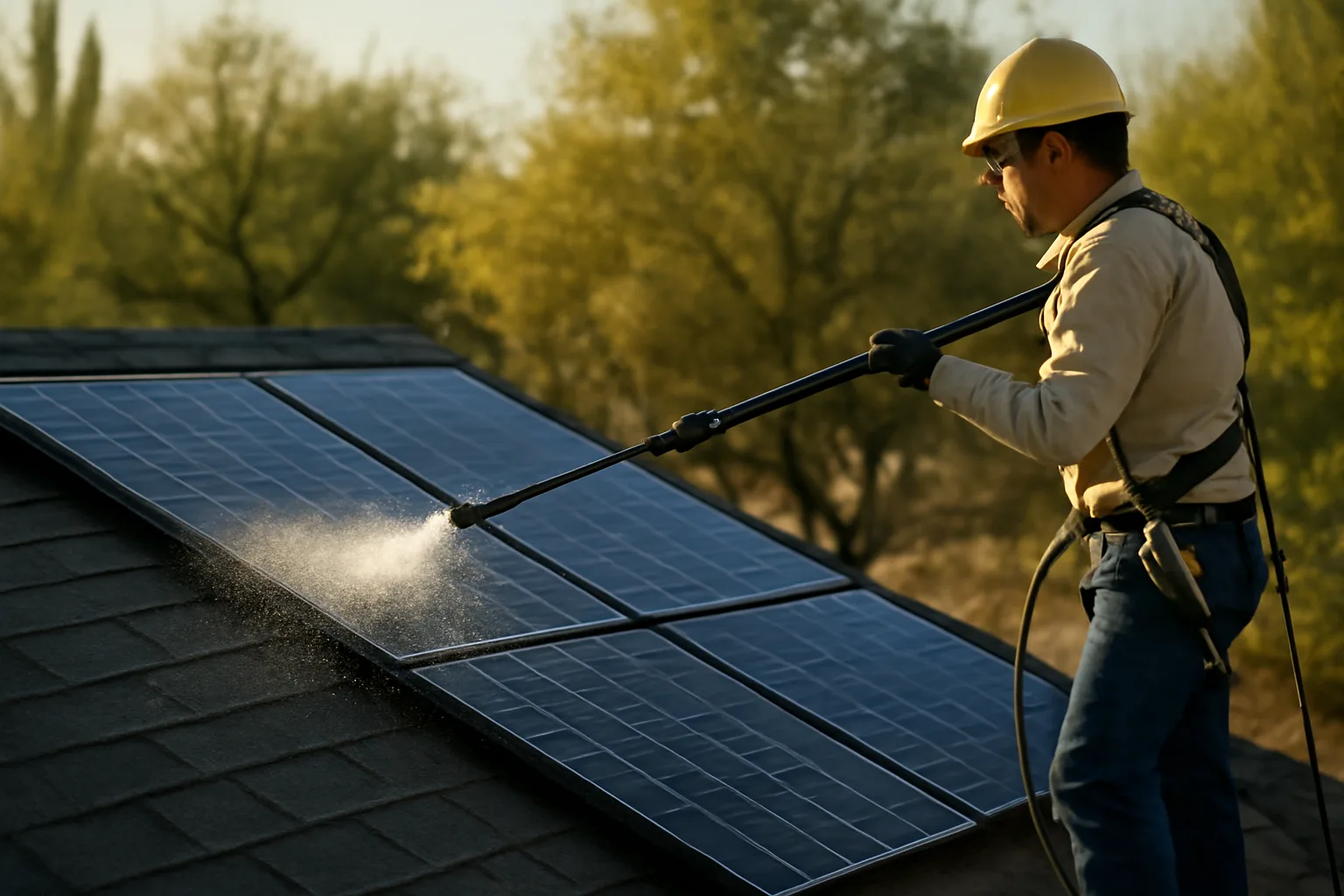
Solar panel cleaning is washing photovoltaic modules so dust, pollen, bird droppings, and film stop cutting output. You start by checking your state contractor board, getting an EIN if you need one, lining up fall protection that matches OSHA height rules, and using low-mineral water so you do not etch glass. Soiling defaults in NREL PVWatts sit at 2 percent. Confirm every license and discharge rule with the local board before you take a paid roof.
What is solar panel cleaning?
Solar panel cleaning is paid washing of photovoltaic glass so dust, pollen, soot, and bird waste stop blocking light. The work is water plus a soft brush, plus a roof plan. It is not inverter repair. It is not racking.
Most arrays lose some output when a film builds up. The loss is not the same in Seattle and Phoenix. NREL PVWatts Version 5 uses a default soiling loss of 2 percent. [10] Dry farm belts and desert parks can run worse. Wet climates still cake pollen in spring. Nobody has one national recovery number that fits every roof.
People mix this job up with window washing. The glass is different. Mineral spots sit in the light path all year. Abrasive pads can clash with a module warranty. High pressure can drive water under frames. I treat the module maker's cleaning note as the spec, not a video.
The customer is buying recovered kilowatt-hours and a cleaner look from the street. You are selling a maintenance visit with a written method. If production data exists on the inverter app, use it. If it does not, say so. Guessing a fat bump on a lightly soiled roof is how you lose the next referral.
Solar panel cleaning sits next to other outdoor service work. The paper path is closer to a small service company than to an electrical shop, until a state board says otherwise. If you are weighing the trade against nearby work, read solar panel cleaning vs nearby career.
How much power does dirt take from panels?
Dirt takes whatever light it blocks. On a typical modeled system, NREL PVWatts Version 5 applies a 2 percent soiling loss unless you change that input. [10] That 2 percent is a default, not a field reading for your town.
Real arrays wander. Bird-heavy ridges, orchard spray, and dust storms move the number. A light pollen film in a rainy county may rinse off. A cement-plant plume will not. I would not promise a production recovery until I see inverter history. Most first-year operators do not own a curve tracer. That is fine. Stay honest.
The NREL best-practices O&M report treats cleaning as ordinary photovoltaic maintenance, not a stunt. [11] Frequency follows the site. Coastal salt, agriculture, and traffic film need a closer look than a steep roof in a wet forest.
If a salesperson quotes a huge recovery with no site photos, walk away. Some dirty desert plants do see large soiling losses. Many suburban roofs do not. Measure or stay humble.
How do you start solar panel cleaning?
You start by asking your state contractor board whether washing photovoltaic modules for hire needs a license class. Ask in writing if they will answer that way. You do not start by buying a van wrap.
Then you pick a structure. A sole proprietor often files Schedule C with Form 1040. [12] If you form an LLC, you still need the state filing and, in many cities, a local business tax certificate. The IRS does not issue state licenses.
Get an EIN if a bank, insurer, or payroll setup asks for one. The IRS says, "Applying for an EIN is a free service offered by the Internal Revenue Service." [6] Skip any site that charges for that form.
Write a one-page method. Water type. Brush type. No walking on modules unless the rail maker says you can. Ladder placement. Who calls the owner if a backsheet looks burned. Add a fall plan that matches the height rules below.
Insurance comes before the first paid roof. General liability is what property managers ask to see. Workers compensation depends on whether you have employees and on your state. Confirm both with a licensed agent. I would not take a commercial yard without a certificate in the email thread.
Gear can stay small. A pure-water setup, a water-fed pole, a rated harness, an anchor plan, and a hose path that does not create a new slip. Fancy robots wait. So does a $15,000 trailer. Compare early choices in solar panel cleaning guide 12.
Your first ten jobs should be people who already trust you. Paid ads on a trade you have not practiced on a wet roof are a fast way to fund someone else's lawyer.
Do you need a contractor license to clean panels?
Maybe. There is no single federal license for solar panel cleaning. California defines a contractor, in part, as a person who undertakes to construct, alter, repair, add to, subtract from, improve, move, wreck or demolish any building. [8] Some boards read "improve" to include paid work on a structure. Some treat washing as janitorial. You confirm with the board that issues the card, not with a comment thread.
California also makes acting as a contractor without the required license a crime under Business and Professions Code section 7028. [9] Other states use different statutes. I will not invent a fee, a test date, or a processing time. Those change. The board page and the clerk on the phone are the record.
Ask a precise question. "I will rinse and brush installed photovoltaic modules. I will not rewire, re-rack, or replace glass. What license class, if any, applies?" Write down the name, date, and answer. If they email, keep the email.
City business licenses are separate. A state card does not cancel a municipal tax certificate. HOA rules are a third layer and they are private contracts, not statutes.
If two neighboring states disagree, that is normal. See solar panel cleaning guide 18 for how people map those differences without inventing a national rule.
What first-year paper actually matters?
The paper that matters is the paper a board, a bank, an insurer, or a property manager can check. Pretty folders do not count.
Federal paper is thin. An EIN if you need one. A way to track income and expenses. IRS Publication 535 explains ordinary and necessary business expenses. [7] Brushes, water filters, and a commercial auto policy can fit that bucket when they are really for the trade. Personal groceries do not. I am not your tax preparer. A CPA who has filed Schedule C for field trades is worth the hour.
State paper is the one people skip. Entity filing if you formed one. Contractor license if the board says you need it. Unemployment or workers compensation accounts if you hire. Confirm each item. Do not copy a checklist from another state.
Local paper is where first-year operators get surprised. Business tax certificate. Fictitious name filing. Parking rules for a tank truck. Some cities care about wash water in the gutter. Under the federal MS4 stormwater rules, illicit discharges to municipal storm sewers are a regulated problem. [14] Ask public works where rinse water is allowed to go.
| Paper | Who confirms it | Typical trigger |
|---|---|---|
| State contractor license | State contractor board | Board says washing is contracting |
| City business tax | City finance desk | Any paid work in that city |
| EIN | IRS | Bank, payroll, or entity needs it |
| Wash-water rule | City public works | Rinse water hits a gutter |
Job paper is photos and a work order. Before. After. Ladder. Anchor. Certificate of insurance when asked. That file wins more disputes than a logo. Fancy private diplomas rarely impress a building department. The board card does.
What water and tools actually do the job?
Low-mineral water and a soft brush do the job. Hard tap water leaves spots. Those spots are new soil. You then own a callback.
Deionized or reverse-osmosis water is the usual fix. The NREL O&M best-practices report treats cleaning method and water quality as real operating choices, not decoration. [11] I would rather spend on resin or an RO membrane than on a wrap.
Poles matter more than trucks. Water-fed poles let you stay on the ground on many one-story roofs. Two-story and steep pitches pull you onto the roof. That is a different safety plan. It is not a different marketing plan.
Do not use kitchen detergent as a default. Residues attract dirt. If a module maker names a cleaner, follow that sheet. If they say water only, use water only.
Pressure washers are a common waste of money. They also drive water toward junction boxes. I do not use them on modules. Robotic crawlers can make sense on a huge commercial roof later. For a first-year residential book they sit in the truck and mock you.
If you want a simple starter bundle of deionized-water and roof-safety gear, SolarWashPath publishes a $149 one-time DI Water + Roof-Safety Kit at /start. This page still works if you never click it. Compare kit-versus-trailer thinking in solar panel cleaning guide 24.
What roof safety rules apply to this work?
Treat the roof as a fall job. OSHA 29 CFR 1926.501(b)(1) requires fall protection at 6 feet on construction walking and working surfaces. The text says, "Each employee on a walking/working surface (horizontal and vertical surface) with an unprotected side or edge which is 6 feet (1.8 m) or more above a lower level shall be protected from falling by the use of guardrail systems, safety net systems, or personal fall arrest systems." [1]
OSHA's general industry rule uses a 4 foot trigger for unprotected sides and edges. [2] Which part applies depends on whether the visit is classed as construction or maintenance. I do not litigate that on a wet morning. I tie off. Personal fall arrest gear has its own rule in 29 CFR 1910.140. [5]
Ladders have their own numbers. For construction, portable ladders used to reach an upper landing must extend at least 3 feet above that landing. [13] Do not walk a stepladder like a plank. 29 CFR 1910.23 covers portable ladder use in general industry. [4]
Electrical work practices sit in 29 CFR 1910.333. Live parts an employee may be exposed to are supposed to be deenergized before work on or near them, unless deenergizing adds hazard or is infeasible. [3] Cleaning glass with a nonconductive pole is not the same as landing in a combiner. I still treat inverters, home runs, and damaged backsheets as stay-away zones. I am not opening enclosures.
If a roof is crumbly, or the customer wants you to skip the harness, the answer is no. One refused job is cheaper than one fall. More site-type notes live in solar panel cleaning guide 30.
How often should solar panels be cleaned?
As often as the site soils. Not on a national calendar. A desert ag belt might want several visits a year. A steep, rainy roof might want one spring rinse. Some need none.
Use production data when it exists. If output dropped after a dust month and recovered after a wash, you have a story. If output did not move, do not invent a savings number.
Bird nests, chewing, and cracked glass are not a cleaning schedule. Those are a stop-work. Then you call the system owner.
I would sell a first visit plus a look at the inverter app, not a 12-visit contract on a clean suburban roof. Over-selling frequency is how this trade gets a bad name.
For climate notes people actually argue about, see solar panel cleaning guide 42.
What insurance do new operators actually buy?
Operators buy general liability because commercial customers ask for a certificate. They buy commercial auto if the truck is in the business. They buy workers compensation when the state says a worker triggers it. A tool rider matters after you own poles and a purification stack worth stealing.
I will not invent a premium. Nobody publishes a clean national rate for this niche that I trust. An independent agent who already writes window washers and gutter trades will get you closer than a blog comment.
Ask the agent whether roof work is excluded. Some cheap policies stay quiet until a claim. Get the height wording in writing.
An extra high limit is not a federal rule. It is a number a property manager typed into a vendor packet. Match the packet or skip that property.
Bond requirements, if any, come from the contractor board or the city. Not from a social feed. Confirm.
What should you charge when you start?
Charge by array size, roof complexity, and water haul. Not by a national average you saw in a thread. A ground mount you can rinse from gravel is not a three-story tile roof.
I price the first year to cover labor, drive time, resin or RO, insurance, and a reserve for a broken skylight. If that number feels high in your county, your county may not support the trade yet. That is useful information.
Per-panel prices go stale fast. Per-visit with a stated module count is easier to defend. Write what is included. Bird nest removal is extra. Heavy cement film is extra. Same-week rush is extra.
Do not undercut to collect praise. You will train the town to expect a price that cannot buy a harness replacement.
For pricing comparisons across nearby offers, solar panel cleaning guide 54 is the next stop.
What is a waste of money in year one?
A wrapped van, a franchise pitch, a private national certificate, and a trailer-mounted robot are the usual wastes. So is buying four water-fed poles before you have four jobs.
You need clean water, a brush that will not scratch, fall gear you will actually wear, and a way to invoice. That is the list.
Paid leads that dump every new operator into the same five zip codes are a tax on impatience. Your first customers are people who already have your number.
I would also skip any course that will not show you the statute it claims to teach. If they cannot name the board, they are selling confidence, not paper.
A longer skip list sits in solar panel cleaning guide 66.
How do you confirm facts with the board?
You call or email the agency that can fine you. Contractor board for license class. City finance for the business tax. Public works or the water board for wash-water rules. The state insurance department if an agent's story sounds off.
Ask one question per email. Save the reply. If a page lists a fee, quote the page date back to them and ask if it is current. Fees move. I will not print a number here that will be wrong next quarter.
SolarWashPath is an independent publisher, not a law firm and not a service company. Nothing on this page is a permit. If you want the kit list we keep for readers, it is at /start.
Boards do not care about your logo. They care whether the work you sold matches a licensed class. Stay inside the answer they gave you. If the work grows into racking or electrical, stop and get the right card.
Frequently asked questions
What is solar panel cleaning?
Solar panel cleaning is washing photovoltaic module glass so dust, pollen, soot, and bird waste stop blocking light. It is maintenance, not electrical repair. Most jobs use low-mineral water and a soft brush. NREL PVWatts Version 5 defaults soiling loss at 2 percent, which is a model input, not a promise for your roof.
How do you start solar panel cleaning?
Ask your state contractor board if paid module washing needs a license class, then set a legal structure, a local business tax certificate if the city requires one, and an EIN if a bank or insurer wants it. The IRS EIN application is free. Add general liability, a written fall plan, and low-mineral water before the first paid roof.
Do I need a contractor license to wash solar panels?
It depends on the state board, not on a national myth. California's contractor definition can include work that improves a structure, and contracting without a required license is a crime there under BPC 7028. Other states treat washing as janitorial. Ask your board a narrow question and keep the answer. Confirm any fee with that board. Fees change.
Can I use regular tap water on modules?
You can, and you will often leave mineral spots. Those spots are new soil and they create callbacks. Deionized or reverse-osmosis water is the usual fix. Follow the module maker's cleaning note if they name a chemistry. Kitchen detergent is a poor default because residue attracts dirt.
Is rain enough to clean solar panels?
Sometimes on a steep roof in a wet climate. Often not where dust, pollen, bird waste, or farm spray bake on. Rain can also leave spots if the water is hard. Use inverter history when it exists. If output did not move after storms, do not sell a rain story as a cleaning plan.
How much should I charge for a first solar panel cleaning visit?
Price the roof, the module count, the access, and the water haul. A gravel ground mount is not a three-story tile roof. Cover labor, drive time, resin or RO, insurance, and a reserve for property damage. Per-visit pricing with a stated module count is easier to defend than a stale per-panel number copied from a thread.
Do I need workers compensation if I work alone?
Maybe not, and maybe yes. It is a state rule, not a forum rule. Some states still care about a one-person shop. Some do not until you hire. Confirm with your state workers compensation agency and with the agent who writes your general liability. Property managers may still ask for a certificate you cannot honestly issue.
Can I walk on solar panels to clean them?
Not as a habit. Many module and rail makers forbid walking on glass. Point loads crack cells you will not see from the ground. Stay on the roof deck or work from a water-fed pole when the geometry allows. If the only path is across the array, that job may not be yours.
Where can solar panel rinse water go?
Ask city public works before you assume the gutter is fine. Federal MS4 stormwater rules treat illicit discharges to municipal storm sewers as a regulated problem. Some cities allow clean rinse water to landscaping. Some do not want detergents or dirty film in the drain. Get the local answer in writing when you can.
Do I need an EIN before my first solar panel cleaning job?
Not always. A sole proprietor can sometimes use a Social Security number. Banks, insurers, and payroll setups often want an EIN anyway. The IRS online EIN application is a free service. Do not pay a third-party site for that number. Confirm with your bank and tax preparer what they need for your structure.
What fall protection height applies on a house roof?
OSHA construction rule 1926.501 uses a 6 foot trigger on unprotected sides and edges. General industry rule 1910.28 uses 4 feet. Which part applies depends on how the visit is classed. I treat every pitched residential roof as a tie-off job and I do not argue the label on a wet morning.
Are private solar cleaning certificates required?
No private school card replaces a state contractor license or a city tax certificate. Boards look at statutes, not diplomas. A course can still be useful if it teaches the actual OSHA text and your board's class list. If they cannot name the board, skip it. Save the money for resin, a harness, and a CPA hour.
Should I turn the system off before cleaning?
OSHA 1910.333 says live parts an employee may be exposed to should be deenergized unless that adds hazard or is infeasible. Cleaning glass with a nonconductive pole is not the same as opening a combiner. I still keep clear of damaged backsheets and enclosures. Follow the owner's shut-down method if they have one, and stay out of electrical boxes.
What insurance certificate do property managers ask for?
Usually general liability, sometimes with a stated limit they typed into a vendor packet. That limit is their rule, not a federal statute. Ask whether roof work is excluded. Add commercial auto if the truck is in the business. Match the packet or skip the property. Confirm every number with a licensed agent.
Sources
- OSHA 29 CFR 1926.501 Duty to have fall protection: Construction employees on unprotected sides or edges 6 feet or more above a lower level must be protected by guardrails, a safety net, or personal fall arrest.
- OSHA 29 CFR 1910.28 Duty to have fall protection and falling object protection: General industry unprotected sides or edges 4 feet or more above a lower level require fall protection.
- OSHA 29 CFR 1910.333 Selection and use of work practices: Live parts to which an employee may be exposed shall be deenergized before work on or near them unless deenergizing adds hazard or is infeasible.
- OSHA 29 CFR 1910.23 Ladders: OSHA sets portable ladder use rules for general industry walking-working surfaces.
- OSHA 29 CFR 1910.140 Personal fall protection systems: Personal fall arrest systems used in general industry are regulated under 1910.140.
- IRS Apply for an Employer Identification Number (EIN) Online: Applying for an EIN is a free service offered by the Internal Revenue Service.
- IRS Publication 535 Business Expenses: IRS Publication 535 explains ordinary and necessary business expenses a trade can deduct.
- California Business and Professions Code section 7026: California defines a contractor to include a person who undertakes to construct, alter, repair, add to, subtract from, or improve a building or other structure.
- California Business and Professions Code section 7028: Acting in the capacity of a contractor in California without the required license is a crime under BPC 7028.
- IRS About Schedule C (Form 1040): Sole proprietors report business profit or loss on Schedule C with Form 1040.
- OSHA 29 CFR 1926.1053 Ladders: Construction portable ladders used to reach an upper landing must extend at least 3 feet above that landing.
- 40 CFR 122.26 Storm water discharges (NPDES): Federal NPDES stormwater rules require MS4 programs to address illicit discharges to municipal storm sewers.