Last updated 2026-08-18
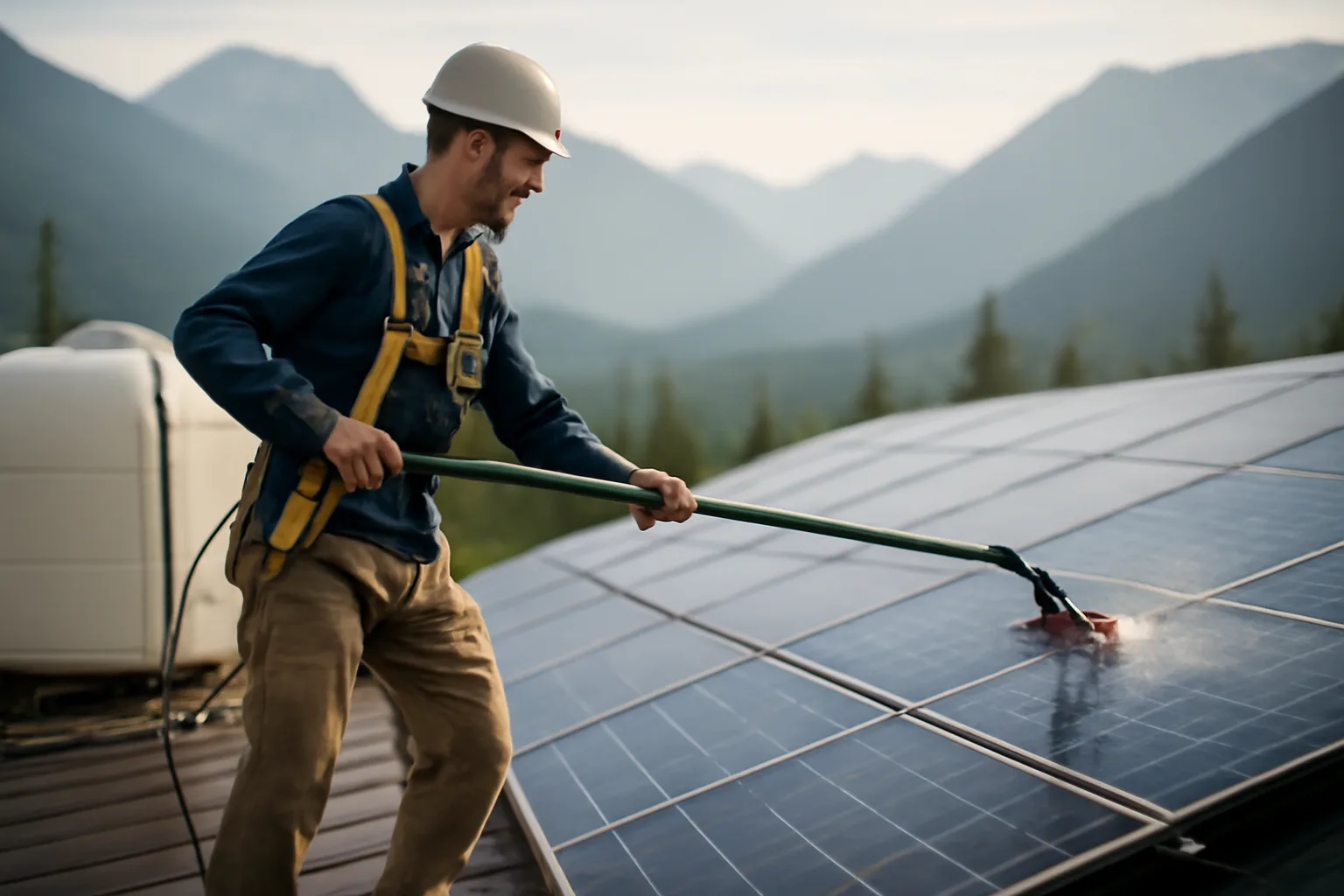
TL;DR
Starting solar panel cleaning in Alaska means a $50 state business license plus a check on your city or borough rules. No trade license exists. Residential jobs run $200 to $400 and take 1.5 to 3 hours. The real hurdle is weather. Your cleaning window is May through September. This guide covers the exact paper path, first-year cost math, and how to handle snow, ice, and short seasons.
Does Alaska require a license for solar panel cleaning?
No. Alaska has no state board that licenses or certifies solar panel cleaners. There is no trade license, no specialty contractor designation, no registration built for washing photovoltaic panels. The state professional licensing list runs from accountants to veterinarians, and cleaning solar panels is not on it [1][2].
You do need a business license, and depending on where you work, a city or borough license too. That is the whole picture for most operators. A few municipalities, Anchorage and the Fairbanks North Star Borough among them, want a separate local license even when you already hold a state one [3][4].
A contractor's license under AS 08.18 only bites if you are doing "construction, alteration, or repair" of buildings or fixed works [5]. Cleaning does not meet that definition. So if someone tells you a general contractor license is required to run a pure exterior cleaning service, they are misreading the statute. Keep your scope to cleaning. No structural changes, no electrical, no panel repairs, and you stay outside the contractor box.
If you plan to work on buildings above three stories, Anchorage's building code may trigger a mechanical or roofing permit. For one and two-story residential arrays, it does not apply. Call your local building department to confirm for any commercial job.
How do you get an Alaska business license for solar panel cleaning?
The Alaska Business License costs $50 for one year or $100 for two. You apply online through the Department of Commerce, Community, and Economic Development (DCCED) portal in about 20 minutes [6]. The state asks for your business name, ownership structure (sole proprietorship, LLC, and so on), a NAICS code, and contact info. The code that fits best is 561790 (Other Services to Buildings and Dwellings). Use 238290 (Other Building Equipment Contractors) only if you also do light maintenance, but 561790 is cleaner if you strictly clean.
DCCED puts it plainly: "All persons and entities conducting business in Alaska must possess a current Alaska business license." [6] No exception for small operations. The license number goes on your estimates, invoices, and vehicle signage if you have any.
The state processes most applications within 10 to 15 business days. Keep the PDF and print a copy. You renew before December 31 each year unless you picked the two-year option.
Forming an LLC? File that through the Division of Corporations first, at a $250 filing fee [7], then get the business license. For a sole prop, skip the entity paperwork entirely. Most cleaners start as a sole prop and switch to an LLC once revenue justifies the liability protection.
Do I need a local city or borough license in Alaska?
Anchorage requires a city business license for anyone operating inside municipal limits, even if you hold a state license. The fee is $125 a year, with a $10 late penalty if you miss the renewal date [3]. The municipality's rule is direct: "Any person conducting business within the Municipality of Anchorage must obtain a Borough Business License."
Fairbanks North Star Borough charges $50 for a calendar-year license [4]. Smaller places like Juneau ($50) and Sitka ($25) keep fees modest. Live in the Matanuska-Susitna Borough? No separate license needed. The state one covers you.
Here is the practical order. Get your state license first. Then pull local licenses for any borough where you plan to actively market. If you do a single job in a borough per year, some will let it slide, but many want the license even for one paid service. That risk is not worth $50.
How much does solar panel cleaning cost in Alaska?
Residential solar panel cleaning in Alaska runs $200 to $400 for a typical 20 to 30 panel array on a one-story home. That sits above the $150 to $350 national range reported by CostHelper [8], and two Alaska realities drive it: thin competition and long travel distances. A 2023 NREL benchmark puts national PV operations and maintenance (O&M) costs at $17 per kW per year for residential systems [9]. For a 6-kW system, that is $102 a year. Cleaning is a slice of that, usually 50 to 70 percent of the total.
The Alaska Center for Energy and Power (ACEP) at UAF studied real solar costs across the state and found O&M expenses can run 20 to 30 percent above national averages once you add transportation and seasonal access [10]. That pushes a realistic annual cleaning budget to $120 to $150 for a 6-kW system, split over one or two visits. Many homeowners just book one mid-summer clean.
Commercial systems price by the watt. Expect $0.02 to $0.04 per watt per cleaning in Alaska, against $0.01 to $0.02 in the Lower 48. A 50-kW school roof might land at $1,000 to $2,000 per clean. The wide range reflects roof pitch, panel tilt, and whether you need a lift.
Snow removal is its own service. Some clients want heavy snow cleared to restore winter output. Charge by the hour ($100 to $150) plus a hazard premium, because icy metal roofs and ladders do not forgive mistakes.
How long does solar panel cleaning take in Alaska?
A 25-panel residential job takes 1.5 to 3 hours from arrival to tools packed, assuming a standard pitched roof with safe ladder access. Flat commercial arrays go faster: 1 to 2 minutes per panel with a water-fed pole. The National Renewable Energy Laboratory's O&M best practices document notes a two-person crew with deionized water and soft brushes can clean an array at roughly 1.5 minutes per panel in good conditions [11].
Alaska eats your time on setup, takedown, and driving, because so many jobs sit in remote spots. A cabin near Talkeetna might be an hour off the nearest road, so a 2-hour clean becomes a 5-hour day. Price that in. Winter cleaning, if the array is snow-free, roughly doubles the time. You are bundled up, hauling extra gear, and walking on slick surfaces.
Most solo operators aim for two residential jobs a day in summer, three if they are clustered close together. A small commercial system can fill a full workday for one person. You will learn fast that wind is the sneaky time killer. Breezy days make pole work wobbly and throw soap everywhere.
When is the solar panel cleaning season in Alaska?
Short. Brutally short. Panels sit under snow from October through April across most populated areas, and even in Anchorage the average April snowpack still measures around 10 inches. The productive window runs May through September, with June and July the best stretch. By August, rain gets persistent in Southeast Alaska, and fall storms throw up grit that dirties panels fast.
What about winter cleaning? Possible, rarely worth it. A 2-kW array making 4 kWh on a good winter day might climb to 6 kWh once you clear the snow, but that gain gets wiped out by the risk of ice falls, frostbite, and gear failure. Most owners wait. If you market winter cleaning, keep it to ground-mount systems where a roof rake is safe.
Your first year will feel compressed. You build your client list from May to July, book cleanings through September, then go quiet. Smart operators use the off months to prep gear, renew insurance, square away the business license, and study marketing.
Alaska's summer solar irradiance is among the highest in the nation in June, so clean panels are producing real value right when you can reach them. Put that in your pitch and get clients to book early.
How do I get my first 10 solar panel cleaning jobs in Alaska?
Alaska's solar market is tiny and growing fast. The Alaska Energy Authority reports residential solar installations doubled between 2020 and 2023 [12]. That means you are stepping into a market of maybe 3,000 to 4,000 households with rooftop PV. Mass advertising is the wrong move. Go hyper-local and relationship-first.
Start with local solar installers. Many do not offer cleaning and will happily refer clients, sometimes for a fee. Visit their offices, bring donuts, leave a one-page flyer with your pricing. Then join the Alaska solar energy groups on Facebook and answer questions without pitching. The community is small enough that your name gets around.
Run a quarter-page ad in the local paper's spring home improvement section. Figure about $200 for a month. Aim at the Kenai Peninsula, the Mat-Su Valley, and Fairbanks, where solar adoption is highest. Register on Thumbtack and Nextdoor too, though the volume will be light.
One tactic people skip: clean a well-known local business (a brewery, an outdoor gear shop) for free in trade for a social media post. Alaskan mountains behind sparkling panels does more than any paid ad.
Year one, aim for 30 to 50 jobs. At a $250 average, that is $7,500 to $12,500. Plenty of solo cleaners clear $25,000 in a second season once referrals build.
What equipment do I need for solar panel cleaning in Alaska?
The tool list is short and built for weather. You need a water-fed pole with a brush head, a portable deionized (DI) water tank, a pump, and personal fall protection. A 24-foot pole handles most one-story roofs. Go 40 feet for two-story arrays. A carbon-fiber pole is worth the $300 to $500. Hauling a heavy aluminum pole up and down ladders all day wrecks you.
DI water matters. Hard tap water dries into mineral spots that cut power output. A portable DI tank costs about $200, and replacement resin runs $50 every 200 to 400 gallons. In Anchorage and Fairbanks you can refill at a local water purification shop. In rural areas, pack extra resin or buy a small reverse osmosis system for $300.
Winter add-ons: insulated boots with studs for roof grip, a small generator to run a heated pressure washer if you hit ice crust, and a roof rake for clearing snow before you clean (an optional service).
The SolarWashPath $149 DI Water + Roof-Safety Kit bundles the core pieces: a DI tank, brush head, connector hoses, and a basic harness. It is a decent one-box start if you would rather not source parts one at a time. You will still need a pole, pump, and ladder.
You can get going with $1,200 to $1,800 in gear and add a truck rack or enclosed trailer later. Buy cheap now, replace when it breaks. Most gear here dies from freeze-thaw cycles, not hard use.
How should I price solar panel cleaning in Alaska?
Price your time, not the panel count. A job 10 miles outside Fairbanks might have 25 panels, but if the road is gravel and you lose 40 minutes each way, you need $325 to $375 to hold your hourly rate. Set a per-job minimum around a target of $75 to $100 per hour for yourself, after expenses.
Here is a simple formula: (travel hours x $50) + (on-site hours x $75) + ($1 per panel for consumables and insurance margin). A 2-hour round trip, 2 hours on-site, 25 panels works out to (2 x 50) + (2 x 75) + $25 = $275. That is your floor. Add $50 for steep roofs or second-story work.
Snow-specific pricing sits apart. A snow removal visit (not a cleaning) with a roof rake and shovel on a one-story array takes 1 to 2 hours and carries real liability. Charge $150 to $250 flat, with a signed waiver. Some cleaners will not touch it, because one slip ends your season.
Bundle cleaning with a visual inspection report and light debris removal for an annual plan. Commercial accounts often want quarterly work at $0.015 per watt. A 100-kW system yields $1,500 a quarter, which is solid recurring money. Do not discount hard. The market is so small that undercutting kills margins for everyone.
Do I need insurance for solar panel cleaning in Alaska?
Alaska does not require insurance for a simple cleaning sole prop, but no smart operator skips it. Carry at least $1 million in general liability. That runs $400 to $800 a year through a provider like Hiscox or Next for a low-revenue business [13]. It covers property damage (you drop a tool and crack a panel) and bodily injury (someone trips over your hose).
Workers' comp is not required for a sole proprietor with no employees. Hire a helper, even part-time, and it becomes mandatory. Alaska's workers' comp law is strict. A single uninsured worker can trigger fines up to $1,000 per week [14]. Get covered before your first helper ever touches a roof.
Look at commercial auto too. Your personal policy probably will not cover business use of your truck. Many cleaners add a commercial endorsement for about $200 more. If you haul a water tank, confirm coverage, because spills can turn into claims.
Umbrella coverage is overkill for year one. Put that money into a solid harness and rope grab. That is the real risk mitigator.
Do I need permits for solar panel cleaning runoff in Alaska?
No Alaska law bans washing solar panels with deionized water and a mild, biodegradable soap. The Alaska Department of Environmental Conservation (ADEC) does not regulate exterior residential cleaning runoff unless you are using solvents or discharging into a water body [15]. Do not get sloppy, though. Keep soapy water out of streams and lakes. Stick to phosphate-free, non-toxic cleaners. Most operators run pure water only, which erases the runoff question entirely.
Commercial systems can trigger different rules if the property has a stormwater pollution prevention plan (SWPPP). Ask the property manager. For large industrial solar farms, you might need a letter from the owner confirming they will manage runoff.
Roof access permits? Not for standard ladder work. If you need a boom lift or scaffolding on public property, you pull a street-use permit from the city. Anchorage's right-of-way permit is $50 and takes two days. This rarely touches residential cleaners.
One Alaska quirk nobody warns you about: bears. Clean a remote array with a water tank and a curious bear may wander over. Carry bear spray and make noise. Not a regulation, but a real part of the job here.
How does starting solar panel cleaning in Alaska compare to the Lower 48?
The paper path is simpler than in many states. No trade exam, no contractor board, no apprenticeship hours. A $50 license and a couple of city forms, and you are legal. That beats California's CSLB licensing ($330, plus a $175 exam) see California guide or Colorado's patchwork of municipal contractor rules Colorado guide.
Startup cost is close to average, around $1,500 to $3,000 with gear and insurance. Seasonality is the real difference. A Phoenix cleaner works year-round and clears 200-plus jobs a year Arizona guide. An Anchorage cleaner might get 50 to 80 in a season. You make up for it with higher per-job pricing, which the market supports because there are so few competitors.
Revenue per job in Alaska runs 25 to 40 percent above the Lower 48 average. The tradeoff is a short rush season and the need to budget for the quiet months. Many Alaskan cleaners run a second winter business: plowing, holiday lights, handyman work. Pair a summer cleaning hustle with a winter service and the numbers pencil out.
For the license details, see our Alaska license detail page.
What should I do in my first 30 days starting solar panel cleaning in Alaska?
Month one is paper and practice, not profit. Work the order:
1. Register your business name with DCCED and get your state business license ($50). 2. Check with your borough or city for a local license fee (Anchorage $125, Fairbanks $50, and so on). 3. Buy general liability insurance ($400 to $800 a year) and print your certificate. 4. Gather gear: pole, DI tank, brush, harness, ladder. Test on your own roof or a friend's. 5. Build a Google Business Profile with real photos. A basic website or Facebook page is fine for now. 6. Contact three local solar installers and introduce yourself. Leave a one-sheet. 7. Do a free clean for a friend in trade for a video testimonial and a detailed Google review. 8. Print business cards and a magnetic vehicle sign. 9. Price your first 10 jobs at $225 flat (cash or check) to build momentum. Raise rates once you are booked. 10. Track every mile and expense in a spreadsheet from day one. Mileage is a big tax deduction here, given the distances.
The first paid job is scary. By the third you have a rhythm. By the tenth you know your true cost per hour and can tune pricing. Keep the SolarWashPath equipment list in your truck as a quick reference for what to restock between jobs.
Frequently asked questions
Do you need a license for solar panel cleaning in Alaska?
No state trade or contractor license exists for solar panel cleaning. You need a $50 Alaska Business License and possibly a local city or borough license. Anchorage charges $125 a year, Fairbanks North Star Borough charges $50. No exam, apprenticeship, or board registration is required to clean panels.
How much does solar panel cleaning cost in Alaska?
Residential cleaning typically runs $200 to $400 for a standard array, above the $150 to $350 national average due to travel and low competition. Commercial systems run $0.02 to $0.04 per watt. The Alaska Center for Energy and Power estimates O&M costs 20 to 30 percent above national norms, putting a 6-kW home system's annual cleaning budget at $120 to $150.
How long does solar panel cleaning take in Alaska?
A 25-panel residential job takes 1.5 to 3 hours on-site. Total time including travel can hit 3 to 6 hours in remote areas. NREL benchmarks suggest about 1.5 minutes per panel with specialized equipment in good conditions. Winter cleaning, if attempted, roughly doubles the time due to cold-weather gear and slippery surfaces.
Can I clean solar panels in winter in Alaska?
Possible but rarely practical. Panels are often buried under snow from October to April, and icy roofs make the work dangerous. Most owners skip winter cleaning. If you offer a snow clearing service, limit it to ground-mount arrays and charge a hazard premium of $150 to $250 with a signed waiver.
What is the NAICS code for solar panel cleaning in Alaska?
Use NAICS 561790 (Other Services to Buildings and Dwellings) when you apply for your business license. It describes exterior cleaning services that are not construction. Some cleaners use 238290 if they also do minor maintenance, but 561790 is the cleanest fit for pure panel cleaning.
Do I need insurance to start solar panel cleaning in Alaska?
Insurance is not legally required for a sole proprietor with no employees, but $1 million in general liability is strongly recommended. It costs $400 to $800 a year. Workers' comp is mandatory the moment you hire an employee, with fines up to $1,000 per week for noncompliance.
How often should solar panels be cleaned in Alaska?
Most residential arrays do fine with one cleaning a year, ideally in June or July to maximize summer output. Panels near gravel roads, trees, or water may need a second cleaning in August. Commercial sites with high soiling rates often clean quarterly during the May through September window.
Do I need a contractor's license to clean solar panels in Anchorage?
No. Alaska's contractor licensing law (AS 08.18) covers construction, alteration, and repair, not exterior cleaning. Anchorage requires a city business license but no contractor's license for panel cleaning. Keep your services to cleaning and you stay outside the contractor rules.
What equipment do I need to start solar panel cleaning in Alaska?
The essentials: a water-fed pole (24 to 40 feet), a DI water tank, a pump, a soft brush, a ladder, and fall protection. Budget $1,200 to $1,800 to start. A portable DI tank and a carbon-fiber pole are worth the money for weight and spot-free results. Insulated boots and a generator help in shoulder seasons.
How do I find customers in Alaska's small solar market?
Partner with local solar installers for referrals. Join Alaskan solar Facebook groups and give real advice. Run ads in spring home improvement sections (about $200 a month). Offer a free commercial cleaning for a visible business in trade for a testimonial. Aim for 30 to 50 jobs in year one.
Are there any environmental regulations for panel cleaning runoff?
Alaska's Department of Environmental Conservation does not regulate exterior residential cleaning runoff from mild, biodegradable soaps. Using deionized water alone erases runoff concerns. Do not discharge soapy water into streams or lakes. Commercial properties may have a stormwater plan, so confirm with the manager.
What's the cheapest way to get started legally?
A sole proprietorship with a $50 state business license, $400 in liability insurance, and $1,200 in gear gets you legal for under $2,000. Skip the LLC and workers' comp until you have revenue. Local city licenses add $25 to $125 if required. Use a friend's roof to practice and grab a testimonial.
Can I offer snow removal as a side service?
Yes, but treat it as a separate, higher-risk service. Charge $150 to $250 per visit for a one-story ground-mount array. Use a roof rake, avoid ladders on icy roofs, and require a signed liability waiver. Many cleaners decline snow removal entirely because the hazard outweighs the small profit.
How do I scale beyond residential cleaning in Alaska?
Target schools and municipal buildings with solar arrays. Bid on annual maintenance contracts for small commercial systems (20 to 100 kW). Offer quarterly cleaning plans with a visual inspection report. Once you have 5 to 10 commercial accounts at $0.02 to $0.04 per watt, you can hire a seasonal helper and shift to recurring revenue.
Sources
- DCCED, Professional Licensing: Solar panel cleaning is not a listed profession requiring a state license.
- Alaska Statutes, AS 08.01.010: List of professions requiring a license does not include solar panel cleaning.
- Alaska Statutes, AS 08.18.011: Definition of 'contractor' covers construction, alteration, and repair, which does not include exterior cleaning.
- DCCED, Alaska Business License: Fee is $50 (one-year) or $100 (two-year); all persons conducting business must possess a current license.
- DCCED, Division of Corporations: Alaska LLC filing fee is $250.
- ACEP/UAF, Alaska Solar Energy Resource Assessment and Economics, 2018: Alaska O&M costs run 20 to 30% above national averages due to logistics.
- Alaska Energy Authority, Solar Energy Programs: Residential solar installations doubled between 2020 and 2023.
- Hiscox Small Business Insurance: General liability for low-revenue cleaning businesses typically $400 to $800/year.
- Alaska DEC, Water Quality: No specific regulation of exterior residential cleaning runoff using mild detergents.