Last updated 2026-08-21
TL;DR
Solar panel cleaning is washing PV glass so dust, pollen, droppings, and minerals stop cutting output. Start by confirming license rules with your state contractor board. Then buy OSHA-grade fall protection and low-mineral water. Skip pressure washers. File an EIN, get liability insurance, and write a scope that excludes electrical work. Most of the job is roof safety plus a brush.
What is solar panel cleaning?
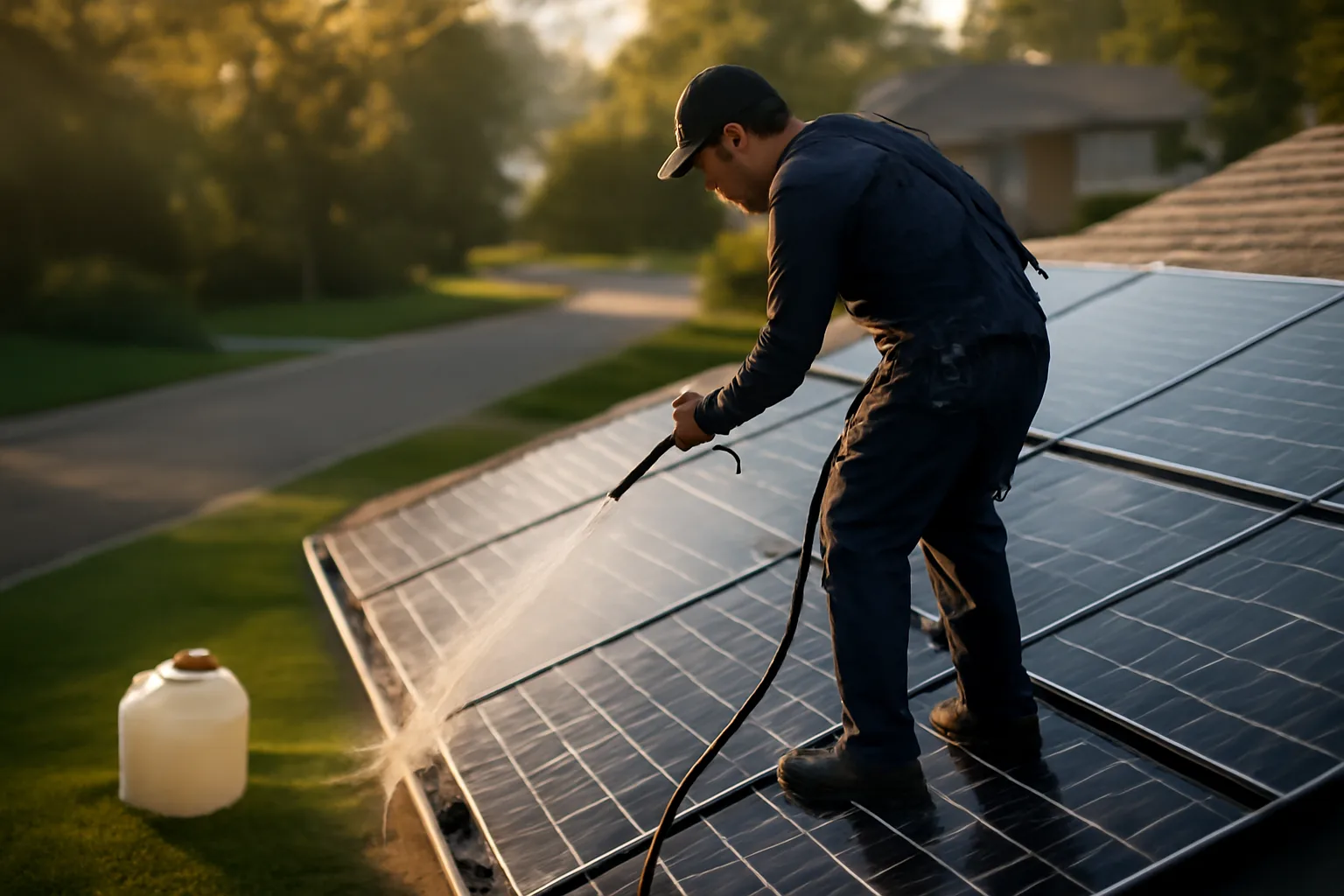
Solar panel cleaning is washing the glass on photovoltaic modules so dust, pollen, soot, bird droppings, and mineral film stop blocking sunlight. You are removing shade from a semiconductor device. You are not repairing the system. The work is closer to window cleaning than to electrical contracting.
The U.S. Department of Energy puts the physics in one line: "Photovoltaic (PV) devices generate electricity directly from sunlight via an electronic process that occurs naturally in certain types of material, called semiconductors." [1] Anything sitting on that glass cuts the light that reaches the cells. Uniform dust nicks the whole array a little. A streak of droppings can clip a cell string a lot.
I treat the job as two problems taped together. Dirt on glass. People on roofs. The first one is simple. The second one is where operators get hurt or get sued.
You do not need a truck full of chemicals. You need water that will not leave spots, a brush that will not scratch coatings, and a way to stay on the roof that would still look sane if someone filmed it. If a customer wants you to open an inverter, re-seat a connector, or run diagnostics, that is a different company. Write the scope so everyone knows you wash glass.
Residential arrays, commercial membrane roofs, and ground-mount farms share the same glass. The access is not the same. A 400 kW tracker row is a walking job. An 8 kW hip roof with no ridge anchors is a fall-protection job that happens to include a hose.
How do you start solar panel cleaning?
You start by confirming license rules with your state contractor board, then buying fall protection and a low-mineral water setup, then filing basic business paper. Do not start with a logo. The board question comes first because it changes what you can put on an invoice.
There is no national washing card. California's contractor definition is broad enough that you should read it, not guess. [11] Other states treat panel washing more like janitorial work until you touch wiring. Confirm with the board that actually issues the card. Processing times and fees change. I will not invent them.
Get an EIN online from the IRS if you want a bank account that is not your Social Security number, or if you will hire. [9] Pick a structure. An LLC is the usual first move because it separates personal assets from the work, not because it impresses anyone. The SBA walks through sole proprietorship, partnership, corporation, and LLC in plain language. [10]
Buy insurance before the first ladder goes up. General liability. If you have employees, workers' compensation in the states that require it (almost all of them once you have staff). Ask an agent who writes window cleaning or roofing. Lawn-care policies often exclude roofs.
Then practice. One story. Low pitch. Ground-mount if you can find it. Your early jobs should be slow on purpose. The first year is learning which arrays you can reach without standing on glass. It is not collecting truck wraps.
How much energy does dirty glass actually cost you?
Dirt costs you the production the glass would have made clean. NREL's PVWatts model uses a default annual soiling loss of 2%. [2] That number is a modeling default, not a reading from your customer's inverter. Real roofs run lower in rainy places and much higher where dust sits for weeks.
A 2019 study in Joule estimated that soiling has reduced global solar power production by at least 3 to 4 percent. [3] Rain resets a lot of local loss. A roof that sees weekly storms in the East is not a desert tracker in the Southwest. Nobody has good residential-only soiling data by zip code. The closest published work is utility-scale soiling economics, not HOA rooftops.
Bird droppings and heavy pollen are not the same as a thin dust film. Local shade on a single cell can drag down a whole series string. That is why an "it rained last month" argument fails when the array sits under a flyway.
Tilt helps. Steep modules shed better. Flat commercial roofs hold grime and puddles. If production data exists, use it. If it does not, you are guessing with a hose.
Monthly residential contracts in wet climates are usually a waste of the owner's money. Annual or seasonal visits after pollen, wildfire ash, or a dry summer are easier to defend.
Do you need a license to clean solar panels?
Maybe. It depends on your state, the contract, and whether you do any electrical work. Confirm with the contractor licensing board before you print business cards. There is no federal solar-washing license.
California law defines a contractor in Business and Professions Code section 7026 as a person who undertakes to construct, alter, repair, or improve a building, among other acts. [11] Some boards read washing as outside that. Some do not. I would not bet a stop-work order on a forum post.
If you only wash glass and never land conductors, you are usually outside C-10 style electrical classifications. That is not a permission slip. Read California solar panel cleaning rules, then the pages for Florida, Arizona, and Alabama. Same hose. Different paper.
City business tax certificates still show up. HOA rules still show up. Utility interconnection agreements do not hire you and do not license you.
If a bid includes troubleshooting the inverter, you just walked into electrical contracting. Split the job or walk away.
What water should you use on solar panels?
Use the lowest-mineral water you can reasonably haul, then a soft brush or a water-fed pole. Hard water leaves white spots that become the next soiling layer. Soft municipal water plus a squeegee can be enough. Very hard well water is a bad idea.
The USGS Water Science School classifies water from 61 to 120 mg/L as CaCO3 as moderately hard, 121 to 180 as hard, and more than 180 as very hard. [8] Those numbers describe tap water, not PV glass, but they tell you whether spots are likely.
| USGS class | Hardness (mg/L as CaCO3) |
|---|---|
| Soft | 0 to 60 |
| Moderately hard | 61 to 120 |
| Hard | 121 to 180 |
| Very hard | more than 180 |
Deionized water is popular because the minerals are gone. It sheets and dries cleaner. You pay for resin or an RO/DI cart. In a soft-water city I would not make DI a religion. In a hard-water desert I would not skip it.
Do not add dish soap as a default. Film. Streaks. Possible coating questions. If a module maker specifies a cleaner, that document wins. Recycled rinse water that ran across asphalt shingles is now dirty water. Do not pretend it is still DI at the bottom of the array.
I would test a corner and let it dry before I commit the whole roof. If you see spots, change the water, not the brush pressure.
What fall protection does OSHA expect on a solar roof?
On a construction site, OSHA requires fall protection at 6 feet. Most solar roofs sit well above that, so plan for a harness, a real anchor, or another listed system, not a pep talk. Treat the job as construction until a competent person and your insurer say otherwise.
29 CFR 1926.501(b)(1) says "each employee on a walking/working surface (horizontal and vertical surface) with an unprotected side or edge which is 6 feet (1.8 m) or more above a lower level shall be protected from falling by the use of guardrail systems, safety net systems, or personal fall arrest systems." [4] General industry walking-working surfaces use a 4-foot trigger. [13] Do not split hairs on a hip roof to save a harness.
Portable ladders used to reach another level need side rails that extend at least 3 feet above the landing. [5] That is the rule. A ladder a foot short is a citation waiting.
PPE has to be provided, used, and maintained when hazards are present. [6] Shoes that grip. Eye protection when you are flushing droppings. Gloves if you want skin left.
Water and electricity share the roof. OSHA's electrical safety-related work practices exist to prevent shock. [7] You should not be inside equipment. You should also not drive water into open connectors or broken glass. If a module is shattered, stop and tell the owner.
Gutters are not anchors. Satellite mounts are not anchors. A rated anchor, a designed harness system, or a method that keeps you off the fall line. Pick one.
What equipment do you need in year one?
Year one, buy a water-fed pole, a way to get low-mineral water, a soft brush, a squeegee, a harness and lanyard that fit you, a roof anchor the structure can actually hold, non-slip shoes, a GFCI if you run a pump, and hose long enough that you are not one tug from walking backward off the eave. That pile beats a wrapped van.
Skip the 4,000 psi washer. Module makers warn about high pressure and abrasives. NREL's PV O&M best-practices guide treats cleaning as maintenance, not as a demolition task. [12] A pressure washer is the wrong tool for coated glass. It is also a great way to drive water under frames.
A trailer tank is optional. Many first-year operators overbuy tanks and underbuy fall gear. Invert that.
If you want a pre-bundled starter pile, SolarWashPath publishes a $149 one-time DI Water + Roof-Safety Kit. You can assemble the same class of gear from a safety supplier and a water shop. The kit is a list with a box, not a license.
Do not cheap out on the harness. Do not buy the lightest pole if wind is real in your market. Do not use metal scrapers. Ever.
How often should you clean solar panels?
Clean when soiling costs more than the visit, or when the owner has a contract that already priced the visit. There is no honest national calendar. Rain, dust, pollen, birds, tilt, and whether the array is the customer's income all move the date.
Wet climates with frequent rain often need little more than an annual look and a droppings pass. Dry, agricultural, or desert sites can justify several washes a year. Pollen season is a local event. Wildfire ash is a local event. After those, a single visit beats a monthly myth.
Utility plants sometimes clean on a measured loss trigger, not a date. Houses rarely have that instrumentation. If the inverter app shows a clear step-down that rain did not fix, you have a case. If production looks normal, do not invent a crisis.
Tilt, frame lips that trap dirt, and nearby HVAC exhaust change the clock. So does a tree that drips sap. Talk to the owner about season. Spring pollen in the Southeast. Summer dust in the Basin. You will learn your county faster than any blog will.
I would rather do one thorough, documented wash than six sloppy sprays that leave minerals.
What cleaning mistakes void warranties or crack cells?
The expensive mistakes are abrasion, high pressure, standing on the laminate, and solvents the manufacturer never listed. Those crack cells, chew coatings, and create hot spots you will not see from the driveway. The module manual beats a video every time.
Do not walk on modules. The glass and the cells under it were never a sidewalk. Microcracks show up later as snail trails and warranty fights.
Do not use steel wool, razor blades, or abrasive pads. If mineral crust will not move with water and time, stop and reset the method. More pressure is not a method.
Ammonia, acetone, and random degreasers are a bad default. Some anti-reflective coatings are picky. If you cannot get the manual, wash with clean water and a soft brush only.
Broken glass is an electrical hazard and a cut hazard. Bag it in the notes. Do not finish the row.
Keep records. Photos before and after. A one-line note if you saw a cracked module. That paper is what you have when someone later claims you caused a string fault.
How should you price jobs when you have no book of business?
Price the safety setup, the stories, the pitch, the access, and the drive, more than panel count. A 20-panel ranch with hose bibs is not a 20-panel three-story townhouse with no parking. Panel count without access is a toy number.
I will not publish a fake national average. Local window-cleaning and pressure-washing labor rates are a closer analog than solar installation rates. Your workers' comp class and your insurance deductible belong in the number.
Bird-heavy sites take longer. So do arrays with no walkway and modules run to the eave. Charge for that. If you do not, you will rush, and rushing on a roof is how the day ends wrong.
First-year operators underprice to collect praise. Skip that. You need slack in the day for the ladder that does not fit.
A simple method: estimated hours on site times a loaded hourly rate, plus water and resin, plus a trip charge. If the array needs DI and you will burn a cubic foot of resin, that is not free. Put it on the line item.
Write exclusions. No interior work. No electrical diagnosis. No tile roofs you are not trained on. If clay tile is common in your market, train or decline.
What paper do you need before you take a customer's money?
Before you take money you need an EIN if you need one [9], a state entity filing if you formed an LLC, the local business license your city actually issues, insurance certificates, and a written scope of work. Confirm sales-tax treatment of residential cleaning with your state revenue department. Do not copy another state's answer.
The invoice should say you are cleaning accessible module glass. It should say you are not a solar installer and not an electrician. Photos attached. Date, address, array size as stated by the owner.
If you hire, add I-9 and payroll accounts. That is not optional folklore. It is DOL and IRS territory.
Board fees, application quotas, and usual approval times are not something a publisher should invent. Hawaii's board path and Connecticut show how different the paper can look. Read the current form. Call the board. Confirm every fee with the agency that collects it.
No approval promises. No timing promises. If a site lists a fee, treat it as stale until the board says it is current.
Is ground-mount cleaning different from roof work?
Yes. Ground-mount cleaning is mostly walking, water logistics, and not punching tracker bearings. Roof work is fall protection first and washing second. Same glass. Different day.
On the ground you still have trip hazards, wildlife, and live equipment. You still keep water out of combiner boxes. You still do not stand on modules. You just are not six inches from an eave.
Roofs add ladder rules [5], anchors, weather windows, and homeowners who want you done before school pickup. Tile, metal, and shingle all fail differently under a misplaced foot.
If you can build a first-year book on ground-mount and low ranch roofs, do that. Two-story tile can wait until the systems and the insurance are boring.
Colorado solar panel cleaning board notes matter for snow and altitude. Georgia is a different pollen and humidity story. Same hose. Different year.
When is solar panel cleaning a waste of money?
Cleaning wastes money when rain already did the job, when soiling sits below what the owner can measure, and when the visit costs more than the kilowatt-hours you return. NREL's 2% default is a modeling input, not a promise that every roof is down 2% today. [2]
Steep arrays in rainy places often look fine. New systems under a week of storms often look fine. A customer who wants weekly service on a small residential array in a wet state is buying theater.
It is also a waste if you cannot work safely. No anchor, no plan, high wind, thunderstorm, broken glass, or a roof you do not understand. Walking away is cheaper than a fall.
If production data is flat and the glass looks clear in raking light, say so. Keep the customer. Do not invent grime.
For the state board path and the starter checklist, go to /start. SolarWashPath is an independent publisher, not a law firm and not a service company.
Frequently asked questions
What is solar panel cleaning?
Solar panel cleaning is washing photovoltaic module glass to remove dust, pollen, droppings, soot, and minerals that block sunlight. It is maintenance, not electrical repair. You use low-mineral water and a soft brush. You do not open inverters or land wires. Production gains track how dirty the glass was, not how fancy the soap was.
How do you start solar panel cleaning?
Confirm license rules with your state contractor board, then buy OSHA-grade fall protection and a low-mineral water setup. File an EIN with the IRS if you need one, pick a business structure, and get general liability insurance before the first roof. Practice on low, simple arrays. Skip pressure washers. Write a scope that excludes electrical work.
Can I clean solar panels with a garden hose?
Yes, if the water is reasonably soft, the pressure is garden-hose gentle, and you can work without walking on modules. Hard water spots as it dries. A squeegee helps. A water-fed pole keeps you off the glass. Do not jam the nozzle into junction boxes or cracked panels.
Does rain clean solar panels enough?
Often, in wet climates with decent tilt. Rain is uneven and leaves minerals. Droppings and sticky pollen can stay. Desert and agricultural sites stay soiled after rare storms. Look at the glass in raking light and at production, not at the calendar. NREL still models a 2% default soiling loss because rain is not a complete reset.
Can I use a pressure washer on solar panels?
I would not. High pressure can drive water under frames, pit coatings, and void warranties. Module makers typically call for low pressure and soft media. A pressure washer is the wrong tool for this glass. Use a water-fed pole or a hose and brush, and keep abrasives off the laminate.
Do solar panels need to be turned off before cleaning?
Many manufacturers allow washing while the array is operating if you stay off connectors and damaged glass. That is not a reason to open equipment. If you do not have the manual, keep water off junction boxes and do not become an electrician. When in doubt, have the owner shut the inverter down.
Is solar panel cleaning a good business?
It can be if you price roofs honestly, carry insurance, and refuse unsafe access. It is not a national gold rush. Wet regions need fewer visits. Competition from window cleaners is real. Your limiter is fall protection and travel, not a secret soap. Confirm license rules before you spend on a van.
How long does a residential solar cleaning take?
A simple single-story ranch can be a short visit once you are set up. Two-story, steep, or bird-heavy arrays eat hours. Ladder placement and water setup often take longer than the brush work. Anyone quoting a fixed 20 minutes for every house is not counting safety or resin changes.
Do I need deionized water for solar panel cleaning?
Not in every city. You need it when tap water is hard enough to spot. The USGS treats more than 180 mg/L as CaCO3 as very hard. Soft municipal water plus a squeegee can look fine. In hard-water deserts, deionized water (or equivalent) is the practical default.
Can I walk on solar panels to clean them?
No. Walking risks microcracks, broken glass, and warranty fights. Use a pole from the roof plane beside the array, from a walkway, or from the ground. If you cannot reach without stepping on laminate, redesign the method or decline the job. Photos help if someone later claims damage.
What insurance do I need to clean solar panels?
General liability at a minimum, written for roof or window-cleaning work, not a lawn policy with a roof exclusion. Workers' compensation if you have employees, per state law. Ask the agent to read the exclusions out loud. Do not invent a coverage number from a blog. Get a quote for your actual class.
Does solar panel cleaning require a contractor license in every state?
No. Rules split by state and by whether you perform construction or electrical work. Confirm with the contractor board that issues licenses where you work. California's contractor definition is broad. Other states treat washing more like janitorial service. City tax certificates are separate from state contractor cards.
How do bird droppings affect solar panels?
They shade individual cells and can cut current on a string more than a thin, even dust film. They also stick through light rain. Treat droppings as a reason to visit even if the rest of the glass looks acceptable. Do not scrape with metal. Water, time, and a soft brush first.
What is the best time of day to clean solar panels?
Early morning or evening when glass is cool. Hot glass flashes water dry and spots. Midday heat is harder on you and on thermal shock at the edges of a cold stream. Avoid wet roofs, lightning, and high wind. Cool, still, and enough daylight that you can actually see the glass.
Sources
- U.S. Department of Energy, How Does Solar Work: Photovoltaic devices generate electricity directly from sunlight via an electronic process in semiconductor materials.
- Ilse et al., Joule (2019), Techno-Economic Assessment of Soiling Losses: Soiling has reduced global solar power production by at least 3 to 4 percent.
- OSHA, 29 CFR 1926.501 Duty to have fall protection: Construction fall protection is required at 6 feet (1.8 m) on unprotected sides and edges.
- OSHA, 29 CFR 1926.1053 Ladders: Portable ladders used to access another level must extend at least 3 feet above the landing.
- OSHA, 29 CFR 1910.132 Personal protective equipment: PPE must be provided, used, and maintained when hazards are present.
- OSHA, 29 CFR 1910.333 Selection and use of work practices: Safety-related work practices must be used to prevent electric shock.
- USGS Water Science School, Hardness of Water: USGS classifies 61 to 120 mg/L as moderately hard, 121 to 180 as hard, and more than 180 as very hard.
- IRS, Apply for an Employer Identification Number (EIN) Online: Businesses can apply online for an EIN from the IRS.
- U.S. Small Business Administration, Choose a business structure: SBA describes sole proprietorship, partnership, corporation, and LLC as common business structures.
- California Business and Professions Code section 7026: California defines a contractor as a person who undertakes to construct, alter, repair, or improve a building, among other acts.
- OSHA, 29 CFR 1910.28 Duty to have fall protection and falling object protection: General industry fall protection is required at 4 feet on unprotected sides and edges of walking-working surfaces.