Last updated 2026-08-18
TL;DR
California has no specific solar panel cleaning board. Most cleaning-only operators using deionized water and water-fed poles do not need a state contractor license. You still need a local business license, liability insurance, and must follow rooftop fall protection rules. Expect to pay $150, $350 for a typical residential cleaning, which takes about 1 to 2 hours.
Is there a solar panel cleaning board in California?
No. There is no state board, commission, or agency that specifically regulates solar panel cleaning in California.
What you run into instead is the Contractors State License Board (CSLB). The CSLB licenses contractors, not the existence of a "solar panel cleaning board." If your cleaning work crosses into what the state defines as construction, a contractor license may be required. But for plain glass-and-frame cleaning, the CSLB does not have a license category that fits you. This is not a gap in the law, it is just how California wrote the rules [1].
Do you need a license for solar panel cleaning in California?
The short answer: probably not, if you stick to low-pressure deionized water cleaning with water-fed poles and no chemicals. But the line is not always clean.
The CSLB says: "If you are the contractor on a project valued at $500 or more (combined labor and material costs), you must be licensed" [1]. A typical $200 residential panel cleaning, where the only input is water and your time, lands well below that. You are not constructing, altering, or repairing anything. You are just washing glass.
Things get sticky if you use pressure washing equipment. The CSLB categorizes pressure washing under classification D-56, a Limited Specialty license [2]. Some operators argue that solar panel cleaning with a low-pressure, pure-water system does not trigger D-56. Others, especially those upselling soft wash and roof washing packages, grab the D-56 to be safe. I have seen both paths work in California. If your marketing leans toward "roof and exterior cleaning" with any pump above 100 psi, factor in the D-56 requirement. For a business that only polishes solar arrays with a water-fed pole and DI rinse, you are almost certainly outside any CSLB licensing mandate.
One more layer: local business licenses. Every California business, regardless of CSLB standing, needs a city or county business license where you operate. Check your city's requirements through the CalGold portal [3]. Fees range from $30 to $200 a year, often with a simple online registration.
Unlike Arizona, where the Registrar of Contractors often requires a specialty trade license for panel cleaning, California has no parallel. That frees you from exam and bonding requirements on day one.
How much does solar panel cleaning cost in California?
A 2024 survey by SolarReviews puts the national average for residential solar panel cleaning between $150 and $350 per job. In California's competitive markets, you see price points toward the tighter end. Typical quotes I hear from operators are $150 for a small 10 to 12 panel system, $250 for a 20 to 24 panel setup, and $350, $450 once you pass 35 panels [6].
Per-panel pricing usually runs $3 to $5, which becomes economical on bigger jobs. Commercial flat-roof arrays with large rack-mounted systems push well above that, sometimes $0.15, $0.25 per watt, but those jobs are harder to win without a track record.
Note that California's wildfire-prone areas and agricultural zones can charge a premium. Panels caked in ash or dust from almond harvests take longer. Operators here often add a $50, $75 surcharge and it sticks.
Here is a rough cost breakdown by system size, based on conversations with three operating crews in the Central Valley and Inland Empire:
How long does solar panel cleaning take in California?
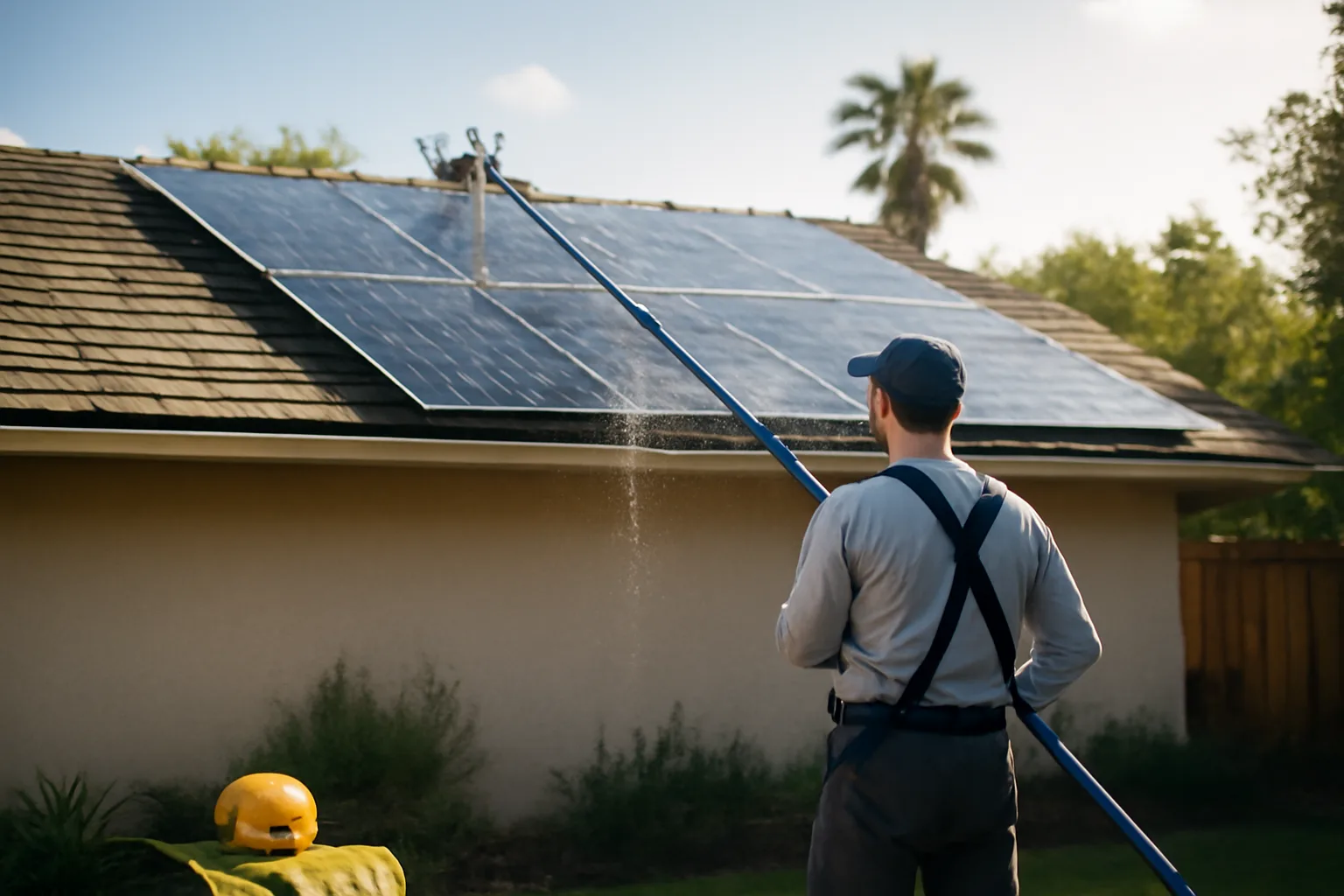
For a standard residential rooftop system of 20 to 30 panels, a professional cleaning with a water-fed pole and deionized water takes 1 to 2 hours start to finish. EnergySage's solar cleaning guide notes: "A professional solar panel clean usually takes an hour or two" [5].
What eats up the clock is the site arrival, ladder setup, harness-up if the roof pitch is steep, and any walk-around to inspect panel condition. The actual rinsing goes fast, maybe 15 to 20 minutes on a 20-panel array, once you are dialed in.
Ground-mount systems are faster, often under 45 minutes. A bigger variable is the water source. If you are running from the customer's spigot and need to run a long hose, it adds 10 to 15 minutes. If you haul a 100-gallon tank on a truck, you set up your own pump and move faster.
In California's summer, you should start jobs before 9 a.m. to avoid cleaning hot glass. That might mean you can squeeze in only one job before 11 a.m., but the actual cleaning time per job stays in the 1 to 2 hour window.
What insurance do you need for solar panel cleaning?
California does not mandate a specific insurance policy for panel cleaners, but operating without coverage is a fast way to lose a client or damage your personal assets.
General liability insurance is the bare minimum. Most operators carry $1 million per occurrence, costing $40, $80 a month through a business owner's policy. The U.S. Small Business Administration recommends general liability for any business that interacts with customer property: "General liability insurance protects your business from financial loss… if your business causes property damage or bodily injury" [8].
If you store water tanks, poles, and DI vessels in a van or truck, consider an inland marine rider to cover stolen gear. Workers' compensation kicks in the moment you hire a helper in California, required by state law even for one employee. I suggest setting up a policy through a local broker who knows contractor-class risks.
Rooftop safety rules in California
You are likely not classified as construction, but Cal/OSHA still cares if you are on a roof. Fall protection requirements are stiff. For construction activities, Title 8, Section 1670 requires fall protection when employees are exposed to fall hazards of 6 feet or more to a lower level [4]. Even if you argue that cleaning is maintenance, using the same threshold is smart.
Practically, that means a full-body harness, a roof anchor, and a positioning lanyard any time your feet leave the ladder. Many solo operators skip it on single-story walkable roofs with a 4:12 pitch or less, but that is your call, not mine. The rule is clear: if you fall and Cal/OSHA investigates, you need to show you had a plan.
On steep tile roofs, I recommend a ladder hook system and a safety harness every time. No hero stuff.
Starting your business: a paper-path checklist
When someone asks me how to start a solar panel cleaning business in California without spinning their wheels, I give them this exact sequence:
1. Form an LLC through the California Secretary of State's bizfile portal [9]. Separate your personal and business assets from day one. 2. Get an EIN from the IRS, free and immediate online. 3. Register for a local business license in the city where your mailing address sits [3]. This is not optional. 4. Open a business bank account. Most banks want your stamped articles of organization and EIN letter. 5. Secure general liability insurance. Many carriers will bind a policy the same day. 6. Buy your water-fed pole, DI tank, and safety gear. The $149 DI Water + Roof-Safety Kit from SolarWashPath gets you working with the right tools without overinvesting. 7. Print a simple, board-confirmable fact sheet to hand to potential customers: showing your insurance certificate, your LLC status, and your cleaning process. Nothing sells trust faster than paperwork.
That is it. No board exam, no state license application. Just local compliance and insurance.
Common traps and how to avoid them
The biggest trap I see is a new operator grabbing a pressure washer, adding a few drop-in chemicals, and calling it solar panel cleaning without checking the CSLB position. You drift into D-56 territory, and if a neighbor reports you for unlicensed activity, the CSLB can issue a citation and a fine up to $5,000 [1].
Another trap is ignoring the local business license. An officer in a high-compliance city like Santa Monica or Irvine can write a ticket on the spot. It is a cheap fix that becomes expensive when you skip it.
Finally, watch your insurance exclusions. Some general liability policies exclude work above one story or exclude "commercial cleaning of solar arrays." Read the endorsement page. I learned that $100 the hard way.
How SolarWashPath kits simplify the first 90 days
I respect operators who piece together a stack of Home Depot buckets and Amazon poles. But if you are serious about this as a business, your image matters. Showing up with a professional kit sends a signal that you are the real thing. SolarWashPath's starter kit pairs a DI filter system with a carbon-fiber pole and roof-safety basics for $149. It is not a magic box, but it removes the guesswork of water quality and pole reach. You can focus on knocking on doors and booking jobs.
Frequently asked questions
Do you need a license for solar panel cleaning in California?
Generally no, if you use low-pressure deionized water and water-fed poles without adding chemicals. The Contractors State License Board (CSLB) only requires a license for construction work over $500 [1]. Simple glass cleaning does not cross that threshold. If you add pressure washing, you may need a D-56 license [2].
Does California require a business license for window cleaners?
While the state does not require a specific "window cleaner" license, every city and county requires a general business license for any person conducting business there. Use the CalGold portal [3] to find your local requirements. Expect a small annual fee.
How much does solar panel cleaning cost in California?
Typical residential cleaning runs $150, $350, based on system size and location [6]. Per-panel pricing is $3, $5. Commercial and large residential systems can exceed $500. Operators in dusty or ash-prone areas often add a $50, $75 surcharge.
How long does solar panel cleaning take in California?
For a standard 20 to 30 panel rooftop array, plan on 1 to 2 hours including setup and safety checks [5]. Ground-mount systems take less time, often under 45 minutes. Job duration is affected by roof pitch, hose runs, and whether panels are hot.
Is a contractor license required for solar panel cleaning?
Not for pure cleaning. The CSLB defines a contractor as someone who constructs or alters a building and charges $500 or more [1]. Cleaning does not equal construction. However, if your service includes roof repairs, painting, or heavy chemical application, a license becomes necessary.
What kind of insurance do I need?
General liability with at least $1 million coverage is standard. Workers’ comp is mandatory if you have any employees. Inland marine insurance protects mobile equipment. The SBA recommends liability coverage for any business touching customer property [8].
Can I clean solar panels from a ladder in California?
Yes, but you are subject to Cal/OSHA fall protection rules. If you are working at heights over 6 feet on a roof, you need fall arrest gear [4]. Many solo operators use a safety harness and roof anchor even on one-story structures.
Is there a solar panel cleaning certification exam?
There is no state-mandated exam. Some manufacturers offer training programs, but they are not required to operate in California. Your customer’s trust comes from insurance and a documented process, not a board certificate.
What water do pros use for solar panel cleaning?
Deionized or reverse osmosis water is the standard. It prevents mineral spotting when the panels dry. A portable DI tank paired with a carbon fiber water-fed pole gives you a brushless, streak-free clean without ladders on simple roofs.
How often should panels be cleaned in California?
In most of California, one or two cleanings a year is enough. Areas with heavy bird droppings, agricultural dust, or wildfire ash may need quarterly service. A good rule is to clean when output drops more than 5% from a baseline measurement.
Is solar panel cleaning profitable in California?
It can be, with low startup costs and healthy margins. A $200 job might cost $5 in DI resin and 1.5 hours of time. Building recurring commercial routes is where the real money sits.
Sources
- CSLB Work Requires a License page: Any construction project valued at $500 or more (labor and materials) requires a license; simple cleaning does not meet the definition.
- CSLB License Classifications: D-56 is the classification for pressure washing; water-fed pole cleaning with no pressure does not fit this category.
- CalGold Business Permit System: Portal to locate city and county business license requirements, applicable to all California businesses.
- Cal/OSHA Title 8, Section 1670: Fall protection required for construction workers exposed to fall hazards of 6 feet or more; prudent for roof cleaning.
- EnergySage Solar Panel Cleaning Guide: Professional solar panel clean usually takes an hour or two.
- SolarReviews 2024 Cost Article: National average residential cleaning cost $150-$350; per-panel pricing $3-$5.
- California Secretary of State bizfile: Online portal to register an LLC or corporation.
- U.S. Small Business Administration insurance guide: General liability insurance recommended for businesses interacting with customer property.