Last updated 2026-08-18
TL;DR
Arkansas does not license solar panel cleaning. Routine washing sits outside the contractor statute, so there's no trade license to renew. Your one hard deadline is the LLC annual franchise tax: $150 to the Secretary of State, due May 1. Residential cleans run $150 to $350 nationally, often less in Arkansas, and take 1 to 2 hours for a typical home. Check your city too.
Do you need a license for solar panel cleaning in Arkansas?
No. Arkansas issues no solar panel cleaning license, and routine washing does not fall under the state's contractor statute. Arkansas Code § 17-25-101 defines regulated contractors around construction, repair, alteration, and improvement work. Washing panels with deionized water and a soft brush is exterior maintenance. That's a different animal [2].
The Contractors Licensing Board is not waiting for your solar cleaner application. There isn't one. Keep the job to water, detergent, and brushing, and you have no state trade license to renew.
The moment you start checking wiring, tightening racking, or patching a roof, the scope changes. Then you may need an electrician's or contractor's license [2].
So the real renewal for an Arkansas solar cleaning business is not a trade license. It's three things: your business entity, your local privilege license, and your insurance. That's the whole map.
What renewal paper do you actually owe in Arkansas?
One deadline matters most: the LLC annual franchise tax, $150, due May 1. Most new owners form an Arkansas LLC, and that single date drives the year. The Arkansas Secretary of State puts it plainly: "Annual franchise taxes are due May 1 each year" [1]. Miss it and you risk late penalties plus administrative dissolution.
A corporation files an annual franchise tax too, on its own schedule. The LLC number is the one cleaners ask about. You pay online through the Secretary of State's business portal. The fee does not move with how many panels you wash. It stays flat at $150 for a standard LLC as of this writing. Confirm the current amount before you file, because the General Assembly can change it [1].
Then check local. Many Arkansas cities require an annual business or privilege license on top of the state filing. That one is usually separate and cheaper, but it's real. More on the local piece further down.
How much does solar panel cleaning cost in Arkansas?
There's no statewide rate sheet for solar panel cleaning in Arkansas. The closest honest data is national. HomeGuide's cost survey puts a typical residential visit between $150 and $350, with per-panel rates of $10 to $25 [6]. Arkansas lands in the bottom half of that range because labor is cheaper than California or Hawaii, and a lot of homes are single story.
For a standard 20-panel, 6kW home in Little Rock or Fayetteville, expect a $160 to $260 visit. A heavily soiled array after pine pollen season may push to $300. A 10-panel system can run as low as $120. A steep two-story 30-panel install can hit $350 or more. None of these are official Arkansas figures. Get two or three local bids before you set your own price.
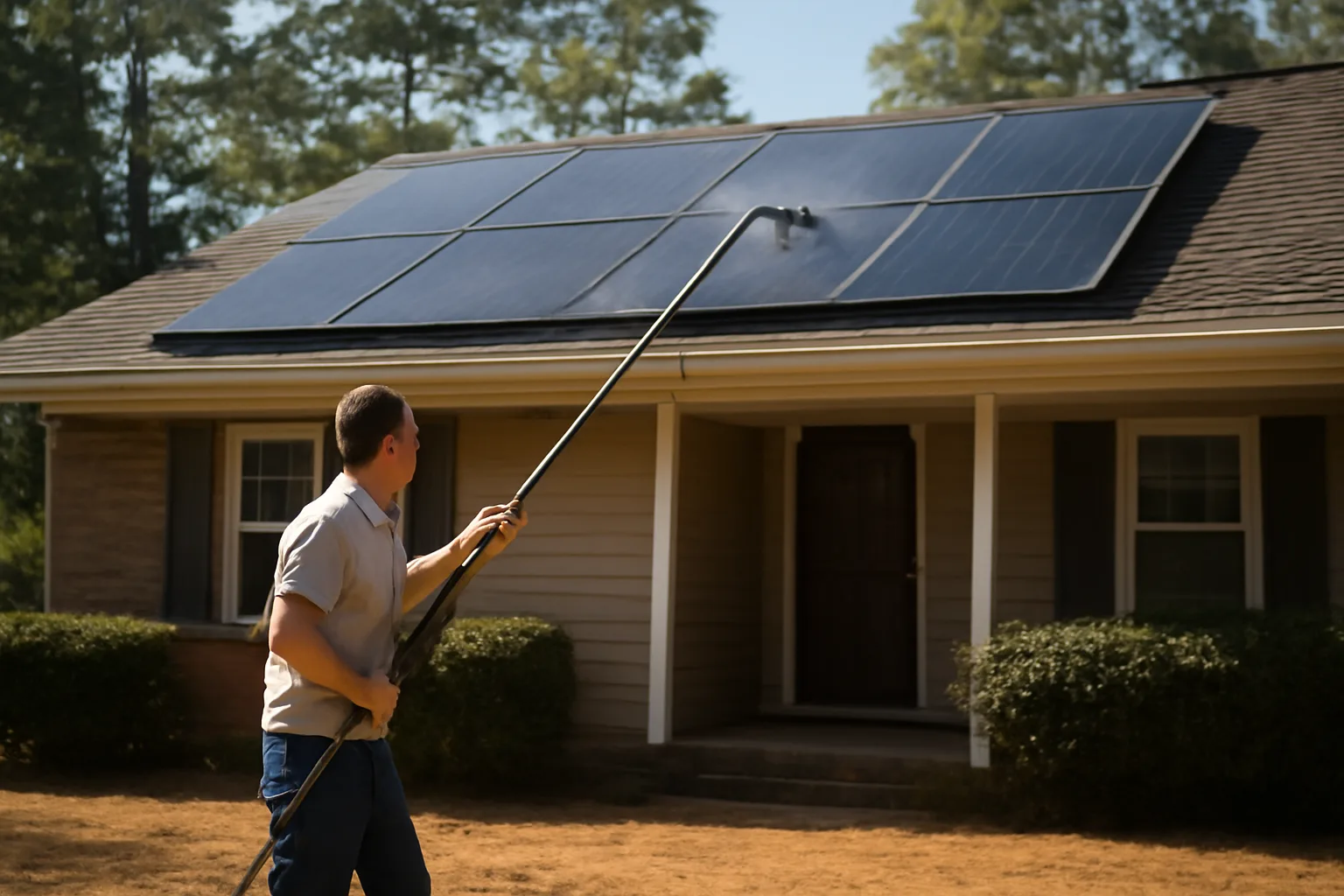
A water-fed pole lets you clean from the ground. That saves setup time and often lets you price lower. The $149 starter kit from SolarWashPath covers the deionized water gear and basic roof safety. It's not the whole cost story, but it removes the biggest first-week equipment unknown.
How long does solar panel cleaning take in Arkansas?
A typical 20-panel residential clean takes 1 to 2 hours, setup to rinse. That assumes a one-story roof, normal dust and pollen, and a deionized water pole with a soft brush. Add 30 to 60 minutes for a two-story roof, a steep pitch, or heavy tree sap.
No state agency publishes a time study for this. The 1 to 2 hour figure is what residential crews report across the country. Arkansas spring pollen and late-summer dust add a few minutes per panel. If you're still learning, block a half day for your first two or three jobs. Speed comes from repetition, not from skipping the rinse.
When a customer asks, quote a window, not a promise. About two hours for a standard one-story. Three to four for two-story or heavily soiled. You'll rarely be wrong.
Does Arkansas require a contractor's license for roof access or water-fed pole work?
No, not if the work stays on the outside of the glass. The Arkansas contractor statute aims at construction and repair. A pole-fed brush running pure water sits in the same category as window washing. Standing on a ladder and rinsing a panel does not make you a general contractor [2].
What changes the answer is what you touch. Remove a panel to clean underneath and that can read as repair or alteration. Meter the electrical connectors or swap a microinverter and you're doing electrical work outside a cleaning scope. Don't. Hand that to a licensed solar installer or electrician.
Watch your marketing too. If your ad says "solar panel repair and cleaning," you've handed the state a licensing question. Keep the offer to washing, dust removal, and soiling loss recovery.
What local business renewals should I check in Arkansas?
State renewal is half the picture. Cities and counties in Arkansas can require a privilege or business license. Little Rock's finance department, for one, requires most businesses operating in the city, even home-based ones, to hold and renew a business license [7]. Fayetteville, Jonesboro, and Springdale run their own versions.
The annual fee is usually modest, often $25 to $100 depending on city and business type. There's no single portal for every Arkansas city. You check the city clerk or finance page for each town where you work. Live in one city and clean panels in another, and you may need a license in both.
This is the part out-of-state advice misses. A $150 state LLC filing does not make you legal to knock on doors in Little Rock. The local license is the one the customer's city actually sees. Working across the line? Alabama and Florida run different local rules.
What insurance and safety records do Arkansas solar panel cleaners need?
Insurance is not a state license, but it's the renewal real customers ask about. General liability in the $500,000 to $1 million range is common for vendor approvals. Some HOAs and property managers want an additional insured certificate before you set foot on the property. No Arkansas law fixes your policy amount. The market and your client base do.
Hire anyone, even part time, and fall protection becomes a federal issue. OSHA's walking-working surfaces standard says an employer "must ensure each employee on a walking-working surface with an unprotected side or edge that is 4 feet or more above a lower level is protected from falling" [4]. Roof cleaning with employees then needs guardrails, a safety net, or a personal fall arrest system. A water-fed pole from the ground sidesteps most of it.
Keep a simple safety log. One line per job: date, address, roof access used, fall protection used, equipment inspected. Two minutes. It helps if anyone ever asks.
Do I need an EIN or Arkansas tax account to renew?
Most Arkansas LLCs pull a federal employer identification number (EIN) from the IRS. It's free and takes minutes online [8]. A single-member LLC with no employees can use the owner's Social Security number for some filings, but an EIN opens a separate business bank account and keeps your SSN off customer W-9s.
Arkansas's Department of Finance and Administration handles sales and use tax. Whether solar panel cleaning is a taxable service here is something to confirm with DFA before you invoice. Some personal services are taxed, some aren't, and the line moves. You don't want to learn in April that you owed tax and never collected it [9].
Have employees, and state income tax withholding plus unemployment insurance accounts come into play. A one-person LLC skips most of that. Stay on top of the franchise tax either way.
What does the first-year renewal really look like?
Form your LLC in July 2025, and your first state renewal is not July 2026. It's May 1, 2026. The Arkansas franchise tax ignores your anniversary date. It's a fixed calendar deadline every year [1].
Here's the structure:
| Item | Typical due date | Typical cost |
|---|---|---|
| Arkansas LLC annual franchise tax | May 1 each year | $150 |
| Local city privilege license | Varies by city, often Jan 1 or July 1 | $25 to $100 |
| General liability insurance | Policy anniversary | $500 to $1,200 per year |
| EIN one time | Before first client | $0 |
Costs vary. The franchise tax is a hard $150 for a standard LLC as of this writing. Insurance moves with coverage, location, and claims history. The local license moves by city.
Start in October and you still renew by May 1. It feels early. It's normal.
Is the $150 Arkansas LLC worth it for a one-person cleaning business?
For most roof-access cleaners, yes. You're working on other people's roofs. A $150 yearly fee is cheap protection against personal liability for equipment, property damage, and contract disputes. It also makes you look like a business when a commercial property asks for your certificate of insurance and W-9.
Stay on the ground with a pole-fed system, own nothing beyond a truck and a brush, and a sole proprietorship carries no state renewal. That's a real savings. Hire anyone, climb roofs, or clean for HOAs, and the LLC is the safer default.
Skip the registered agent service just for renewal. You can be your own registered agent in Arkansas if you have a physical street address and you're available during business hours. That kills the recurring $100 to $200 service fee.
How does Arkansas weather affect cleaning renewal and frequency?
Arkansas pollen runs hard from late February through April. Pine and oak pollen settles on glass and cuts output. Late summer brings crop dust and dry spells. The good news: Arkansas gets enough rain to wash away light dust most months. NREL's PV soiling research shows soiling losses vary by region, and rainy climates usually see lower annual soiling on tilted panels [5].
That doesn't mean skip a year. Pollen cakes with morning dew and turns into a film that rain alone won't lift. A semiannual clean, once after pollen season and once in September, fits most Arkansas homes. Near a gravel road or a soybean field, offer quarterly.
This rhythm helps your renewal calendar. The May 1 franchise tax deadline lands right after pollen season. Set the reminder for the same week you wrap the spring push.
What records should you keep for Arkansas renewal?
Keep one folder: your Arkansas LLC articles of organization and operating agreement, your Secretary of State franchise tax payment confirmations for every year, your local city or county business license receipts, your certificate of liability insurance, any EIN letter and W-9, and a short note on worker classification if you use helpers.
None of these are hard to produce, but you'll need them when a city asks why you're working without a local license, or when a client's vendor portal wants proof of insurance. The franchise tax confirmation is the one people lose. Save the PDF from the SOS portal before you close the browser.
Starting gear like the $149 SolarWashPath DI water and roof-safety kit is a one-time purchase, not a renewal. Renewal in Arkansas is a paperwork problem, not a licensing exam. File the LLC, pay the $150 by May 1, check your city, carry insurance, and clean panels.
Frequently asked questions
Do you need a license for solar panel cleaning in Arkansas?
No. Arkansas has no solar panel cleaning license, and routine washing falls outside the contractor licensing statute. You still need a local business license in many cities and, if you form an LLC, an annual $150 franchise tax. Keep your scope to cleaning only.
How much does solar panel cleaning cost in Arkansas?
National data puts residential cleaning at $150 to $350 per visit. Arkansas often runs lower, with a typical 20-panel home between $160 and $260 because of cheaper labor and single-story stock. Get local bids. Per-panel pricing is usually $10 to $25.
How long does solar panel cleaning take in Arkansas?
A standard 20-panel one-story residential clean takes 1 to 2 hours. Two-story or steep roofs add 30 to 60 minutes. Pollen and tree sap add extra time. No state time study exists, so quote a window, not a firm promise.
Do I need a contractor's license to clean panels on roofs in Arkansas?
No, if you only wash panels and do not alter or repair the array. Walking on the roof to rinse panels is not construction under Arkansas Code § 17-25-101. Touching wiring, removing panels, or repairing racking changes that.
What is the annual renewal for an Arkansas LLC?
Arkansas LLCs file an annual franchise tax with the Secretary of State by May 1. The tax is $150 for a standard LLC as of this writing. Late filings can bring penalties and administrative dissolution. Pay online and save the confirmation.
Is the $150 franchise tax the same for an Arkansas corporation?
The corporation franchise tax has its own schedule and can be higher based on capital structure. Most solar panel cleaners form an LLC, not a corporation. Confirm your exact entity amount with the Arkansas Secretary of State each year before filing.
Do I need a local business license in every Arkansas city?
Usually yes for cities where you physically operate, even part time. Little Rock requires business licenses for most businesses, including home-based ones. Fees often run $25 to $100. Check each city clerk's office. County requirements vary.
Can I operate as a sole proprietor with no state renewal?
Yes. A sole proprietorship has no annual state franchise tax. You pay income tax on your Schedule C, and you still need local licenses and insurance. The tradeoff is personal liability. I'd still use an LLC if I got on roofs.
Does Arkansas require workers' comp for a one-person cleaning business?
Generally no, if you have no employees. Owners can exclude themselves in many cases. Hire even one helper and check Arkansas Workers' Compensation Commission requirements before the first job. The exact threshold and construction classification can change.
Is solar panel cleaning taxable in Arkansas?
Maybe. Arkansas taxes some services and not others. Confirm whether your cleaning service is subject to sales and use tax with the Arkansas Department of Finance and Administration before you send invoices. Collecting tax late is expensive.
What safety gear do I need before roof cleaning in Arkansas?
Stay on the ground with a water-fed pole and you need eye protection, gloves, and slip-resistant shoes. Go on the roof and add a fall arrest system or guardrail plus a ladder stabilizer. OSHA's roof edge threshold for employees is 4 feet.
How often should panels be cleaned in Arkansas?
Most Arkansas homes do well with twice a year, after spring pollen and in September. Homes near gravel roads or soybean fields may need quarterly. Rain washes light dust, but pollen films need manual removal.
Do I need an EIN for a single-member Arkansas LLC?
No legal requirement if you have no employees. But an EIN is free from the IRS and keeps your Social Security number off W-9s and bank accounts. Get one if you plan to hire or form a multi-member LLC.
What is the biggest renewal mistake in Arkansas?
Missing the May 1 franchise tax deadline. Cleaners get buried in spring pollen and forget the $150 filing. Set a calendar reminder for April 20. Losing your LLC over $150 is a preventable error.
Sources
- Arkansas Secretary of State, Franchise Tax: Arkansas LLCs pay a $150 annual franchise tax due May 1 each year.
- Arkansas Code § 17-25-101 (2023): Arkansas contractor licensing law covers construction, repair, alteration, and improvement, not routine exterior cleaning.
- IRS, Independent Contractor (Self-Employed) or Employee?: The IRS distinguishes employees from independent contractors based on behavioral, financial, and relationship control.
- OSHA, 29 CFR 1910.28 (Walking-Working Surfaces): Employers must protect employees from falls on walking-working surfaces 4 feet or more above a lower level.
- HomeGuide, Solar Panel Cleaning Cost: Residential solar panel cleaning costs $150 to $350 per visit, or $10 to $25 per panel.
- IRS, Apply for an Employer Identification Number (EIN) Online: Businesses can obtain an EIN free online from the IRS.
- Arkansas Department of Finance and Administration, Sales and Use Tax: DFA administers Arkansas sales and use tax; service taxability should be confirmed with the agency.
- Arkansas Contractors Licensing Board, Laws and Rules: The Contractors Licensing Board licenses construction trades and enforces Arkansas contractor licensing law.