Last updated 2026-08-21
TL;DR
Solar panel cleaning is washing PV modules so dust and droppings stop blocking light. NREL's PVWatts default soiling loss is 2% a year. Start with an entity, an EIN, insurance, and whatever license your city or state board actually requires. Prefer water-fed poles from the ground. OSHA construction fall protection starts at 6 feet. Confirm paper locally.
What is solar panel cleaning?
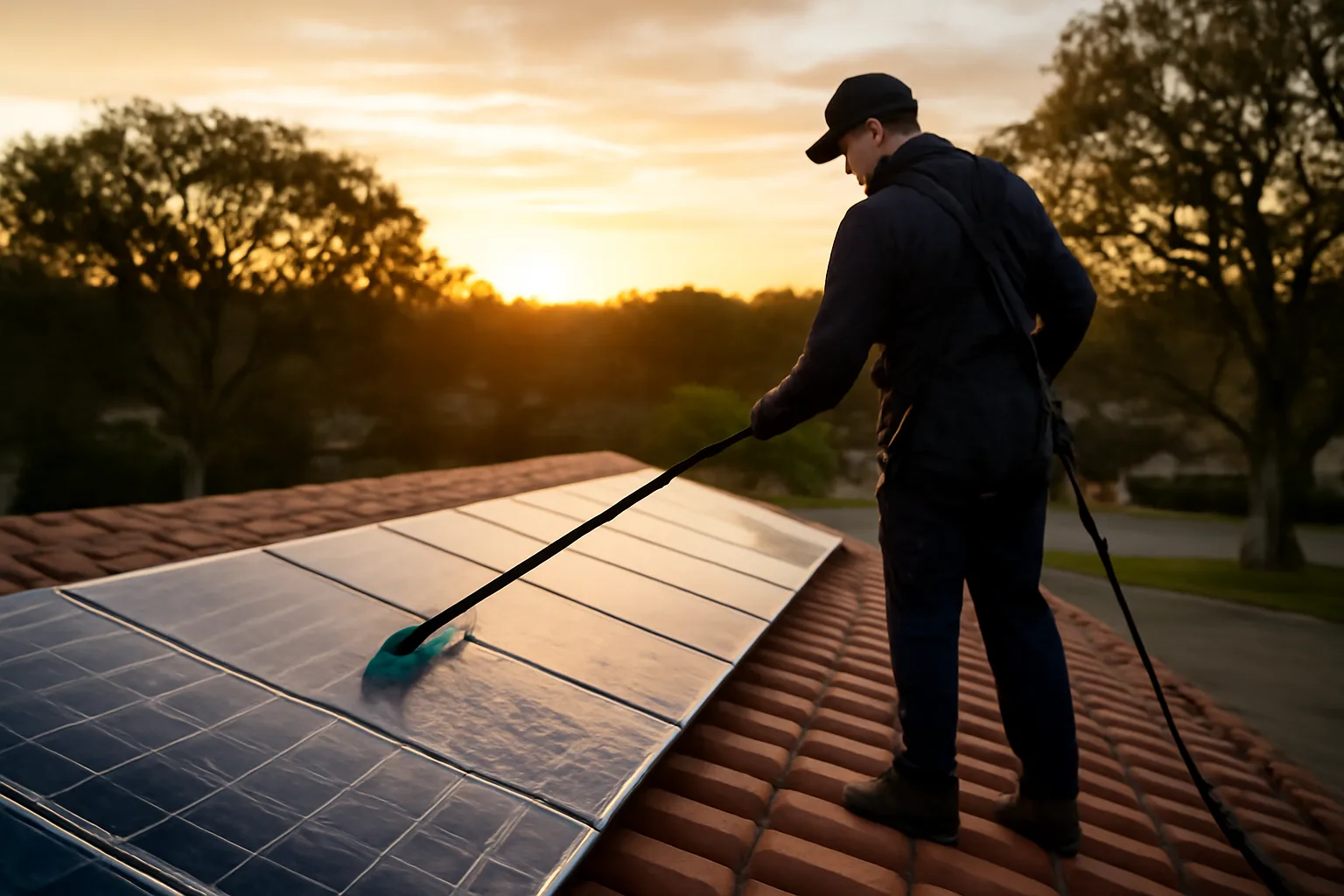
Solar panel cleaning is washing photovoltaic module glass so dust, pollen, soot, and bird droppings stop blocking light. You are not installing arrays. You are not fixing inverters. You remove soil from glass, then leave the site in a condition people can walk without slipping.
That is the whole trade. People dress it up. The work is still a wash.
A photovoltaic cell turns sunlight into electricity. Dirt on the cover glass cuts the light that reaches the cell. NREL's PVWatts Version 5 Manual sets a default annual soiling loss of 2%. [3] Dry, dusty, or agricultural sites run higher. A roof that sees regular rain may need little help. A low-tilt array under a flight path is a different job.
Census NAICS 561790 is the statistics bucket that includes exterior building cleaning and pressure washing of buildings. [8] That code is how some operators file taxes. It is not a license, and it does not tell you if your city wants a contractor card.
I would not sell a suburban homeowner a 30% production miracle. Rain already did part of the work. If they have a monitoring app, compare a dirty week to a clean week. If they don't, say you cannot prove a number. Nobody has clean public data on every roof in every county. The closest planning figure people actually use is that 2% PVWatts default, and that is an assumption for energy models, not a promise for your route.
Most residential solar panel cleaning is pollen in spring, dust in late summer, and birds whenever they feel like it. Commercial ground-mount in farm country is silt and spray film that bakes on. Same skill, different day.
How do you start solar panel cleaning?
You start solar panel cleaning by treating it as a small contracting business, not a weekend gadget hobby. Form an entity your state recognizes, get an EIN if you need one, buy insurance, then ask the city clerk and the contractor board what license applies to exterior washing and roof access. [5] [6]
Do not buy a giant trailer first. That is a common waste of money.
The order I would actually use is boring on purpose. Name search and LLC (or whatever your state uses). EIN. A bank account that is not your rent account. General liability quote. A conversation about workers' compensation the week you think about hiring. City or county business tax receipt. Then, and only then, the water system.
The IRS does not charge a fee to apply for an Employer Identification Number online. [5] SBA's licenses page says the licenses and permits you need vary by activity and location. [6] There is no national solar-washer card. A course that sells you one is selling a course.
Write a one-page agreement before the first job. Scope, water source, runoff, no walking on modules unless the maker allows it, what happens if the weather turns, and a clear line that you are not an electrician. Take photos before you wet anything.
First customers are rarely random rooftops off a map. Talk to people who already pay for exterior cleaning. Property managers with filthy carports. HOAs with a dusty community array. Solar installers who hate washing. Twenty real conversations beat a vinyl wrap on a truck you have not earned.
Call the board. Get a name and a date. Keep the note.
Do you need a license for solar panel cleaning?
Maybe. It depends on your state, your city, the dollar size of the contract, and whether you step onto roofs. Confirm with the contractor board and the city clerk. Do not take a group-chat answer.
Some places treat solar panel cleaning as janitorial work that needs only a local business tax receipt. Other places treat roof access like construction the minute a ladder hits a two-story eave. Dollar thresholds and classification lists change. I will not invent a current fee or a processing time. Confirm those with the board that prints the card.
California's contractor board is the example people copy into forums. Other states do not copy it. If you work there, read the paper path for solar panel cleaning renewal in California after you talk to CSLB. Same habit for Florida and Arizona. The renewal writeups earn their keep even on day one, because they show which agency actually owns the classification.
Give the board your exact scope. Water-fed pole from the driveway is not the same as a harness on a 6:12 tile roof. Ask them to name the classification out loud. If two clerks disagree, ask for the written rule.
Skip any vendor who says a certificate from their academy replaces a state card. It does not.
How often should solar panels be cleaned?
Clean when the soil costs more than the wash, not on a calendar copied from a blog. In wet climates, many homes need one visit a year, and some need none. In dry, dusty places, commercial arrays can justify several washes a year.
NREL's PVWatts Version 5 Manual sets a default annual soiling loss of 2%. [3] That number is for planning software. It is not a schedule. NREL's Best Practices for Operation and Maintenance of Photovoltaic and Energy Storage Systems (3rd edition) is the federal lab document that frames cleaning as part of plant upkeep, next to inspection and vegetation. [4] Skim it. Do not worship it.
Bird-heavy roofs need spot work even when dust is low. Agricultural spray can leave a film rain will not cut. Traffic soot on a carport is its own mess.
I would not sell monthly residential plans in a rainy coastal city. I would sell a measured plan in orchard or desert country if monitoring shows a real dip. If the owner has no monitoring, you are guessing. Say you are guessing.
Rain helps. Rain does not rinse pollen out of the frame edge on a low-tilt array. Anyone who tells you otherwise has not looked closely.
What equipment do you need to clean solar panels?
You need low-mineral water, a water-fed pole, a soft brush that will not grind grit into glass, a TDS meter, basic PPE, and fall gear if you leave the ground. You do not need a diesel hot-water skid on day one.
Buy the meter. Hard tap water dries into spots that look like you made the array worse. Deionized or reverse-osmosis water is how you avoid that. There is no single federal TDS statute for solar panel cleaning. Follow the module maker and chase water that dries clean.
If you want a starter water-plus-safety bundle instead of a dozen separate orders, SolarWashPath publishes a $149 one-time DI Water + Roof-Safety Kit. You can also buy a mixed-bed resin vessel and an ANSI-rated harness from industrial suppliers. I would not cheap out on the harness either way.
Ladders are equipment, not an afterthought. OSHA's construction ladder rule at 29 CFR 1926.1053 requires that a ladder used to reach an upper landing surface extend at least 3 feet above that landing. [9] Tie it off. Do not carry a pole up a ladder you are also climbing like a pirate.
Pressure washers are a bad default on modules. High pressure and a close nozzle crack cells and void warranties. If a manufacturer publishes a max pressure, stay under it. If they don't, use low flow and a brush.
Skip the $8,000 custom trailer until you have repeat work and a place to park it. A clean hose, a working DI vessel, and a harness you actually wear will make more money in month one.
Can you use soap or a pressure washer on solar panels?
Most module makers want clean water and a soft brush, not dish soap. Soap can leave a film. It can also turn a simple rinse into a wastewater problem your city cares about.
Plain water, preferably deionized, is enough on ordinary dust. Bird lime may need dwell time and a brush, still without household detergents if you can avoid them. Ammonia glass cleaner is a no. Abrasive pads are a no.
Pressure washing is how people crack cells and then argue with a warranty department. Do not make it your standard method. A low-pressure rinse to wet the glass, then a brush, then a final pure-water rinse is the pattern that survives contact with manufacturer PDFs.
If a commercial site requires a listed cleaner, get that in writing from the owner and match the module warranty. Your preference does not override their paper.
Runoff from a soap job can be a stormwater issue. A no-soap DI rinse is simpler, cheaper, and easier to defend if someone from the city walks up. I would start there and stay there until a contract forces a change.
What OSHA roof and fall rules apply to solar panel cleaning?
If you work on a walking or working surface with an unprotected side or edge 6 feet or more above a lower level, OSHA's construction fall rule requires a guardrail system, a safety net system, or a personal fall arrest system. [1] Prefer the ground. Poles exist for a reason.
The text at 29 CFR 1926.501(b)(1) is not subtle. "Each employee on a walking/working surface (horizontal and vertical surface) with an unprotected side or edge which is 6 feet (1.8 m) or more above a lower level shall be protected from falling by the use of guardrail systems, safety net systems, or personal fall arrest systems." [1]
Calling yourself a cleaner does not punch a hole in that rule. A lot of solar panel cleaning on roofs looks like construction work to an inspector. General industry personal fall protection rules also exist at 29 CFR 1910.140. [10] Read both. Argue with neither on a 20-foot eave.
PPE is not optional theater. 29 CFR 1926.95 requires protective equipment for eyes, face, head, and extremities to be provided, used, and maintained when hazards are present. [11] Glasses on a bright roof. Gloves that still let you feel a ladder rung. Shoes that grip wet granule shingles.
Electrical work is a hard stop. 29 CFR 1910.333 says live parts to which an employee may be exposed shall be deenergized before the employee works on or near them, unless deenergizing introduces extra hazards or is infeasible. [2] You are not a qualified electrical worker on day one. Do not open combiners. Do not soak connectors and then grab metal.
Heat on dark modules drops people faster than a mild slope. Work mornings. Water in the truck is not a safety plan if it stays in the truck.
How much should you charge for solar panel cleaning?
There is no honest national rate card I can cite. Public, current, board-confirmable price surveys for this trade barely exist. Anyone quoting a single U.S. average is inventing comfort.
Price your time, drive, water, insurance, and the fall-risk premium. Ground-mount is faster. Two-story tile is slow. A 20-panel ranch with hose bib access is not the same job as a three-story contemporary with no water on site.
I would not race to a $99 whole-house special. That is how people skip harnesses and then skip sleep.
Build the bid from access, not from a Facebook screenshot. Panel count matters. Pitch matters more. Bird density matters. If you have to haul water, charge for the haul.
| Site type | Access | What I'd actually bid on |
|---|---|---|
| Residential roof | Ladder or water-fed pole | Panel count, stories, pitch, water on site |
| Ground-mount rows | Walk the aisle | Row length, soiling type, water haul |
| Carport / canopy | Pole or lift | Height, traffic control, film type |
If a commercial manager wants a per-watt number, convert after you know hours. Do not start there. Hours are real. Watts are a sales language.
Put a trip fee in writing for rural sites. Put a cancellation fee for lightning. You will use both.
What insurance and first-year paper do you actually need?
You need general liability that actually lists your work, auto coverage that covers business use, and workers' compensation when you have employees or when your state says you do. SBA's insurance guide is a sane starting map, not a policy. [7]
Ask the insurer the ugly questions. Roof work. Water intrusion claims. Unoccupied homes. Additional insured certificates for property managers. If they flinch, that is useful information.
Paper in year one is dull, and it keeps you in business. Entity annual report. Sales tax permit if your state taxes the service (confirm). A written contract. Before and after photos. An incident form you hope never to open.
The IRS EIN application is free online. [5] Licensing is not free, and the number on the check changes. Confirm fees with the board. I will not invent a quota or a processing time.
If you already hold a card and you are staring at renewal instead of a first application, the state writeups help you find the agency, not a myth. Start with Colorado, Georgia, or Hawaii if that is your map. Same idea for Alabama and Connecticut.
A certificate of insurance with the wrong wording will bounce a commercial bid. Read the additional-insured sentence before you send it.
How is rooftop work different from ground-mount solar panel cleaning?
Rooftop solar panel cleaning is access, fall risk, and homeowners. Ground-mount is acres, mud, and a site manager who wants a COI by Friday.
On a house, the constraint is usually a ladder, a dog, and a hose bib that barely reaches. On a plant, the constraint is usually water volume, row spacing, and a gate code that stopped working. Both are solar panel cleaning. They do not share a bid sheet.
Ground-mount lets you keep your feet on dirt, which is the whole point of a pole. You still need eye protection, heat discipline, and a plan for energized equipment you will not touch. [2] [11] Commercial buyers may want a site-specific safety plan and proof of training. Give them paper, not vibes.
Public sites can trigger extra wage or procurement rules. Confirm. Do not guess from a forum.
Residential work pays in small checks and reviews. Commercial work pays in slower checks and more insurance. I would take ground-mount subcontracts from an O&M firm before I leased a lift for steep residential tile. The lift can wait.
What mistakes void warranties or crack modules?
Walking on modules is the classic way to crack cells you cannot see until a thermal camera shows up. Most manufacturers tell you not to. Believe the PDF for that brand, not a video of someone in sneakers.
High pressure, close nozzles, abrasive pads, metal scrapers, and ammonia cleaners are the rest of the hall of shame. Hard-water spots that you then scrape are how a rinse becomes a claim.
Connectors and junction boxes are not for wiping with a dripping rag. See 1910.333 again if you need a statutory reason to keep water off live parts. [2]
Warranties are brand-specific. SunPower is not First Solar is not a no-name import. Download the cleaning note before you quote, or write into the contract that the owner accepts the method. I would rather lose a bid than argue with a warranty clerk.
Frames hold grit. If you dry-brush dirty glass, you sand it. Wet it first.
If a module is already shattered, stop. Photograph it. You did not come to own that failure.
How do you get the first solar panel cleaning jobs?
You get the first jobs from people who already pay for dirty exteriors, not from a national lead marketplace that auctions your phone number. Installers, pressure-wash companies, property managers, and small O&M firms need a local washer who shows up with a harness and a contract.
Waste of money: wrapping the truck before ten repeat customers, buying leads by the zip code, and a 30-foot water tank you cannot park. Spend on insurance, resin, and a ladder that meets 1926.1053. [9]
Offer a simple residential visit and a simple commercial hourly or per-array visit. Do not invent seven service tiers. You will confuse yourself.
Ask every installer one question. Who washes the arrays they just sold? Many of them do not want to. That gap is the business.
SolarWashPath is an independent publisher, not a law firm and not a service company. If you want the kit path after the paper is in motion, it is at /start. The article still works if you never click it. Call your board either way.
Frequently asked questions
What is solar panel cleaning?
It is washing photovoltaic module glass so dust, pollen, soot, and bird droppings stop blocking light. You are not doing electrical repairs. NREL's PVWatts Version 5 Manual uses a 2% default annual soiling loss for planning. Rain helps in wet climates. It does not replace a wash on every low-tilt, bird-heavy roof.
How do you start solar panel cleaning?
Treat it as a contractor business. Form an entity, get a free IRS EIN if you need one, buy insurance, then confirm licenses with the city and the state board. Write a one-page contract. Prefer water-fed poles from the ground. Buy fall gear before you buy a fancy trailer. Confirm every fee with the board that issues the card.
Do I need deionized water to clean solar panels?
You need water that dries without mineral spots. Deionized or reverse-osmosis water is how most operators get there, especially in hard-water towns. There is no single federal TDS statute for this trade. Follow the module manufacturer, carry a TDS meter, and do not finish a job with spotted glass you then try to scrape off.
Can I pressure wash solar panels?
Not as your default method. High pressure and a close nozzle crack cells and collide with manufacturer warranties. Use low flow, a soft brush, and a pure-water rinse unless the module maker and the site owner put a different method in writing. If they do, keep that PDF with the job file.
Is a contractor license required in every state?
No. Rules split by state, city, contract value, and roof access. Some jobs are local business-tax only. Roof work can flip you into a contractor classification. Confirm with the board and the city clerk. Do not trust a national course that claims to replace a state card. Fees and processing times change, so confirm those too.
How often should I clean residential solar panels?
When soiling costs more than the visit. Many rainy-climate homes need one wash a year or none. Bird-heavy or dusty roofs need more. NREL's 2% PVWatts soiling default is a planning assumption, not a calendar. Use monitoring if the owner has it. Do not sell monthly plans where summer storms already rinse the glass.
Can I walk on solar panels to clean them?
Usually no. Walking cracks cells you will not see until production drops or a camera scan finds them. Read that brand's cleaning note. Work from the ground with a water-fed pole when you can. If you must be on the roof, stay on designated walkways or racking the manufacturer allows, with fall protection at 6 feet under OSHA construction rules.
Do I need workers' compensation for solar panel cleaning?
If you have employees, assume yes until your state says otherwise. Some states also pull in certain owner-operators. Confirm with your state workers' compensation agency and your insurer, not a forum. General liability does not replace workers' comp. If you are solo, still ask the insurer how a helper for one day is treated.
Is wash water runoff regulated?
It can be. Plain water rinses are simpler to defend than soap. Detergent, grease, or dirty runoff into a storm drain can become a local stormwater issue. Rules sit with the city, the sewer district, or a state water board. Ask before you wash a downtown canopy into a gutter. Get the answer in writing if the site is sensitive.
How do I price a 20-panel residential roof?
Build from access, stories, pitch, bird mess, and whether a hose bib exists. There is no reliable national average I can cite. Charge for drive time and fall risk. A $99 whole-house special is how people skip harnesses. Put trip fees and weather cancellation in the contract so you are not negotiating in a driveway.
What PPE is required on a solar roof?
OSHA 29 CFR 1926.95 requires protective equipment for eyes, face, head, and extremities when hazards are present. On roofs, that usually means eye protection, grip shoes, gloves, and a personal fall arrest system at 6 feet on unprotected edges. Add heat discipline. PPE you leave in the truck is not PPE.
Can rain replace professional solar panel cleaning?
Sometimes, on steep roofs in wet climates with little bird activity. Rain does a poor job on low-tilt glass, pollen at the frame edge, baked agricultural film, and droppings. Use production data when you have it. NREL's 2% default soiling loss is a reminder that soil sits in the energy model even when the sky looks clean.
Should I form an LLC before I take the first job?
I would form the entity your state recognizes before you take money, then get the EIN and a bank account. An LLC is common. It is not magic. Insurance and a contract do more day-to-day work than the letters on the invoice. Confirm formation steps with your secretary of state. Do not pay a middleman for a form you can file yourself.
Sources
- OSHA 29 CFR 1926.501 Fall protection: Construction fall protection is required at 6 feet on unprotected sides or edges, via guardrails, safety nets, or personal fall arrest.
- OSHA 29 CFR 1910.333 Selection and use of work practices: Live parts to which an employee may be exposed shall be deenergized before work on or near them unless deenergizing adds hazard or is infeasible.
- IRS Apply for an Employer Identification Number (EIN) online: Applying for an EIN online is a free IRS service.
- U.S. Small Business Administration, Apply for licenses and permits: Business licenses and permits vary by activity, location, and government rules. There is no single national card.
- U.S. Small Business Administration, Get business insurance: SBA outlines common small-business insurance types, including general liability, as a starting map for new operators.
- U.S. Census Bureau NAICS 2022 details for 561790: NAICS 561790 includes establishments engaged in cleaning building exteriors, including pressure washing of buildings.
- OSHA 29 CFR 1926.1053 Ladders: A ladder used to access an upper landing surface must extend at least 3 feet above that landing.
- OSHA 29 CFR 1910.140 Personal fall protection systems: General industry personal fall protection system requirements apply when that standard's scope is met.
- OSHA 29 CFR 1926.95 Criteria for personal protective equipment: Protective equipment for eyes, face, head, and extremities shall be provided, used, and maintained when hazards require it.