Last updated 2026-08-18
TL;DR
Connecticut has no dedicated solar panel cleaning license. Operators who clean panels on residential rooftops need an active Home Improvement Contractor registration from the Connecticut Department of Consumer Protection, renewed every two years. Commercial-only cleaners may avoid that requirement but still need general liability insurance. No state fee is specific to solar cleaning.
Do you need a license for solar panel cleaning in Connecticut?
Short answer: not a solar-specific one. Connecticut has no license category for solar panel cleaning as a standalone trade.
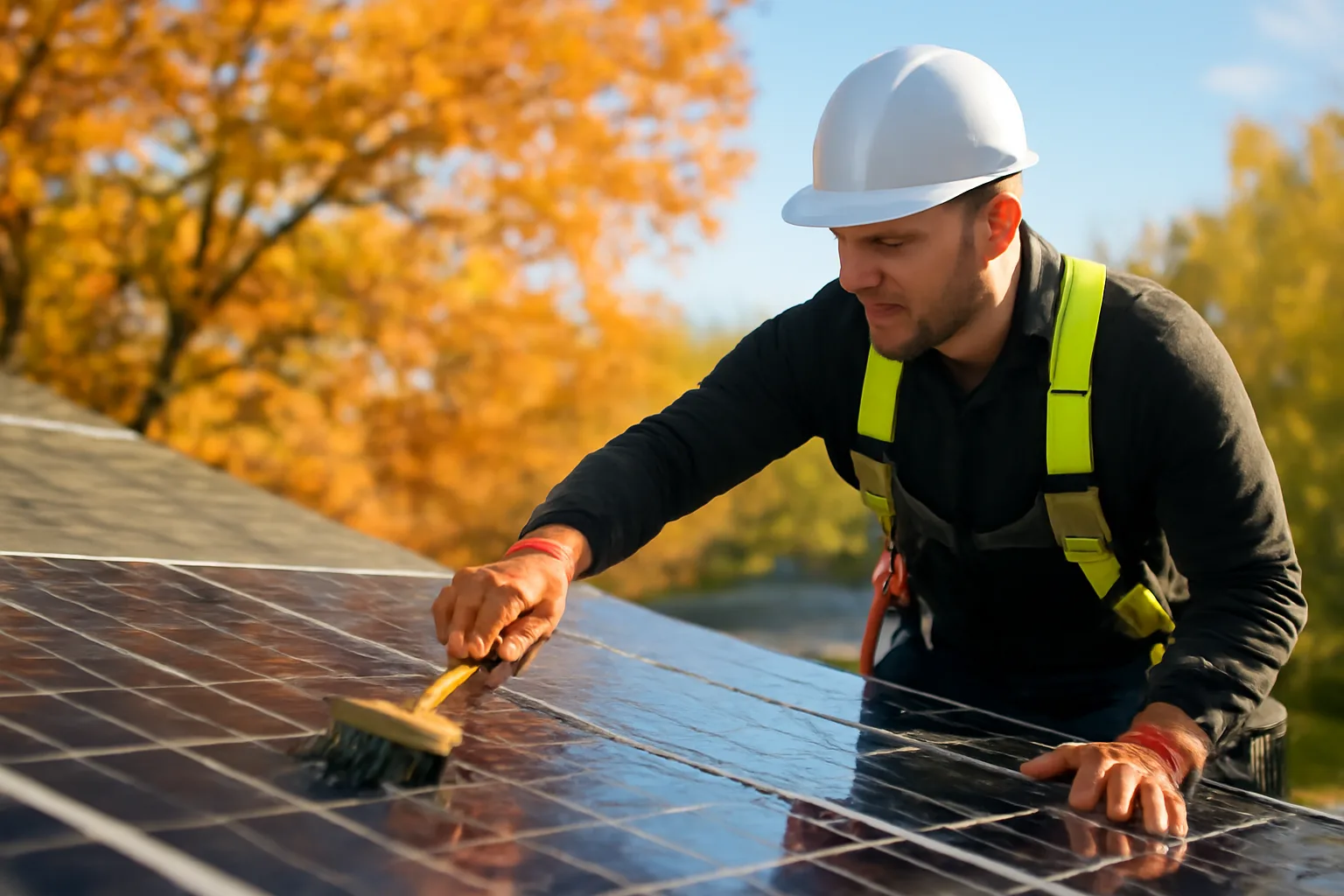
What the state does require is a Home Improvement Contractor (HIC) registration if you clean panels on a residential property. Connecticut General Statutes Section 20-419 defines 'home improvement' broadly to include 'any repair, replacement, remodeling, alteration, conversion, modernization, improvement, or addition to any land or building' that is primarily residential [1]. Washing solar panels on a homeowner's roof fits that definition as the Department of Consumer Protection (DCP) reads it. The requirement covers any contractor who gets paid for that kind of work.
Commercial-only work, meaning panels on warehouses, commercial buildings, or ground-mounted utility arrays, does not trigger the HIC registration under the residential statute. That narrower scope limits your market a lot. Most of Connecticut's residential solar sits on home rooftops.
If your work involves any electrical disconnection to make cleaning easier, even unplugging DC connectors, that crosses into electrical work, and Connecticut requires a licensed electrician for it. DCP and the Department of Administrative Services enforce trade licensing on separate tracks [2]. Keep the job mechanical (water, brushes, squeegees) and you stay out of electrical licensing territory.
Here is the whole path for a new operator: get the HIC registration, carry general liability insurance, and leave any wiring to a licensed electrician.
What is the Connecticut Home Improvement Contractor registration and how do you get one?
The HIC registration comes from the Connecticut Department of Consumer Protection under CGS Chapter 400. It is not a license in the trade-skill sense. It is a consumer-protection credential that puts your business on record and ties you into the state's Home Improvement Guaranty Fund, which homeowners can draw on if a registered contractor does defective work and cannot pay [1].
To register, you file an application with DCP, pay the fee, and prove you carry general liability insurance. DCP's fee schedule changes when the legislature adjusts it, so confirm the number before you pay. On the most recent public schedule, initial and renewal fees for individual contractor registrations have run roughly $220 to $240 for a two-year term, but verify the exact current figure with DCP [3].
The registration runs two years from the date of issue. Renewal uses the same DCP portal or a paper renewal form, and you need a current certificate of insurance on file.
One thing catches new operators off guard: the registration must be in the legal name of the business entity that signs contracts with homeowners. If you operate as an LLC, the LLC registers, not you personally. Make sure your insurance certificate names the same entity.
You can check registration status and file renewals through the DCP online licensing system [3]. Processing times vary, and DCP does not guarantee turnaround, so apply or renew at least 60 days before your current registration expires.
How much does solar panel cleaning cost in Connecticut?
Pricing in Connecticut reflects high labor costs, seasonal demand, and typical system size. Nobody has rigorous, Connecticut-specific market data on cleaning prices. The figures below come from industry survey ranges and are honest approximations, not a rate card.
For a standard residential system of 20 to 30 panels (roughly 7 kW to 10 kW), most Connecticut operators charge $150 to $350 per visit. Smaller systems under 15 panels sometimes start around $100 to $125. Large systems above 40 panels or steeply pitched roofs can push $400 or higher.
Commercial jobs get quoted per panel or per square foot. Per-panel rates on commercial work typically run $8 to $18 depending on access difficulty and water-supply logistics.
Connecticut's hard winters mean most residential customers want one cleaning in late spring after pollen season and sometimes a second in late summer or early fall. NREL research shows soiling losses in the northeastern United States are generally lower than in arid states, in the range of 1 to 4 percent annual output loss from dust and pollen under typical conditions [4]. So the value to a homeowner is real but modest. You have to explain it plainly rather than oversell it.
The table below shows a rough comparison of per-visit pricing tiers common in Connecticut's market.
| System size (panels) | Typical price range per visit |
|---|---|
| Under 15 | $100 to $150 |
| 15 to 30 | $150 to $280 |
| 31 to 50 | $280 to $400 |
| 50+ or commercial | Quoted per panel ($8 to $18) |
These ranges are not official data. Treat them as a calibration point, not a contract floor.
How long does solar panel cleaning take in Connecticut?
A residential job of 20 to 30 panels takes most operators 45 to 90 minutes from arriving on-site to packing up. That covers setup, cleaning, and rinse. Bigger or messier systems with multiple roof planes, steep pitches, or heavy bird fouling can run two to three hours.
Grounded-feed deionized (DI) water systems tend to beat bucket-and-brush setups on speed because you spend less time repositioning water supply. On a ground-mounted commercial array of 200 panels, a two-person crew with a tank-fed DI system can realistically clean 80 to 120 panels per hour under good conditions.
Connecticut's climate adds a variable. Algae and lichen from the state's humid summers can need a soak or light agitation before rinsing, which adds time. In shaded installations near trees, biofilm builds up faster than it does on sun-baked roofs in arid climates, and a plain rinse will not remove it.
For scheduling, plan on roughly one hour of billable time per residential job plus 20 to 30 minutes of drive and setup overhead. That gives you a realistic throughput of four to six residential jobs per full day if they are clustered close together.
What insurance does a Connecticut solar cleaning operator need?
The HIC registration requires proof of general liability insurance. The market standard is $1 million per occurrence and $2 million aggregate, though you should confirm the current DCP minimum at renewal because limits can change [3].
For roof work, most general liability policies carry height or rooftop exclusions by default. Read yours carefully. Some carriers exclude work above a certain height or on sloped surfaces unless you add a rooftop work endorsement. If your policy excludes the roof and you file a claim for a panel you cracked or an antenna you knocked loose, you find out at the worst possible moment that you were uninsured for the actual work.
Workers' compensation is required in Connecticut for any business with one or more employees. The Connecticut Workers' Compensation Commission administers this separately from DCP [5]. If you are a sole proprietor with no employees, you are generally exempt from the mandate, but you carry no coverage if you get hurt on the job.
A business auto policy covering your cleaning vehicle and trailer is a separate need. A personal auto policy will not cover commercial use in most cases.
On average, a small solar cleaning operator in Connecticut might budget $1,200 to $2,500 per year for a general liability policy with a rooftop endorsement, though actual quotes depend heavily on payroll, revenue, and claims history. Get multiple quotes.
What is the HIC renewal process and what can go wrong?
Renewing the HIC registration is simple on paper: file a renewal application, pay the fee, and submit a current certificate of insurance. DCP sends a renewal notice to the address and email on file, usually 60 to 90 days before expiration.
The most common failure point is a lapsed insurance certificate. If your general liability policy renews at a different time of year than your HIC registration, there can be a gap where DCP's file shows an expired certificate. DCP can suspend your registration for lack of current insurance [1]. Sign a contract with a homeowner while your registration is suspended and you are operating illegally under Connecticut law, and you lose your right to enforce that contract or recover payment.
The second common failure is address changes. DCP sends renewal notices to the address of record. Move your business address without updating DCP and you may miss the renewal window entirely, then have to re-register rather than renew, which resets your standing in the Guaranty Fund and costs more time.
Connecticut's DCP online system allows address updates and document uploads, so there is no excuse for letting an address drift. Log in and verify your record once a year, not only at renewal time [3].
Operating with an expired HIC registration in Connecticut is a Class D misdemeanor under CGS Section 20-427 [1]. That is not a fee. It is a criminal charge. Renew on time.
Do Connecticut towns or cities add any local requirements?
Some Connecticut municipalities require a local business license or vendor permit for businesses operating within their borders. This is separate from the state HIC registration and varies town by town. Hartford, New Haven, Bridgeport, and Stamford each run their own business licensing offices with their own fee schedules.
There is no statewide database that cleanly lists every Connecticut town's requirements for service contractors. The practical approach is to call the town clerk or business licensing office in each municipality where you plan to work regularly before you take your first job there.
For most suburban and rural Connecticut towns, there is no local business license requirement for contractors who already hold a state registration. But 'most' is not 'all,' and the cost of checking is a phone call.
Homeowner association (HOA) rules are another layer. Some Connecticut HOAs, especially in master-planned developments, require contractors to check in, show proof of registration, and carry HOA-specific insurance minimums before working on any property. Ask the homeowner whether they have an HOA before you schedule the job.
How does Connecticut compare to neighboring states for solar cleaning requirements?
Connecticut sits in the middle of the northeastern regulatory pack. New York runs its own Home Improvement Contractor license through county and city consumer affairs offices, with higher fees and additional bond requirements in New York City. Massachusetts requires a Home Improvement Contractor registration through its Office of Consumer Affairs, similar in structure to Connecticut's. Rhode Island has a contractor registration program through its Contractors' Registration and Licensing Board.
None of these states have a dedicated solar panel cleaning license. They all use general contractor or home improvement registration frameworks that were written before residential solar was common, and those frameworks now apply to solar cleaning by default.
For a comparison view of how neighboring states structure their requirements, the solar panel cleaning renewal in Florida guide and the solar panel cleaning renewal in Colorado guide both show how sunnier, higher-solar-penetration states approach the same regulatory question differently.
Connecticut's HIC Guaranty Fund is a meaningful consumer protection feature that some neighboring states lack. It works as a backstop for homeowners, which gives your registration genuine credibility when you market to risk-averse residential customers.
What equipment do you actually need to start solar cleaning in Connecticut?
The core toolkit is deionized water delivery, extension-fed soft brushes, and roof safety equipment. DI water leaves no mineral deposits on glass, which is why the industry has largely dropped tap water for the final rinse even in Connecticut's relatively low-hardness water regions.
A basic setup runs a DI water tank (50 to 100 gallons for a day of residential work), a pump, a hose reel, and a brush wand. Panels get rinsed, brushed gently with a soft bristle or microfiber head, and rinsed again. No soap needed for typical dust and pollen. Soap leaves a residue that attracts more soiling and streaks the glass.
Roof safety equipment is not optional. OSHA's fall protection standard, 29 CFR 1926.501, requires fall protection for employees working at heights of six feet or more in construction. Residential rooftop work falls under OSHA's residential construction standards. A personal fall arrest system, anchor points, and a harness are the minimum [6]. Ladders used in construction must meet the design requirements in 29 CFR 1926.1053 [7].
SolarWashPath's $149 DI Water and Roof-Safety Kit covers the documentation and sourcing checklist for new operators, if you want a structured starting point for equipment procurement.
For Connecticut's climate, add a plan for winter. Cleaning frozen or near-freezing panels is generally not productive and risks cracking glass through thermal shock from warm water. Most Connecticut operators run March through November and plan cash flow around that.
How does soiling affect solar output in Connecticut specifically?
Connecticut averages roughly 4.5 peak sun hours per day across the year, with a strong summer peak and a deep December low, based on NREL's solar resource data for the region [8]. That seasonal swing is large, and the soiling story tracks it: spring tree pollen and summer construction dust are the main fouling agents, while winter snow and rain often self-clean panels better than a paid wash would.
NREL's soiling research found annual energy losses from soiling in the northeastern United States average roughly 1.5 to 4 percent depending on local vegetation, traffic, and panel tilt [4]. On a 10 kW system producing roughly 11,000 kWh per year in Connecticut, a 3 percent soiling loss is about 330 kWh, worth roughly $65 to $85 at Connecticut's residential electricity rate (which averaged around 24 to 26 cents per kWh in recent years, consistently among the highest in the contiguous United States) [9].
That math means one professional cleaning per year at $200 to $250 roughly breaks even on energy value recovered. Two cleanings a year in high-soiling spots (near pollen-heavy trees, near active construction) can make economic sense. Selling cleanings on payback math alone is a tough pitch. Selling on panel longevity, warranty compliance, and peace of mind lands better with Connecticut homeowners who paid $25,000 to $40,000 for their systems.
Where can you find the official Connecticut registration forms and fee schedule?
All HIC registration and renewal forms live on the Connecticut DCP website under the Contractors section [3]. The fee schedule is listed there too, but download or screenshot it when you file, because fee changes do not always update the same day they take effect.
The DCP online licensing portal (eLicense Connecticut) handles electronic renewal [3]. If you prefer paper, DCP still accepts mailed applications, but online renewal is faster and generates an immediate confirmation.
For insurance compliance questions, the Connecticut Insurance Department publishes guidance for contractors [10]. That is where you verify minimum liability requirements if a broker gives you conflicting information.
If a homeowner ever files a complaint, DCP handles investigations under the Home Improvement Act. Knowing the complaint process in advance is worth a few minutes of reading. CGS Section 20-427 and the surrounding sections lay out the penalty structure [1].
For new operators who want to cross-check Connecticut against other solar-heavy states, see the solar panel cleaning renewal in California and solar panel cleaning renewal in Hawaii guides, which cover states where solar density runs much higher and regulatory interpretation has had more time to develop. The solar panel cleaning renewal in Delaware guide is also relevant given Delaware's regulatory proximity to Connecticut's framework.
SolarWashPath publishes this article as an independent reference. It is not legal advice. Verify current fees, forms, and requirements directly with the Connecticut Department of Consumer Protection before you file.
Frequently asked questions
Do you need a license for solar panel cleaning in Connecticut?
There is no dedicated solar panel cleaning license in Connecticut. Operators cleaning panels on residential properties need a Home Improvement Contractor (HIC) registration from the Department of Consumer Protection under CGS Section 20-419. Commercial-only work does not trigger that requirement, but you still need general liability insurance. Any electrical work requires a separately licensed electrician.
How much does solar panel cleaning cost in Connecticut?
Most residential jobs in Connecticut run $150 to $350 per visit for systems of 15 to 30 panels, based on typical market pricing. Smaller systems can start around $100 to $125, and large or difficult installations exceed $400. Commercial work is usually quoted at $8 to $18 per panel. Connecticut's high electricity rates (averaging roughly 24 to 26 cents per kWh) make the energy-payback case for cleaning real but modest.
How long does solar panel cleaning take in Connecticut?
A standard residential job of 20 to 30 panels takes 45 to 90 minutes from setup to pack-up. Larger systems or those with algae and biofilm from Connecticut's humid summers can take two to three hours. Plan for roughly one hour of billable time per residential job plus 20 to 30 minutes of drive and setup overhead, giving a realistic throughput of four to six clustered residential jobs per full day.
How often should you renew the Connecticut HIC registration?
The HIC registration runs for two years from the issue date. DCP sends renewal notices roughly 60 to 90 days before expiration. You need a current certificate of general liability insurance to renew. Operating with an expired registration violates CGS Section 20-427 and is classified as a Class D misdemeanor, more than a fine.
What happens if you clean solar panels in Connecticut without an HIC registration?
Working on residential properties without a valid HIC registration is a Class D misdemeanor under CGS Section 20-427. Beyond criminal exposure, an unregistered contractor cannot legally enforce a contract or collect payment from a homeowner through Connecticut courts. Homeowners can also report unregistered contractors to DCP, which can impose civil penalties.
Does Connecticut require workers' compensation for solar cleaning businesses?
Yes, if you have one or more employees. The Connecticut Workers' Compensation Commission requires employers to carry workers' comp coverage. Sole proprietors with no employees are generally exempt but have no personal injury coverage if they are hurt on a job. Rooftop work carries real injury risk, so even exempt sole proprietors should evaluate voluntary coverage.
Can you clean commercial solar panels in Connecticut without the HIC registration?
Probably, because the HIC registration applies specifically to residential home improvement work under CGS Section 20-419. Ground-mounted commercial arrays and panels on commercial buildings fall outside that definition. That said, some municipalities have local contractor registration requirements that apply regardless of property type. Check with each town's business licensing office before assuming you are clear.
What insurance minimums does Connecticut require for HIC-registered contractors?
DCP requires proof of general liability insurance to register and renew. The market standard is $1 million per occurrence and $2 million aggregate. Confirm the current DCP minimum directly with the department, as minimums can change. For roof work, verify your policy does not exclude sloped-surface or elevated work; many standard general liability policies carry height exclusions by default.
Does Connecticut have a solar panel cleaning season?
Effectively yes. Most Connecticut operators run March through November. Cleaning near-freezing panels risks thermal shock and cracking, and winter precipitation (rain and snow) provides partial self-cleaning. The peak demand period is late spring through early fall, driven by pollen, summer dust, and bird activity. Plan cash flow around a roughly nine-month active season.
Is DI water required for solar panel cleaning in Connecticut?
No law requires it, but deionized water is the industry standard for the final rinse because it leaves no mineral deposits on glass. Connecticut's tap water hardness varies by municipal source, and mineral spotting from hard water can offset the benefit of cleaning. Most professional operators use DI water for the rinse even if they use tap water for the initial loose-soil removal.
Do Connecticut HOAs add any requirements for solar panel cleaning contractors?
Some do. HOAs in planned communities may require contractors to show proof of state registration, present a certificate of insurance naming the HOA, and check in before starting work. These rules vary by development and are not regulated by state law. Ask your customer whether their property has an HOA before scheduling, and contact the HOA management office if so.
What is the Connecticut Home Improvement Guaranty Fund?
The Guaranty Fund is a state-administered reserve that compensates homeowners when a registered HIC contractor does defective work and cannot pay a judgment. It is funded partly through registration fees. As a registered contractor, your participation gives homeowners a real backstop, which is a legitimate selling point. The fund is governed under Connecticut General Statutes Chapter 400.
How do Connecticut's solar cleaning regulations compare to Florida or California?
All three states use a general home improvement or contractor registration framework rather than a solar-specific license. Florida and California have much higher solar panel density and more interpretive guidance from their licensing boards. Connecticut's HIC Guaranty Fund is a distinguishing feature that some sunnier-state programs lack. See our guides on solar panel cleaning renewal in Florida and California for direct comparisons.
Sources
- Connecticut Department of Administrative Services, Occupational and Professional Licensing: Connecticut requires a licensed electrician for electrical work, separate from the DCP home improvement registration
- Connecticut Department of Consumer Protection, License Services: HIC registration application, renewal process, insurance requirements, eLicense portal, and fee schedule managed by DCP
- National Renewable Energy Laboratory, Photovoltaic Soiling Research: Annual energy losses from soiling in the northeastern United States average roughly 1.5 to 4 percent depending on local conditions
- Connecticut Workers' Compensation Commission: Connecticut requires workers' compensation coverage for businesses with one or more employees
- OSHA Standard 29 CFR 1926.501, Duty to Have Fall Protection: OSHA requires fall protection for employees working at heights of six feet or more in construction environments
- OSHA Standard 29 CFR 1926.1053, Ladders: Ladders used in construction must meet the design requirements in 29 CFR 1926.1053
- National Renewable Energy Laboratory, PVWatts Calculator: Connecticut averages roughly 4.5 peak sun hours per day across the year, with a strong summer peak and a deep December low
- U.S. Energy Information Administration, Electric Power Monthly, Table 5.6.A Average Retail Price of Electricity by End-Use Sector by State: Connecticut residential electricity rates averaged approximately 24 to 26 cents per kWh in recent reporting periods, among the highest in the contiguous United States
- Connecticut Insurance Department: Connecticut Insurance Department provides guidance on minimum liability requirements for contractors operating in the state