Last updated 2026-08-18
TL;DR
Alaska has no license just for solar panel cleaning. Contractor registration can apply if you add repairs above the state threshold, but routine washing sits outside that. A typical residential array runs $150 to $350 nationally, and Alaska travel adds 25 to 50 percent on top. A 20 to 30 panel job takes 1 to 2 hours in good weather, longer with snow or ice.
Do you need a license for solar panel cleaning in Alaska?
No solar panel cleaning license exists in Alaska. Washing panels is maintenance, not construction, so the state's contractor registration rule usually leaves it alone. Alaska does require contractor registration for anyone who submits a bid or works as a contractor under Alaska Statute 08.18.011 [2]. The Division of Corporations, Business and Professional Licensing runs that program [1]. If your job stays limited to clean water and a soft brush on the glass, you are not a contractor in the construction sense. No state test. No state fee for the cleaning itself. No continuing education.
The line moves fast, though. Tighten racking bolts, replace wires, clear snow while standing on the roof, or do any repair, and you may cross into contractor territory. Check with the Alaska Division before you quote that kind of job. Registration is mostly paperwork and a small fee. Working unregistered after you step over the line can cost you more than a whole season of cleaning income. Keep the scope narrow and you stay license free. Register if you plan to sell repairs, and price the job accordingly.
Alaska also requires every employer to carry workers' compensation insurance, even with a single employee [3]. A sole owner with no helpers is usually exempt, but confirm that with the Alaska Department of Labor and Workforce Development. Nobody is coming after you for washing a neighbor's panels once. Advertise a business, though, and you do the paperwork.
Alaska Statute 08.18.011 says, "A person may not submit a bid or work as a contractor unless that person is registered with the department." That one sentence is the whole game.
How much does solar panel cleaning cost in Alaska?
Plan on $250 to $450 for a typical 25 panel home in Alaska. Nationally the same job runs $150 to $350, or $10 to $20 per panel [4]. Alaska lives at the high end of that band, often 25 to 50 percent above the Lower 48. Three things drive it: travel distance, a short season, and almost no price competition. An Anchorage or Fairbanks house with an easy roof might land at $250 to $400. A remote place off the road system can hit $600 or more once you add a ferry, a plane, or a snowmachine. Those are honest estimates, not published Alaska rates. No state tariff or rate board exists, and the market is too small for reliable public numbers.
| Service | National range | Alaska estimate | Notes |
|---|---|---|---|
| Per panel cleaning | $10 to $20 | $15 to $25 | Pure water or soft brush |
| 25-panel residential array | $150 to $350 | $250 to $450 | No major soiling |
| Snow removal add-on | $50 to $150 | $75 to $200 | Roof rake or soft broom |
| Steep roof or ladder surcharge | $75 to $150 | $100 to $200 | Pitch over 7/12 |
DIY costs less, but it is not free. A basic water fed pole kit runs $150 to $500. Deionized water costs $30 to $60 per 5 gallon jug. Fall protection adds $150 to $300 the moment you leave the ground. Compare all that to paying a pro $300 on a one story house. For most people, a one story ground mount is the only DIY that pays off in Alaska. A second story roof is a bad place to learn on ice.
How long does solar panel cleaning take in Alaska?
A 20 to 30 panel residential array takes 1 to 2 hours for a pro with pure water and a water fed pole [4]. In Alaska, add 30 to 60 minutes for setup, ladder safety, and the snow or ice that hangs at the edges. A ground mount in summer can be done in under an hour. A steep roof in winter can stretch to 3 hours if you clear snow first or wait for a warm window. Cleaners quote by the job, not the hour, so you are paying for risk and travel, more than elbow grease. If a quote includes snow removal, ask how long that step takes and what tools they bring.
A 5 to 10 kW commercial roof can eat half a day with two people. On homes, an afternoon job in March often crawls compared to a June job, because the low sun leaves ice sitting in the valleys. Plan on the high end if your roof has dormers, skylights, or a steep north face.
Why Alaska solar panel cleaning prices run higher than the Lower 48
Ask any solar cleaner in Anchorage what drives cost and the answer is travel. Alaska is scattered road system towns, fly in villages, and seasonal ferries. A 25 panel job in Palmer can eat half a day once you drive from Anchorage. The same job in Kodiak needs a ferry ticket and an overnight. That travel cost lands in your quote, or the cleaner swallows it as a bad business decision.
Compare the Lower 48. Solar panel cleaning cost in Alabama often lands at $150 for the same array because competitors sit 20 minutes apart. Solar panel cleaning cost in Arizona stays low on dense solar installs and year round work. Alaska has neither density nor year round demand. The season runs roughly April through September. Outside that window panels are often snow covered and out of reach. A cleaner who works five months has to earn a full year of income in those five months, so prices climb. Solar panel cleaning cost in California runs $150 to $300, and solar panel cleaning cost in Florida adds humidity and pooled water. None of those markets deals with a ferry ride to every third job.
Does snow removal count as solar panel cleaning in Alaska?
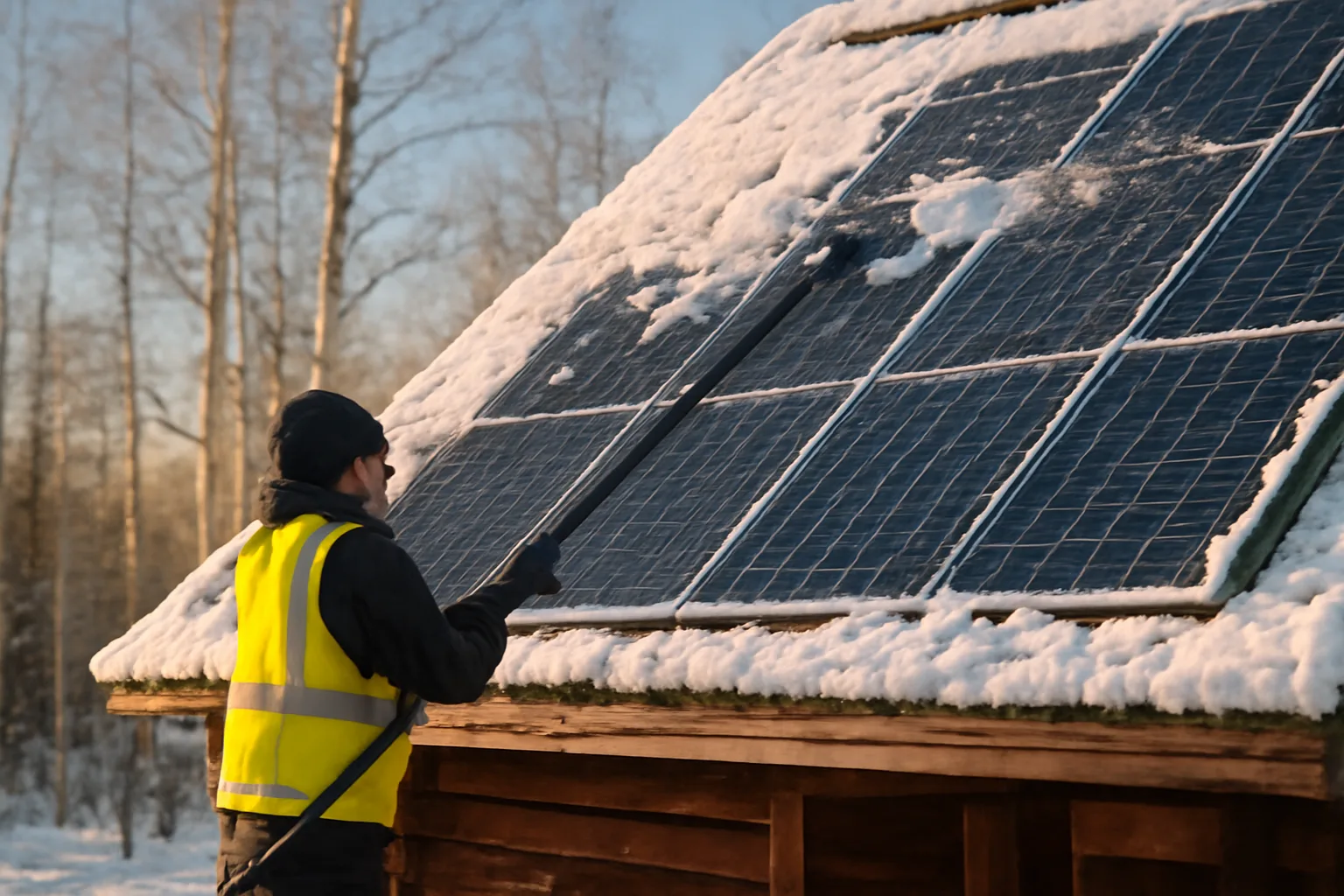
Snow removal is a separate job from cleaning. Standard cleaning takes off dust, pollen, bird droppings, and tree sap. Snow removal is an add on, and it needs a different touch. A soft roof rake pulls snow off panels without touching the glass, but it takes care. Never use a metal shovel or a hard scraper. Never pour hot water on cold glass. The U.S. Department of Energy recommends keeping panels clear of debris and snow where you can [5].
A foot of snow can shut an Alaska array down for days or weeks. A $100 snow removal add on often beats losing $40 to $90 of production over the same stretch [7]. That math depends on your utility rate and array size, so run your own numbers. Heavy wet snow, clear it before it freezes into a block. Already frozen, wait for a thaw instead of chipping at it.
Is it safe to clean solar panels yourself in Alaska?
DIY makes sense on a ground mount or a one story roof you can reach from a ladder. A second story roof with a 9/12 pitch and ice, hire someone. A fall costs more than any cleaning. I would not DIY a second story panel array in winter, ever. Use a water fed pole from the ground, deionized water, and a soft brush. No pressure washer. No tap water loaded with minerals. No dish soap, since common dish soap leaves a film that grabs dust.
The cold stacks on more problems. Plastic brush handles turn brittle below zero. DI water freezes at 32 degrees Fahrenheit, same as tap. Work during the warm daylight hours, or keep the water in a heated van. Ice on the panels, do not chip it off. Wait for a thaw. A scratch in the glass is permanent.
What equipment do Alaska solar panel cleaners use?
A working Alaska cleaner needs four things at minimum: a water fed pole that reaches 24 to 40 feet, a deionized water system or bottled DI water, a soft brush head, and roof safety gear once they leave the ground. Pure water systems start around $1,000 new, and used rigs run $400 to $700. SolarWashPath sells a $149 one time DI water and roof safety kit for first year operators. That kit covers the minimum, not a full van setup. It is enough to test demand in Anchorage or Fairbanks without dropping $3,000 before your first customer.
Scale up later and you add a vehicle, a tank, insurance, and a second person for ladder work. A one person crew with a water fed pole can clean most one story roofs from the ground. Two story roofs need ladder training and probably a harness. Most Alaska cleaners I talk to start with a truck, a ladder, and a pole. That kit works May through September.
Do I need to register a business in Alaska to offer panel cleaning?
Yes. Operate under a business name or advertise to the public, and Alaska requires a state business license through the Department of Commerce, Community, and Economic Development [6]. The fee is roughly $50 a year for most businesses, but confirm the exact amount on the division's business licensing page. That license is separate from contractor registration and separate from any borough requirement. Anchorage, Fairbanks, and Juneau each run their own business licensing or sales tax rules. Call the borough clerk before you book your first paid job.
Sole proprietor working under your own legal name, the state still wants a business license for most commercial work. A few exemptions exist, like occasional isolated sales, but a solar cleaning business does not qualify. Get the license. It costs less than a tank of gas, and it keeps a $500 missed filing penalty off your books later.
How to find a solar panel cleaner in Anchorage, Fairbanks, or Juneau
The Alaska cleaning market is thin. No statewide certification, no licensing board, no union. Search local directories, ask solar installers for referrals, check the Alaska Solar Energy Association membership list [8]. Ask any cleaner for proof of a business license, liability insurance, and local references. I would not count on a national chain to send anyone to Alaska. Most do not work here. In a remote community, you may be better off buying a water fed pole and doing it yourself than waiting for a cleaner who never shows. Compare solar panel cleaning cost in Hawaii, another state where island travel shapes the whole market.
Same goes for solar panel cleaning cost in Idaho if you live near the Canadian border and figure Lower 48 prices carry over. They do not. Anchorage is not Boise.
Does cleaning improve solar output enough to justify the cost in Alaska?
For most Alaska homes, cleaning once or twice a year is plenty. Snow costs you more each year than dust. A 5 percent soiling loss on an 8 kW array in Southcentral Alaska might mean 200 to 400 kWh gone per year. At Alaska's average residential rate near 24 cents per kWh [7], that is $48 to $96 a year. A $300 cleaning does not pay for itself on energy savings alone. It does head off permanent glass damage from lichen, sap, and bird droppings. I would clean every spring after snowmelt and again after birch pollen season in late May. That is an opinion, not a study.
Ground mount near a gravel driveway or under birch trees, clean twice a year. Remote cabins with panels tilted steep enough to shed snow may need one cleaning. The U.S. Department of Energy sets no fixed schedule, just clean when output drops or soiling shows [5]. Watch your monitoring data for the dip. If your inverter shows no loss, keep your money. EnergySage notes most soiling losses on tilted residential arrays are small enough that cleaning can often wait [10].
What questions should you ask a solar panel cleaner in Alaska before hiring?
Ask these before you hire anyone in Alaska. Do you have an Alaska business license and liability insurance? What water do you use, and how do you keep mineral spots off the glass? Will you use a pressure washer? If yes, hang up. How do you handle snow and ice without wrecking the glass? What is your travel fee for my exact location? Can you give me a firm total before you drive out?
A real cleaner answers all of these without a pause. A side hustler with a garden hose stalls. That gap matters when a scratched panel costs $300 to replace.
Frequently asked questions
Do you need a license for solar panel cleaning in Alaska?
No specific license exists for routine panel washing. Contractor registration may apply if you do repairs, but plain cleaning is maintenance, not construction. Any business advertising to the public still needs a state business license.
How much does solar panel cleaning cost in Alaska?
Expect $250 to $450 for a typical 25 panel home, with national averages at $150 to $350. Remote locations can push the total above $600 once travel is added. Per panel rates run $15 to $25 in most Alaska markets.
How long does solar panel cleaning take in Alaska?
A 20 to 30 panel residential array takes 1 to 2 hours in good weather. Snow, ice, steep roofs, and setup add 30 to 60 minutes. A winter job with snow removal can stretch to 3 hours.
Is solar panel cleaning worth it in Alaska?
The energy payback alone is often modest, maybe $50 to $100 per year from avoided soiling. The bigger reason is preventing permanent glass damage from lichen, sap, and bird droppings. Spring and post pollen cleanings are the best value.
Can I clean solar panels myself in Alaska?
Yes, if you have a ground mount or a one story roof reachable from a ladder. Use a water fed pole, deionized water, and a soft brush. Do not use a pressure washer or dish soap. Avoid second story roofs in winter.
Does snow removal damage solar panels?
No, if you use a soft roof rake and never touch the glass with metal or hard plastic. Never chip ice. Never pour hot water on cold panels. Wait for a thaw instead.
Do I need workers' compensation for a solar cleaning business in Alaska?
Yes, if you have any employees. Alaska requires workers' compensation coverage even for one employee. Sole proprietors with no employees usually are exempt, but confirm with the Alaska Department of Labor.
How much does it cost to start a solar panel cleaning business in Alaska?
You can start for under $500 with a water fed pole kit and DI water, plus a $50 business license and liability insurance. A full van setup with a pure water system runs $1,000 to $3,000.
What is the best time of year to clean solar panels in Alaska?
Clean in spring after snowmelt, usually April or May, and again after birch pollen season in late May or June. A fall cleaning before first snow also helps if trees drop sap or leaves.
Are there solar panel cleaning companies in Anchorage?
There are a few independent operators, but no large chains. Ask local solar installers for referrals or check the Alaska Solar Energy Association member list. Remote areas often have no local cleaner at all.
Does Alaska have any rebates for solar panel cleaning?
No. Alaska has no state rebate or incentive for cleaning services. The economics come from avoided production loss and preventing panel damage, not from a government program.
How often should solar panels be cleaned in Alaska?
Twice a year works for most residential arrays. Clean more often if you live near a gravel road, under birch or cottonwood trees, or if you see visible soiling. Steep panels that shed snow may need only one spring cleaning.
Sources
- Alaska Division of Corporations, Business and Professional Licensing, Construction Contractors: Alaska requires contractor registration for construction work; no specific solar panel cleaning license exists.
- Alaska Statutes AS 08.18.011: Statute text: A person may not submit a bid or work as a contractor unless that person is registered with the department.
- Alaska Department of Labor and Workforce Development, Workers' Compensation: Alaska employers must carry workers' compensation insurance, even with one employee.
- HomeGuide, Solar Panel Cleaning Cost: Solar panel cleaning costs $10 to $20 per panel and $150 to $350 for a typical 25-panel system; jobs take 1 to 2 hours.
- U.S. Department of Energy, Solar Energy Technologies Office: The Department of Energy recommends keeping panels clear of debris and snow and cleaning when output drops or soiling is visible.
- Alaska Department of Commerce, Community, and Economic Development, Business Licensing: Alaska requires a state business license for most commercial activity; fee is roughly $50 per year.
- U.S. Energy Information Administration, Alaska State Energy Profile: Alaska's average residential electricity price is around 24 cents per kWh.
- Solar Energy Industries Association, Alaska Solar: The Alaska solar market is small, and the Alaska Solar Energy Association is a useful referral source.
- EnergySage, Solar Panel Cleaning: What to Know: Most soiling losses on tilted residential arrays are small, so cleaning can often be deferred.