Last updated 2026-08-18
TL;DR
Florida doesn't make you get a state contractor license to clean solar panels. The state calls it exterior maintenance, not construction. What you actually need: a local business tax receipt, general liability insurance, and basic gear (a water-fed pole and a deionized water system). A typical 20-panel residential clean runs $150 to $300 and takes 1 to 2 hours. Get the local tax receipt and insurance first, then learn Florida's humidity and storm-season quirks.
Do you need a license for solar panel cleaning in Florida?
No. Florida doesn't require a state contractor license to clean solar panels. The state treats it as maintenance, which sits outside construction licensing. The Florida Department of Business and Professional Regulation (DBPR) publishes a brochure listing exactly what falls outside the rules: "Activities that do not require a state contractor license include painting, pressure washing, window cleaning, janitorial services, and general maintenance." [1] Solar panel cleaning lands squarely in that maintenance bucket.
The DBPR Construction Industry Licensing Board doesn't regulate cleaners. So there's no "solar panel cleaning license" waiting for you at the state level. That's a relief. California often wants a specialty contractor license for the same work. Florida keeps it simple. (See our guide to the solar panel cleaning license in California for the contrast.)
"No state license" doesn't mean no paperwork, though. Almost every city and county in Florida wants a business tax receipt, sometimes called an occupational license. You get it from the local tax collector's office or city hall before you charge anybody. It costs $25 to $100 depending on where you operate. [2] You'll also register a business name with the state through Sunbiz, whether you run as a sole proprietor or form an LLC.
If you hire anyone, Florida law requires workers' compensation insurance. [8] As a solo operator you can exempt yourself from workers' comp, but you still want general liability insurance. That's the real gatekeeper here. Not a license.
How much does solar panel cleaning cost in Florida?
Plan to charge $150 to $300 for a standard 20-panel residential array in Florida. That matches the national average. EnergySage puts the typical U.S. residential clean at $150 to $300. [3]
Per panel, you're looking at $10 to $15 nationally, sometimes dropping to $8 in competitive metros like Orlando or Tampa. Single-story homes on flat lots help your margins because you can reach the panels from the ground with a water-fed pole. That saves time and keeps overhead down.
Complexity drives the price up fast. A two-story home, a steep tile roof, or panels caked with pollen, love bugs, or post-hurricane grime pushes the quote to the high end. Many cleaners set a minimum job fee of $100 to $125 to cover travel and setup no matter the system size. On commercial or large arrays (50 or more panels), per-panel pricing often drops to $5 to $8, and volume covers the difference.
Florida's dense solar market keeps rates honest. If you're weighing startup markets, Arizona's dust drives a different cleaning frequency. Check how to start solar panel cleaning in Arizona for that picture.
How long does solar panel cleaning take in Florida?
A 20-panel residential job usually takes 1 to 2 hours from arrival to pack-up. [4] That covers setup, cleaning, and a quick inspection. Single-story Florida ranch homes are the easy case. Many get cleaned entirely from the ground with a water-fed pole, which cuts the clock.
Two-story homes or tile roofs you have to walk on add time, sometimes stretching a job to 2.5 hours. Commercial work swings wider. A small 50-panel array might come in under an hour, while a 200-panel warehouse system eats half a day.
Florida's flat terrain works in your favor. You rarely fight extreme roof pitch here, unlike the mountain-slope roofs of Colorado (see our guide on starting in Colorado). The real time eaters are humidity and biological buildup. Panels that haven't been touched in two years mean more scrubbing, maybe 30 extra minutes. Book mornings. By afternoon the sun heats the glass and spot-free rinsing gets harder.
What are startup costs for a Florida solar panel cleaning business?
You can start for under $3,000 if you already own a reliable vehicle. The table below breaks down the main expenses. [5][6][7]
| Item | Cost Range | Notes |
|---|---|---|
| Florida business tax receipt | $25 to $100 | Varies by city or county |
| Florida LLC formation (Sunbiz) | $125 | One-time filing fee |
| General liability insurance | $500 to $1,200/year | $1M/$2M coverage typical |
| Water-fed pole kit (30 to 40 ft) | $500 to $1,500 | Unger, Tucker, etc. |
| DI water tank or portable system | $250 to $800 | Resin refills extra |
| Used utility van or truck | $2,000 to $5,000 | Optional but helpful |
| Marketing and website | $200 to $1,000 first year | Simple site and business cards |
These numbers aren't guesses. A water-fed pole and DI tank together run $750 to $2,300 according to industry buyers' guides. [5] A $1 million general liability policy for a small exterior cleaning business in Florida costs $500 to $1,200 a year through most carriers. [7]
Some new operators trim the setup by buying a starter kit. SolarWashPath's $149 DI Water + Roof-Safety Kit bundles a portable DI tank and a basic harness, but you'll still buy a good water-fed pole on your own.
What equipment do you need to start in Florida?
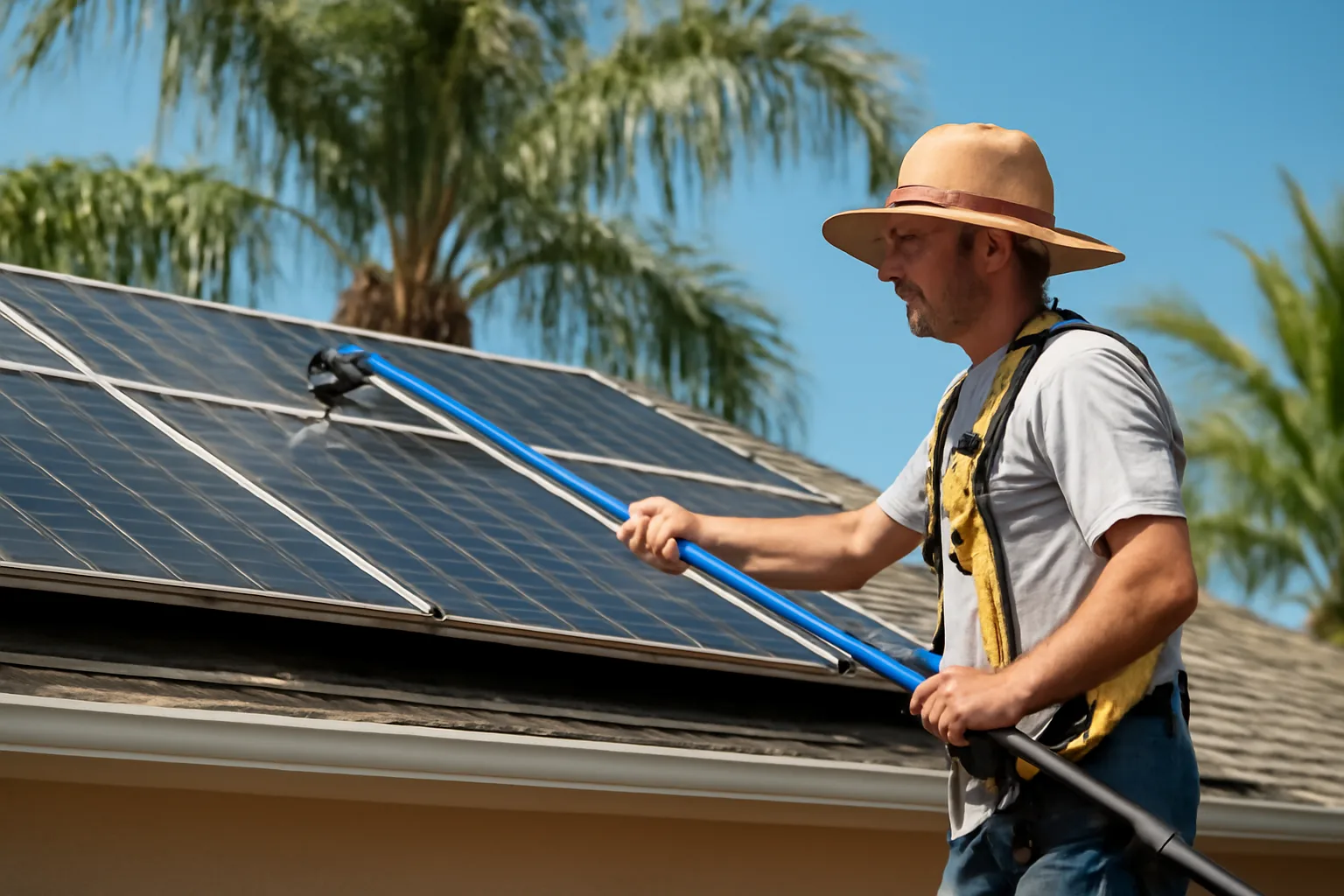
Three things are non-negotiable: a water-fed pole, a deionized (DI) water system, and safety gear. Tap water is a mistake in Florida. Our hard, mineral-heavy water leaves spots that bake into the glass. The Florida Solar Energy Center at UCF recommends deionized or distilled water to avoid mineral deposits. [10]
A pole that reaches 30 to 40 feet covers most one- and two-story homes. DI tanks range from compact portable units to larger in-truck setups. A TDS (total dissolved solids) meter costs a few bucks and settles the argument fast when a customer questions your water quality.
For safety, you need a roof harness and rope system any time you step onto a roof, which happens on steep pitches or when panels sit in awkward spots. Plenty of Florida jobs never need it. That's a selling point. A good pole and DI water let you work the whole thing from the driveway. (See our DI water and roof-safety kit.)
How do you register a Florida solar cleaning business and get insured?
Start with Sunbiz, Florida's online business portal. An LLC (limited liability company) costs $125 to file and clears in about a week. [6] Grab an EIN from the IRS for free. Then open a business bank account so your money stays separate from your personal cash.
Next, hit your city hall or county tax collector's website. The business tax receipt is usually a short form and a small fee. [2] You list your business name and the service you provide. Some counties, like Miami-Dade or Broward, add local permits for pressure washing, but solar cleaning with DI water and low pressure rarely trips any of that.
Insurance is where the real money goes. General liability is a must because clients and HOAs ask for proof. [7] A $1 million per occurrence and $2 million aggregate policy is the standard. Hire any help, even part-time, and Florida's workers' compensation law applies. [8] Skip it and one ladder fall can wipe out the whole business.
Florida-specific quirks: humidity, pollen, love bugs, and hurricanes
Florida is its own animal. Humidity keeps panels damp overnight, so mold and mildew creep along the edges. Spring pollen coats the glass in a yellow-green powder that cuts production. Love bugs hit in May and September and bake onto the surface. And hurricanes throw salt spray, sand, and tree debris across every roof.
Cleaning frequency runs higher than in the dry Southwest. Most homeowners here do well with twice-a-year cleanings. Post-storm callouts are a whole sub-niche. After a hurricane or strong tropical storm, panels are often physically rinsed but tilted or smeared with organic gunk. Offer a hurricane debris inspection-and-cleaning package and solar owners will grab it.
Heat matters too. Summer afternoons on a Florida roof are brutal. Start by 8 a.m. and wrap by noon. Panels hit 140 degrees F by lunchtime, and DI water evaporates before you can rinse it clean. Your schedule shifts with the seasons whether you plan for it or not.
How do you get your first solar cleaning customers in Florida?
Solar-dense neighborhoods are the easy money. Florida ranks second in the nation for installed solar capacity, and whole communities (Lakewood Ranch, Avalon Park, Celebration) are roof-to-roof panels. Door hangers with a plain offer ("$199 flat 20-panel clean, same-day quote") do real work.
Partner with local solar installers. Offer their new buyers a discounted one-year maintenance package. Installers don't want to handle cleaning after the sale, so you fill the gap. Real estate agents are the next channel. A clean array and a spotless roof line help a listing move. Hand them a flyer and a quick phone-camera inspection report.
Nextdoor and Facebook community groups run strong in Florida. A before-and-after shot of a pollen-caked panel pulls attention. Say you're insured and licensed (meaning your business tax receipt) and you stand out from the guy with a garden hose and a ladder.
What pricing strategy works best for Florida solar cleaners?
Per-panel pricing is simplest for small residential jobs, but flat-rate packages market better. A $199 "Standard 20-Panel Clean" is easy to advertise and gives you room to upsell bigger systems. Commercial pricing usually goes by kilowatt or per-panel at a volume rate ($5 to $8 each).
Subscription plans build recurring revenue. Quarterly or bi-annual cleaning at a small discount keeps customers on the books. In Florida, where twice-a-year cleaning already makes sense, a 10% discount on a pre-paid annual plan locks people in.
Don't undercharge for hard access. A two-story tile roof with panels hanging over a pool cage earns a premium, likely $325 to $450. Always write a "worst-case" clause into your quote for heavy organic buildup. Show a photo from the first panel and explain why the price is the price.
Common mistakes when starting solar cleaning in Florida
Skipping insurance is the fastest way to fail. One broken tile or one slip and you're personally on the hook. Using tap water is the second big one. Hard-water spots on a $30,000 array get you a cancelled invoice or a lawsuit. Buy a DI tank before you bid a single job.
Ignoring the business tax receipt is common and dumb. Florida counties enforce it, and a customer can report you for operating without one. You'll catch a cease-and-desist and a fine. The receipt runs about $35 in many places. Just get it.
Not adjusting for heat is a rookie error. Swinging a water-fed pole in triple-digit heat index wears you down fast. Hydrate, wear a hat, work early. And treat tile roofs like glass. One cracked barrel tile from a bad step costs you $200 and your reputation. When in doubt, clean from the ground.
How profitable is solar panel cleaning in Florida?
It runs lean and it can pay well. A solo operator doing two $225 jobs a day, five days a week, grosses about $4,500 weekly before expenses. Subtract insurance, water, pole upkeep, and fuel, and net income lands between $50,000 and $80,000 a year, which matches industry income guides. [9] Plenty of Florida cleaners add pressure washing or window cleaning to fill the calendar. It's a natural add-on once you already own the pole and the DI water.
Profit comes down to cheap equipment and tight routing. Florida's dense development makes routing easy. Don't chase a single panel 45 minutes across town unless the fee pays for the drive.
What does a first-year checklist look like for a Florida solar cleaning business?
Month 1: Form your LLC on Sunbiz, get an EIN, open a business bank account, and secure general liability insurance. Pull your local business tax receipt. [2][6][7]
Month 2: Buy a 30-foot water-fed pole, a DI tank, a TDS meter, and a safety harness. Practice on friends' and family panels until your system is smooth.
Month 3: Build a simple one-page website. Post before-and-after photos on Nextdoor and Facebook groups. Print door hangers and target four solar-heavy neighborhoods.
Months 4-6: Approach two solar installers and two real estate agents about referral partnerships. Lock in your first 20 paying customers. Tune your pricing.
Months 7-12: Reinvest in a second pole, a better vehicle, and a small Google Ads campaign. Add window cleaning if you want a second service. Review your insurance before hurricane season.
Want a board-confirmable factsheet for your exact county? Head to solarwashpath.com/start for a step-by-step kit that walks the paper path.
Frequently asked questions
Do you need a license for solar panel cleaning in Florida?
No state contractor license is required. The Florida DBPR classifies solar panel cleaning as maintenance, exempt from construction licensing rules. You will need a local business tax receipt from your city or county, proof of insurance, and, if you hire employees, workers' compensation coverage.
How much does solar panel cleaning cost in Florida?
A typical 20-panel residential job costs $150 to $300. Per-panel rates run $8 to $15 depending on difficulty and location. Commercial arrays drop to $5 to $8 per panel. Florida's competitive market keeps prices near the national averages reported by EnergySage. Add-ons like heavy pollen removal or two-story access push the price up.
How long does solar panel cleaning take in Florida?
Plan on 1 to 2 hours for a standard 20-panel residential system when you can work from the ground. Two-story homes or dirty panels that need scrubbing take longer. Commercial jobs scale with size; a 50-panel array takes under an hour, while larger systems can take half a day.
What is the best water for cleaning solar panels in Florida?
Deionized (DI) water is the standard. Florida's tap water is often hard and leaves spots. The Florida Solar Energy Center recommends DI or distilled water to prevent mineral deposits that reduce panel performance. A portable DI tank with a refillable resin cartridge is the usual setup for mobile cleaners.
Can I use a pressure washer on solar panels?
You shouldn't. High-pressure water can crack the glass, damage seals, or force water past junction boxes. The industry consensus is low-pressure DI water applied with a soft brush through a water-fed pole. Stick to methods that don't void panel warranties.
Do I need insurance to clean solar panels in Florida?
Yes. General liability insurance is the baseline. A $1 million/$2 million policy is typical and costs $500 to $1,200 per year. If you walk on roofs, some clients and HOAs may also require proof of workers' comp even if you are solo. Insurance protects you from property damage and injury claims.
What is a business tax receipt in Florida?
It's a local license to operate, issued by your city or county tax collector. Think of it as permission to do business in that jurisdiction. It costs $25 to $100 and renews annually. Even though the state doesn't license solar cleaning, most municipalities require this receipt before you take customers.
How often should solar panels be cleaned in Florida?
Twice a year works for most homeowners. Pollen in spring and love bug season in May and September coat panels quickly. Properties near the coast or under lots of trees may need quarterly cleaning. Post-hurricane cleanings are common add-ons because debris and salt spray cut output.
Is solar panel cleaning profitable in Florida?
It can be. A solo operator with efficient routing and two jobs a day can net $50,000 to $80,000 a year. The startup is lean, and Florida's high solar adoption gives you a ready customer base. Adding window cleaning or pressure washing smooths out seasonal dips.
How much does equipment for solar panel cleaning cost?
A good 30-foot water-fed pole and DI tank system cost between $750 and $2,300. A basic roof harness adds about $150. Some starter kits, like the one from SolarWashPath, bundle DI and safety gear for $149, but you'll still buy a pole. Plan on $1,000 to $3,000 for core equipment.
Do I need a roof harness when cleaning solar panels in Florida?
Only if you step onto the roof. Many Florida jobs get done entirely from the ground with a long water-fed pole. If roof access is necessary (steep pitch, panels beyond pole reach), you must wear a harness and tie off. Never risk a tile roof without safety gear and caution.
What are the main seasons for solar panel cleaning in Florida?
Spring (pollen), late spring (love bugs), and early fall (second love bug season) run heavy. Hurricane season from June through November drives post-storm cleanup demand. Winter is slower but still steady in South Florida. Adjust marketing and scheduling around these peaks.
Can I start a solar panel cleaning business part-time in Florida?
Yes, and many successful cleaners began on weekends. Keep your gear in a vehicle, schedule a few jobs Saturday mornings, and build a customer base before quitting a day job. Part-time operators still need the business tax receipt and insurance; those don't scale with hours.
How do you price large commercial solar farms in Florida?
Use a per-panel or per-kilowatt rate with volume discounting. For a 100-panel commercial system, $8 per panel is standard, but for a ground-mount utility-scale site of 5,000 or more panels, bids often fall to $0.15 to $0.25 per panel. You'll need specialized equipment (a ride-on pole or tractor setup) for massive sites.
Sources
- Florida DBPR, Unlicensed Contracting brochure: Pressure washing, window cleaning, janitorial, and maintenance do not require a state contractor license
- EnergySage, Solar Panel Cleaning Cost: Average U.S. residential solar panel cleaning cost $150 to $300
- Solar Power World, Water-Fed Pole Cleaning Guide: Water-fed pole kits cost $500 to $1,500 and DI tanks $250 to $800
- Florida Sunbiz, Division of Corporations, LLC fees: LLC formation filing fee is $125
- U.S. Small Business Administration, Get Business Insurance: General liability insurance is essential for property damage and injury claims
- Florida Statute 440.10, Workers' Compensation: Businesses with employees must carry workers' compensation
- Angi, How to Start a Solar Panel Cleaning Business: Potential revenue $50,000 to $80,000 annually for a sole proprietor
- Florida Solar Energy Center (UCF), Cleaning Your Solar Panels: Deionized or distilled water recommended to prevent mineral spots