Last updated 2026-08-18
TL;DR
Delaware has no state license for solar panel cleaning. You need a registered business entity, a general business license from the Division of Revenue (about $75), and liability insurance before your first job. Roof work triggers OSHA fall protection at six feet. Expect to charge $100 to $250 per residential visit depending on system size and roof access.
Do you need a license for solar panel cleaning in Delaware?
No state license exists specifically for solar panel cleaning in Delaware. The state does not classify panel washing under its contractor licensing framework, and the Delaware Division of Professional Regulation does not list it as a regulated trade [1]. That's genuinely good news for someone starting out.
What you do need is different from a trade license but still real paperwork. Every person or company providing a service for compensation in Delaware must hold a valid business license issued by the Delaware Division of Revenue [2]. This is sometimes called the general business license. It costs $75 for most new applicants as of the Division's published fee schedule, though you should confirm the current amount directly with the Division of Revenue because fees can change between publication cycles.
If you operate as an LLC or corporation rather than a sole proprietor, you also register the entity with the Delaware Division of Corporations before applying for the business license [3]. Sole proprietors operating under their own legal name skip the entity registration step but still need the business license.
One nuance matters here. If a job requires you to get on a roof to reach panels, some Delaware counties or municipalities may treat that as a home improvement or contractor-type activity subject to local permit requirements. New Castle County and Wilmington both run contractor registration programs worth checking before you take steep-roof work. The safest move is to call the local building or licensing office in any municipality where you plan to work before you advertise roof-access cleaning.
What business registrations and licenses does Delaware actually require?
The paper path in Delaware has three layers: entity formation, the state business license, and any local business licenses.
Entity formation comes first if you're not operating as a plain sole proprietor. An LLC filed with the Delaware Division of Corporations currently costs $90 for a standard filing, though expedited processing carries a higher fee [3]. Delaware is famous for low formation costs, and the online system is fast. Most small cleaning operators choose a single-member LLC for basic liability separation.
After entity formation, apply for a Delaware business license through the Division of Revenue's online portal at onestop.Delaware.gov. The state describes this as a license to do business in Delaware and it covers your revenue-generating activities statewide [2].
Some incorporated towns and cities layer on their own business license. Wilmington, Dover, and Newark each have local business licensing requirements. Check directly with each city where you plan to market services. The fees are usually small, under $50 per year, but skipping them can result in fines.
Sales tax deserves a brief mention. Delaware has no state sales tax, which simplifies pricing [4]. You won't collect or remit sales tax on cleaning services. That removes an administrative burden that trips up operators in neighboring states like Maryland or Pennsylvania.
How much does solar panel cleaning cost in Delaware?
Pricing for solar panel cleaning in Delaware runs roughly $100 to $250 for a standard residential system, and $0.10 to $0.25 per watt is the range most operators use when quoting larger commercial arrays. Neither figure comes from a Delaware-specific survey because no published study isolates Delaware panel cleaning prices. The ranges come from national contractor pricing data and regional market comparisons. Treat them as a starting framework, not a fixed tariff.
Several factors push prices toward the high or low end. Ground-mounted systems cost less because there's no roof access involved. A typical ground-mount visit at a single-family property might clear $100 to $150. A rooftop system on a two-story pitched roof, especially with shading debris or heavy bird soiling, reasonably commands $175 to $250. Delaware's coastal counties get salt haze deposits that require more rinse cycles, which adds time and shifts pricing up.
Commercial accounts on flat commercial roofs or carport arrays are priced differently. Many operators use a per-panel rate of $5 to $15 for commercial work, or a square-footage rate. The per-watt formula tends to be cleaner when the customer already knows their system size from their inverter data.
Recurring service agreements are where the margin lives. A customer who signs a two-visit-per-year contract at $180 per visit is worth more than a one-off at $250 because your scheduling and driving costs drop. Offer a 10 to 15 percent discount for annual contracts and residential customers will listen, especially in the Sussex County solar corridor where coastal soiling is a genuine maintenance issue.
How long does solar panel cleaning take in Delaware?
A typical residential rooftop system in Delaware (6 to 12 panels, or roughly 2 to 4 kW) takes 45 minutes to 90 minutes from setup to packdown. Larger systems of 20 to 30 panels run 2 to 3 hours. Ground-mount systems of similar panel counts go faster because you skip the roof-access setup time.
The main time variables are roof pitch, debris load, and water source distance. Delaware's coastal areas can accumulate heavier salt and pollen layers than inland sites, adding rinse time. If you're hauling a DI water tank rather than connecting to an on-site spigot, filling and connection adds another 10 to 15 minutes per job.
As a new operator, budget more time than you think you need for the first month. Equipment setup, customer walk-throughs, and post-job drying inspections all run slower until they become habit. Three to four residential jobs per day is realistic once you're experienced. Two per day is a reasonable first-month expectation.
Commercial jobs scale differently. A 100 kW commercial carport array can take a full day or more depending on water access and crew size. Price those jobs by site survey, not by rule of thumb.
What insurance do you need before your first Delaware job?
Get general liability insurance before you take any paid work. A $1 million per-occurrence policy is the market standard and what most property managers and commercial clients will ask to see on a certificate. Annual premiums for a new solo operator in a low-hazard service classification typically run $500 to $900 per year, though actual quotes vary by your claims history and coverage limits. Call at least three carriers and compare.
If you're doing any roof work, ask your broker specifically whether your policy covers roof-access operations. Some general liability policies exclude work above a certain height or on pitched roofs. You may need a separate rider or a policy written for exterior cleaning contractors. This is not a hypothetical gap. It's a common one.
Workers' compensation comes into play the moment you hire even a part-time employee. Delaware law requires employers with one or more employees to carry workers' compensation coverage [5]. Sole proprietors with no employees are generally exempt, but confirm your status with the Delaware Department of Labor if you ever bring on a helper, even informally.
Commercial vehicle insurance is separate from your personal auto policy. If you're driving a vehicle with cleaning equipment to job sites, your personal auto insurer may deny a claim arising from business use. A commercial auto policy or business-use endorsement is the fix.
What equipment do you actually need to start?
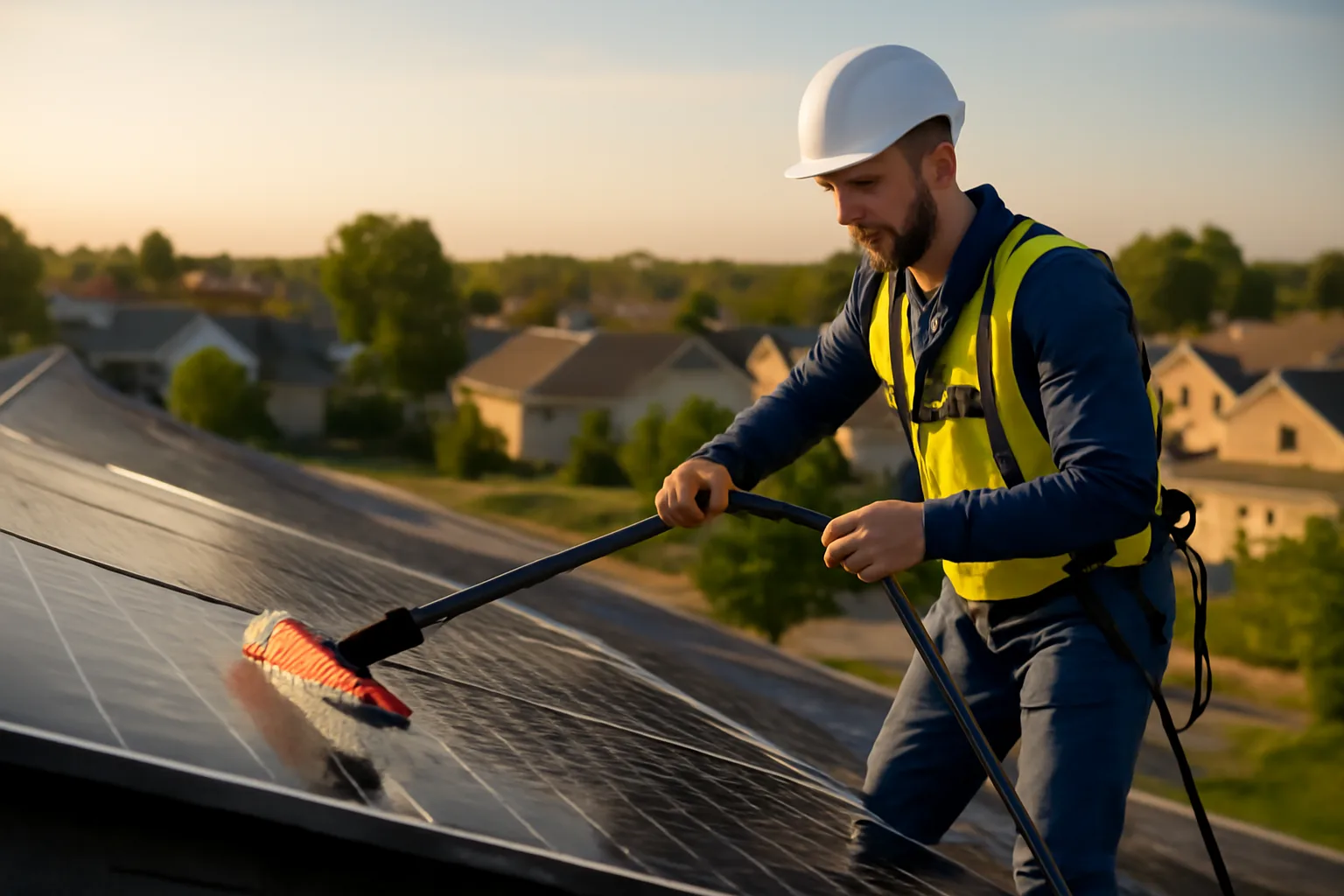
The core setup for a Delaware solar panel cleaning operation is a water-fed pole with a soft-bristle brush, a deionized (DI) water system or portable tank, and basic roof-safety gear if you'll access rooftops.
DI water matters because tap water in Delaware carries dissolved minerals that leave white spotting on panels as the water evaporates. DI water dries spot-free without a rinse wipe. A portable DI system with a flow-through resin vessel is the most common entry-level approach. You fill a tank with tap water, run it through the resin, and the output is clean enough to leave panels streak-free. Resin life depends on your local water hardness. Delaware water hardness varies by county and water source, so test your tap water with a TDS meter before assuming resin life.
For roof safety, OSHA requires fall protection when working at or above six feet on a walking/working surface [6]. A roof anchor, a personal fall arrest harness, and a lanyard are the minimum compliant setup for pitched-roof work. Do not skip this. Delaware operates under federal OSHA and citations can reach even sole-proprietor operations with employees.
SolarWashPath's $149 DI Water + Roof-Safety Kit covers the core equipment list for a first-time operator at /start. It's a reasonable starting point for someone who wants the equipment checklist confirmed before buying individual pieces.
A pressure washer is the wrong tool for panels. High-pressure water can void manufacturer warranties and damage junction boxes. A soft-bristle brush plus DI water is the method the National Renewable Energy Laboratory's operations and maintenance guidance points toward for routine cleaning [7].
How does Delaware's solar market affect demand for cleaning services?
Delaware has punched above its weight in solar adoption relative to its size. The state's Renewable Portfolio Standard requires utilities to source 40 percent of retail electricity sales from renewables by 2035, with a 10 percent carve-out for solar [8]. That policy has driven residential and commercial installations at a rate that creates real demand for maintenance services.
As of recent data, Delaware had over 20,000 solar installations statewide according to the Solar Energy Industries Association's state-level market tracking [9]. That's a meaningful service market for a small state with fewer than 1 million residents.
Sussex County leads on residential installations, partly because high electricity rates from Delmarva Power combined with strong net metering policy make solar economics work well there. New Castle County has more commercial and utility-scale installations. Both markets need cleaning.
The coastal geography is worth noting. Salt air, pollen from agricultural operations, and the region's clay-heavy soil dust all cut panel output faster than in dryer inland climates. Research on photovoltaic performance has found soiling losses of 1 to 6 percent annually in Mid-Atlantic coastal regions, though the exact figure for Delaware specifically is not isolated in publicly available studies. A 2 to 4 percent loss estimate is defensible for marketing purposes. Just don't represent it as a Delaware-specific guarantee.
For comparison with how operators approach neighboring states, see how to start solar panel cleaning in Alabama or how to start solar panel cleaning in California for license and market contrasts.
How do you price your first Delaware jobs competitively?
Start with your costs, not with what competitors charge. Calculate your hourly overhead: insurance ($500 to $900 a year divided by billable hours), vehicle costs, equipment amortization, and your own labor floor. For a solo operator doing roughly 400 billable hours per year, that overhead math produces a floor price somewhere in the $35 to $55 per hour range before any profit margin.
Then build your per-job price from the average time that job takes. A 90-minute residential visit at a $50/hour floor needs to sell for at least $75 to cover costs, and you need margin on top of that. Most operators targeting the Delaware market find $130 to $160 is the sweet spot for a standard residential rooftop system where customers don't push back.
Don't price below your floor to win a first job. Buying business with below-cost pricing trains customers to expect that rate permanently and attracts price-sensitive customers who will cancel the moment a cheaper competitor shows up.
For commercial work, submit a site-visit-based quote every time. Flat-rate commercial pricing without a site visit regularly results in underpriced jobs. Carport arrays have different access issues than rooftop arrays. Agricultural solar installations in Kent County can have significant dust and bird issues that a quick street-level assessment won't reveal.
What's the realistic first-year financial picture for a Delaware operator?
Nobody has good published data specifically on first-year solar cleaning revenue in Delaware. What we have is general exterior cleaning business benchmarking and some reasonable math.
A solo operator doing three residential jobs per day, four days per week, charging $150 average per job, and working 40 weeks per year (accounting for weather, ramp-up, and seasonality) would gross $72,000 annually. That's the ceiling, not the expectation. First year, figure 50 to 60 percent of that ceiling is realistic as you build a customer base.
First-year startup costs for a Delaware solar cleaning operation are low compared to licensed trades. Entity formation ($90), state business license ($75, confirm current fee), liability insurance ($500 to $900), equipment ($800 to $2,500 depending on what you already own), and vehicle preparation. Total startup outlay can reasonably stay under $4,000 for a basic solo operation.
Seasonal variation matters. Delaware winters slow outdoor service work. November through February will bring more cancelled and rescheduled jobs than summer months. Plan for a revenue dip of 30 to 50 percent in Q1 and budget accordingly. Some operators fill the slow months with gutter cleaning or exterior window washing to keep revenue steady.
For context on how licensing costs affect startup math in more regulated states, see the solar panel cleaning license in California guide.
What are the step-by-step actions to launch in Delaware?
Here's the actual sequence, in order.
First, decide your business structure. Most new operators choose a single-member LLC for basic liability separation. File with the Delaware Division of Corporations online. Pay the $90 filing fee. Keep your formation documents; you'll need them when opening a business bank account.
Second, apply for your Delaware business license through the Division of Revenue's One Stop portal (onestop.Delaware.gov). This is a state requirement for any for-profit service business operating in Delaware [2].
Third, get an EIN (Employer Identification Number) from the IRS even if you're a sole proprietor with an LLC. It's free, takes about five minutes online, and lets you open a business bank account and operate without giving your Social Security number to vendors [10].
Fourth, open a business bank account. Keep business income and expenses completely separate from personal funds. This matters both for tax filing simplicity and for maintaining the LLC's liability protection.
Fifth, purchase general liability insurance. Get at least three quotes. Make sure the policy explicitly covers roof-access exterior cleaning if you'll do pitched-roof work.
Sixth, buy your equipment. A water-fed pole, DI resin vessel, a TDS meter to test your output water, and fall protection gear are the minimums.
Seventh, check local business license requirements in any municipality where you'll work before you advertise there.
Eighth, set your pricing based on your cost floor, and create a simple one-page service agreement that clients sign before each job. A service agreement protects you if a customer claims panel damage.
Ninth, take your first jobs. Track time per job, adjust your pricing model at 90 days based on actual data, and reinvest early profit into better equipment rather than pulling it all out.
For state comparisons as you build out your knowledge, the how to start solar panel cleaning in Colorado and how to start solar panel cleaning in Arizona guides show how different licensing environments affect the startup sequence.
What safety rules apply to your Delaware cleaning operation?
Delaware operates under federal OSHA standards. It does not run a state-plan OSHA program [11]. That means the federal Occupational Safety and Health Administration enforces workplace safety rules for Delaware businesses, including self-employed operators who have employees.
The rule that applies most directly to rooftop panel cleaning is 29 CFR 1926.502, which governs fall protection systems for construction-related work at heights of six feet or more [6]. The Subpart M fall protection standard requires a personal fall arrest system, guardrail system, or safety net when employees face fall hazards at or above six feet.
Even sole proprietors without employees should treat these standards as the floor. Liability exposure from an unprotected fall is worse than the cost of a harness. A basic fall arrest harness and anchor system runs $150 to $400 depending on quality. That's less than one job.
For chemical safety, the mild, biodegradable soaps sometimes used in panel cleaning are generally low-hazard, but you should keep Safety Data Sheets (SDS) for any cleaning agents you use and store them in your vehicle. Delaware follows federal HazCom standards requiring SDS access for workers.
SolarWashPath's equipment kit at /start includes the fall protection checklist and DI water setup guide as part of its documentation package.
For a comparison of how another low-regulation state handles the same safety baseline, see how to start solar panel cleaning in Alaska.
Frequently asked questions
Do you need a license for solar panel cleaning in Delaware?
No state-specific license exists for solar panel cleaning in Delaware. The Division of Professional Regulation does not regulate this trade. You do need a Delaware business license from the Division of Revenue, which costs around $75 for most new applicants. Confirm the current fee directly with the Division of Revenue before you apply, as fees can change. Local municipality licenses may also apply depending on where you work.
How much does solar panel cleaning cost in Delaware?
Most residential solar panel cleaning jobs in Delaware run $100 to $250 per visit. A standard 6 to 12 panel ground-mount system trends toward the lower end; a larger rooftop system on a pitched two-story roof with coastal salt deposits trends toward the higher end. Commercial arrays are usually priced at $5 to $15 per panel or $0.10 to $0.25 per watt. These ranges reflect national contractor benchmarks applied to the Delaware regional market, not a state-specific study.
How long does solar panel cleaning take in Delaware?
A residential rooftop system of 6 to 12 panels typically takes 45 to 90 minutes from setup to packdown. Systems of 20 to 30 panels run 2 to 3 hours. Ground-mount systems of similar size take less time because there's no roof-access setup. New operators should budget extra time in the first month as workflow becomes routine. Commercial arrays require a site-specific estimate rather than a time rule of thumb.
Does Delaware have a home improvement contractor license that covers panel cleaning?
Delaware does not have a statewide home improvement contractor license in the way that neighboring Maryland does. Some municipalities, particularly New Castle County and Wilmington, run their own contractor registration programs. If your solar cleaning work involves roof access, check with the local building or licensing office before advertising in that jurisdiction. Standard panel washing without roof structural work generally falls outside contractor licensing scope in Delaware.
Do I need to collect sales tax on solar panel cleaning services in Delaware?
No. Delaware has no state sales tax, so solar panel cleaning services are not subject to sales tax collection or remittance. This is one of Delaware's genuine advantages for service businesses. You do not need a sales tax permit or account. Your invoices do not include a tax line. This simplifies bookkeeping compared to operating in Maryland, New Jersey, or Pennsylvania, all of which tax services.
What insurance does a Delaware solar panel cleaner need?
General liability insurance at a $1 million per-occurrence limit is the standard before taking any paid work. Annual premiums for a new solo operator typically run $500 to $900. If you access rooftops, confirm your policy explicitly covers pitched-roof work; some policies exclude it. Workers' compensation is legally required in Delaware the moment you hire even one employee. A commercial auto endorsement is needed if you use a personal vehicle for business service calls.
Can I use a pressure washer to clean solar panels in Delaware?
You can, but you probably shouldn't. High-pressure water can void manufacturer warranties, damage junction boxes, and force water under panel frames. The method most consistent with manufacturer guidance and NREL operations and maintenance recommendations is a soft-bristle water-fed brush with deionized water. Deionized water dries spot-free without residue. Pressure washing may suit heavily soiled frames but should not be aimed at panel glass under most circumstances.
How do I find solar panel cleaning customers in Delaware?
Start with solar installers. Delaware has active installers serving New Castle, Kent, and Sussex counties. Introduce yourself and ask if they refer customers for maintenance work. Many installers don't offer cleaning themselves. Google Business Profile is the second fastest path; most residential customers search for local services online. Sussex County coastal communities have high panel density and salt-deposit issues that make the value of regular cleaning easy to explain to homeowners.
What is the best time of year to start a solar panel cleaning business in Delaware?
Late February through April is the best launch window. You catch the spring pollen surge, which is a natural trigger for property owners to think about panel maintenance. Summer stays busy. November through January is slower and not ideal for a cold start because you'll spend early revenue on overhead while booking fewer jobs. If you start in winter, use the time to get paperwork done, buy equipment, and build your Google Business Profile so you rank by spring.
Do I need fall protection gear to clean solar panels in Delaware?
Yes, for any rooftop work. Delaware follows federal OSHA standards under 29 CFR 1926.502, which requires fall protection when working at six feet or above. A personal fall arrest harness, a roof anchor, and a lanyard are the minimum compliant setup for pitched-roof cleaning. Ground-mounted systems don't trigger the six-foot rule. Skipping fall protection isn't only an OSHA violation; a single unprotected fall could end your business and your health permanently.
How does Delaware's Renewable Portfolio Standard affect demand for panel cleaning?
Delaware's RPS requires 40 percent renewable electricity by 2035 with a 10 percent solar carve-out, which has driven significant residential and commercial solar installation growth. More installations mean more panels that need maintenance. The state had over 20,000 solar installations as of recent SEIA tracking data. Sussex County in particular has high residential solar density, and the coastal environment accelerates soiling, which makes cleaning services a harder sell to skip.
How do I register a business to do solar panel cleaning in Delaware?
Sole proprietors operating under their own legal name need only a Delaware business license from the Division of Revenue. If you form an LLC or corporation, register the entity first with the Delaware Division of Corporations (about $90 for a standard LLC filing), then apply for the business license through the Division of Revenue's One Stop portal. Get a free EIN from the IRS after entity formation. Check for local business license requirements in each city or county where you plan to work.
Is solar panel cleaning profitable in Delaware?
The math works at full capacity. A solo operator running three residential jobs per day at $150 average, four days per week, over 40 working weeks, grosses $72,000. First-year reality is closer to 50 to 60 percent of that ceiling as you build clientele. Startup costs are low, under $4,000 for a basic solo operation. The margin risk is underpricing and seasonality. Delaware winters slow outdoor service work noticeably, so plan for a Q1 revenue dip.
Do I need a contractor's license to clean solar panels on rooftops in Delaware?
There is no statewide contractor license in Delaware that specifically covers solar panel cleaning. However, if your rooftop work crosses into structural or electrical territory, that changes. Pure cleaning work, meaning brush and water on panel glass and frames, sits outside contractor licensing scope at the state level. Some Delaware municipalities have local contractor registration requirements, so check with New Castle County, Wilmington, or Dover specifically if you plan to work in those jurisdictions.
Sources
- Delaware Division of Professional Regulation, Boards and Commissions list: Solar panel cleaning is not listed as a regulated profession under Delaware's Division of Professional Regulation
- Delaware Division of Revenue, Business License information: Every person or company providing services for compensation in Delaware must hold a valid business license from the Division of Revenue
- Delaware Division of Corporations, How to Form a New Business Entity: LLC formation in Delaware costs $90 for a standard filing with the Division of Corporations
- Delaware Division of Revenue: Delaware has no state sales tax, so service businesses do not collect or remit sales tax on cleaning services
- Delaware Department of Labor, Office of Workers' Compensation: Delaware law requires employers with one or more employees to carry workers' compensation coverage
- OSHA, 29 CFR 1926.502, Fall Protection Systems Criteria and Practices: Federal OSHA requires fall protection when workers are exposed to fall hazards at or above six feet on walking/working surfaces, under 29 CFR 1926.502
- Delaware Code, Title 26, Chapter 1, Renewable Energy Portfolio Standards: Delaware's Renewable Portfolio Standard requires utilities to source 40 percent of retail electricity from renewables by 2035 with a 10 percent solar carve-out
- Solar Energy Industries Association, Delaware Solar State Profile: Delaware has over 20,000 solar installations statewide according to SEIA state-level market tracking
- IRS, Apply for an Employer Identification Number (EIN) Online: An EIN is free and can be obtained from the IRS online in approximately five minutes; it allows business bank account opening without using a personal Social Security number
- OSHA, State Plans list, Delaware status: Delaware does not have a state-plan OSHA program and operates under federal OSHA enforcement