Last updated 2026-08-18
TL;DR
Arkansas requires no state license to clean solar panels. Register your entity with the Arkansas Secretary of State ($50 for an LLC), check whether your city wants a local business license, and carry general liability insurance. Startup can stay under $2,000. Residential jobs pay $150 to $350, and 1,163 MW of installed solar in the state makes demand real and growing.
Do you need a license for solar panel cleaning in Arkansas?
No. Arkansas issues no specific solar panel cleaning license, and the state contractor licensing board does not count rooftop cleaning as residential contracting work.[2] You are not wiring, repairing, or altering the roof. You are cleaning glass with water and a brush.
What you do need is a business registration. Every for-profit entity operating in Arkansas registers with the Secretary of State's Business & Commercial Services division. You can file online, and the fee for an LLC is $50. You also need an Employer Identification Number (EIN) from the IRS if you plan to hire anyone or open a business bank account.[7] Your city or county may add a local business license, so call your City Clerk's office and ask. In many Arkansas towns the fee is under $25.
If you want the short version, read our breakdown of solar panel cleaning license in arkansas. The paper path is short. Register, get an EIN, check local rules, buy insurance. That is the whole list.
How to legally set up your Arkansas solar cleaning business
Start with the Arkansas Secretary of State. Pick an LLC or a sole proprietorship. An LLC protects your personal assets, costs $50 to file online, and carries a $150 minimum annual franchise tax. A sole proprietorship costs nothing to register, but it gives you no liability shield.[1]
Next, sales tax. Most services in Arkansas are not taxable, but the Department of Finance and Administration says to confirm your situation if you sell any tangible product alongside the cleaning.[3] Sell a maintenance package that crosses into tangible personal property and you might need a sales tax permit. The application is free on the DFA website.
Workers' comp is optional with fewer than three employees in Arkansas, though some commercial clients demand proof of coverage. General liability insurance is the one thing you cannot skip. A $1 million policy runs $40 to $80 a month for a small service business. Bundle it with inland marine coverage for your gear.
How much does solar panel cleaning cost in Arkansas?
Residential cleaning in Arkansas runs $150 to $350 per job, set by panel count, roof pitch, and how filthy the array is. The national average, reported by Angi, is $150 to $350, with most homeowners paying about $220 for a standard 25-panel array.[5] Commercial rates start near $10 per panel and drop with volume.
Markets like Little Rock, Fayetteville, and Bentonville sit on the lower end because competition is thin. A rural homeowner with a ground-mount system may pay $120. A two-story house with a steep roof and heavy pine pollen pushes toward $350.
Pricing per panel keeps quoting fast. A common formula: $8 to $15 per panel for one-story reachable roofs, $15 to $25 per panel for steep or two-story work. Add a trip charge for isolated jobs. Most new cleaners start flat-rate to win the work. Experienced operators price by panel count, height, and how hard the roof is to reach.
How long does solar panel cleaning take in Arkansas?
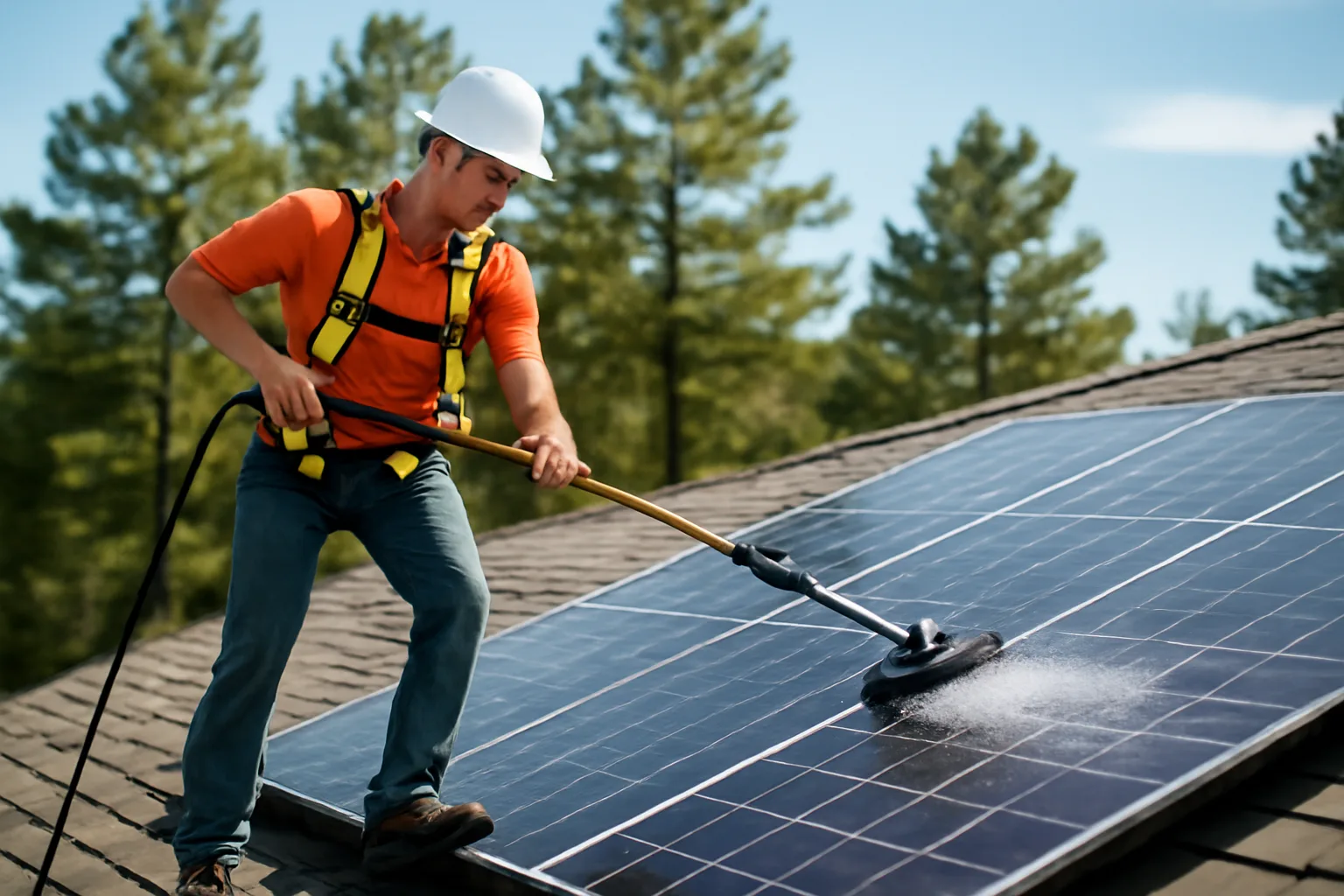
A typical residential system of 20 to 30 panels takes 60 to 120 minutes on-site. That covers setup, cleaning with a water-fed pole and deionized water, a final rinse, and a visual check. Most service companies cite 1 to 2 hours as the average job window.[5]
Time balloons if you skip deionized water. Tap water leaves mineral spots that force you to wipe every panel, which can double your labor. In rural Arkansas, well water with high iron will stain glass unless you rinse it off fast with DI water. Plan an extra 30 minutes if you have to run a hose from a distant spigot or work a steep metal roof.
Arkansas humidity slows drying too. A DI system with the right flow rate leaves panels spot-free without a touch. You can finish a simple ranch house in under an hour, handshake included.
What equipment do you need to start?
A water-fed pole, a deionized water system, and fall protection are the three you cannot go without. A pole reaching 24 feet covers most single-story roofs. The brush at the tip scrubs with pure water. DI water dries without spots, so you skip the squeegee and skip the ladder climbing that causes most roof-work injuries.[9]
A portable DI tank, like a $149 DI Water + Roof-Safety Kit from SolarWashPath, is a starter system that fits in a sedan. Refill the tank at a local water treatment store for $20 to $30 per job's worth. Larger operators buy a trailer-mounted commercial DI rig, but that is a month-ten purchase, not a day-one one.
Safety harness, rope, and anchor come next. OSHA requires fall protection for work at six feet or more.[9] Homeowners notice when you show up without a harness. So do insurance companies. A basic harness kit costs $100 to $200. Hard hat, non-slip shoes, and eye protection round it out.
Arkansas solar market: who are your customers?
Arkansas had 1,163 megawatts of solar capacity installed through the third quarter of 2024, enough to power over 130,000 homes.[4] The state is not a top-10 solar market, but capacity has grown more than tenfold since 2018. Utility-scale projects put the Delta and northwest Arkansas on the map.
Residential systems cluster in Northwest Arkansas (Benton and Washington counties), central Arkansas (Pulaski County), and around Jonesboro. Many homeowners added panels while the federal solar tax credit stayed at 30 percent. Those panels collect pollen, dust, and bird droppings, and few owners realize they ever need cleaning.
Commercial customers include schools, warehouses, and big-box stores with flat-roof arrays. A single large retail store can carry over 1,000 panels. Those contracts want more insurance and a crew, but the work is there.
Environmental challenges that make Arkansas panels filthy
Pine pollen is the number-one enemy. March through May, a yellow film coats every surface, panels included. After rain, pollen turns to paste and cuts output. The University of Arkansas Division of Agriculture says dirt and debris on panels "will reduce the efficiency of the system" and recommends keeping the surface clean.[6]
Summer brings humidity and insect residue. Bug splatter bakes into a sticky layer under direct sun. Fall adds leaves and crop-harvest dust, worst in eastern Arkansas. A panel in Stuttgart can look frosted after two weeks of soybean harvest.
Winter is mild enough for year-round work. Cold snaps are short and snow rarely sticks. You can clean ten months a year without trouble. The two hottest weeks of July are the only stretch that puts real heat-exhaustion risk on the roof.
How to find solar panel cleaning clients in Arkansas
A Google Business Profile is your free lead machine. Build one with "solar panel cleaning arkansas" in the description and post before-and-after photos of clean panels against a blue sky. Most residential clients find local services through Google or Nextdoor.
Knock on doors where you spot dirty panels. A $50 first-cleaning offer gets the homeowner onto your list. After one rain they see the difference and call for a regular schedule. Facebook community groups in Little Rock, Conway, and Fayetteville are full of people asking who cleans solar panels.
Partner with local solar installers. Companies like Seal Solar and Shine Solar install hundreds of systems and have no interest in cleaning them. Offer a referral fee, or just ask to leave your cards at their front desk. It costs you nothing and it hands you instant credibility.
Insurance and liability: what you really need
General liability insurance covers you when water drips into a light fixture or a pole nicks a shingle. Most policy minimums are $1 million per occurrence and $2 million aggregate. Cost: $500 to $900 a year for a one-person operation.
Commercial auto insurance matters if you drive your vehicle for work. A personal auto policy can deny a claim when you are hauling a 40-pound DI tank and ladders. A simple commercial policy adds $600 to $1,200 a year.
Workers' compensation is optional in Arkansas with no employees, but the day you hire even a part-time helper, the law requires it. Get quotes from carriers licensed by the Arkansas Workers' Compensation Commission before you bring anyone on.
Common mistakes that sink new Arkansas cleaners
Using tap or well water is the fastest way to lose a customer. Hard-water spots look worse than the pollen did. Charge enough to cover DI resin and never cut that corner.
Underpricing is the second trap. A $99 special fills your schedule and empties your bank account. At $200 per job, two jobs a day, 20 days a month, you gross $8,000. That leaves room for insurance, resin, gas, and taxes.
Skipping the local permit step buys you a headache. A neighbor calls the city about an unlicensed worker on the roof, and you catch a citation for failure to register. It is a $25 fix, so fix it.
Want to see how neighboring states handle startup? Read our guide on how to start solar panel cleaning in Alabama, where the paper path looks similar. If you work areas with high-end homes and tile roofs, how to start solar panel cleaning in Arizona shows how to price steep pitches.
Frequently asked questions
Do you need a license for solar panel cleaning in Arkansas?
No. There is no state-issued license for solar panel cleaning. You register your business with the Arkansas Secretary of State and check with your city or county for any local business license. The Arkansas Contractors Licensing Board does not classify cleaning as residential contracting work, so no contractor license applies.
How much does solar panel cleaning cost in Arkansas?
Residential jobs run $150 to $350. A typical 25-panel system costs about $220. Commercial rates start near $10 per panel. Price shifts with roof height, access, and soiling. Light pollen in Fayetteville might cost $160, while heavy harvest dust in eastern Arkansas can hit $300.
How long does solar panel cleaning take in Arkansas?
A standard residential job takes one to two hours from arrival to final rinse. A one-story ranch with 20 panels often finishes in 45 minutes. Steep roofs or heavy soiling add 30 to 60 minutes. Setup and customer conversation add about 15 minutes per job.
What business structure is best for solar panel cleaning in Arkansas?
An LLC is the safest choice for most cleaners. It costs $50 to file online with the Arkansas Secretary of State and shields your personal assets. A sole proprietorship costs nothing to register but leaves you personally liable. An LLC also gives commercial clients more confidence in you.
Is solar panel cleaning profitable in Arkansas?
Yes. With low overhead and two jobs a day at $200 each, a solo operator can gross about $8,000 a month. Equipment costs under $2,000 to start, and recurring expenses like DI resin, insurance, and gas run a few hundred dollars a month.
Do I need insurance to clean solar panels in Arkansas?
General liability insurance is not legally required, but most homeowners and all commercial clients ask for proof. A $1 million policy costs $500 to $900 a year. Workers' comp is required only once you have employees. Many cleaners also carry inland marine coverage for their equipment.
What equipment is required to start cleaning panels?
You need a water-fed pole (24 feet or longer), a deionized water system or portable DI tank, and a safety harness with anchor. A DI system costs $150 to $2,000 depending on size. A basic harness kit runs $100. Skip tap water; it spots the glass and ruins the job.
Where can I find solar panel cleaning clients in Arkansas?
Google Business Profile, Nextdoor, and door-knocking in neighborhoods with visible panels are the top three channels. Partnerships with local installers like Seal Solar or Shine Solar bring steady referrals. Facebook community groups in larger towns generate leads too.
Does pine pollen really hurt solar panel output?
Yes. Pollen and dust reduce energy production, and the loss climbs in peak spring months. The University of Arkansas Division of Agriculture advises keeping panels clean to maintain efficiency. A sticky pollen film after rain blocks a meaningful share of light until you wash it off.
Can I clean panels year-round in Arkansas?
You can clean about ten months a year. Winter temperatures are mild, and snow is rare and short-lived. The hottest weeks of July can be unsafe for roof work, but morning and evening jobs keep the calendar full. Fall harvest dust drives strong demand in eastern counties.
Do I need a sales tax permit to clean solar panels in Arkansas?
Probably not. Most services in Arkansas are not subject to sales tax. If you sell cleaning products or a contract that includes tangible goods, confirm with the Arkansas Department of Finance and Administration. The permit is free and takes minutes online if you need it.
How do I avoid water spots when cleaning?
Use deionized water. DI water has zero dissolved minerals, so it evaporates without leaving calcium or magnesium spots. Tap water and Arkansas well water leave streaks that look worse than the dirt did. A portable DI tank with refillable resin is the standard low-cost fix.
Sources
- Arkansas Secretary of State, Business & Commercial Services: All for-profit entities must register with the Secretary of State; LLC filing fee is $50; annual franchise tax applies.
- Arkansas Contractors Licensing Board, Residential Contractors: The board defines residential contracting as construction or improvement; cleaning solar panels is not construction and requires no state contractor license.
- Arkansas Department of Finance and Administration, Sales and Use Tax: Services are generally not taxable in Arkansas; sales tax applies to tangible personal property sold; permit available online.
- Solar Energy Industries Association, Arkansas Solar: Arkansas had 1,163 MW of solar capacity installed through Q3 2024, powering over 130,000 homes.
- Angi, How Much Does Solar Panel Cleaning Cost?: National average cost for residential solar panel cleaning is $150 to $350, with most homeowners paying about $220; typical job takes 1 to 2 hours.
- University of Arkansas Division of Agriculture, Arkansas Solar Access: A Homeowner's Guide (FSA-5050): Dirt and debris on panels reduce system efficiency; keeping the surface clean is recommended for Arkansas solar arrays.
- IRS, Employer ID Numbers: Most businesses need an EIN; sole proprietors without employees may use a SSN but an EIN protects personal information.
- OSHA, Fall Protection in Residential Construction (Standard 1926.501): Workers at heights of six feet or more must use fall protection systems such as guardrails, safety nets, or personal fall arrest systems.