Last updated 2026-08-18
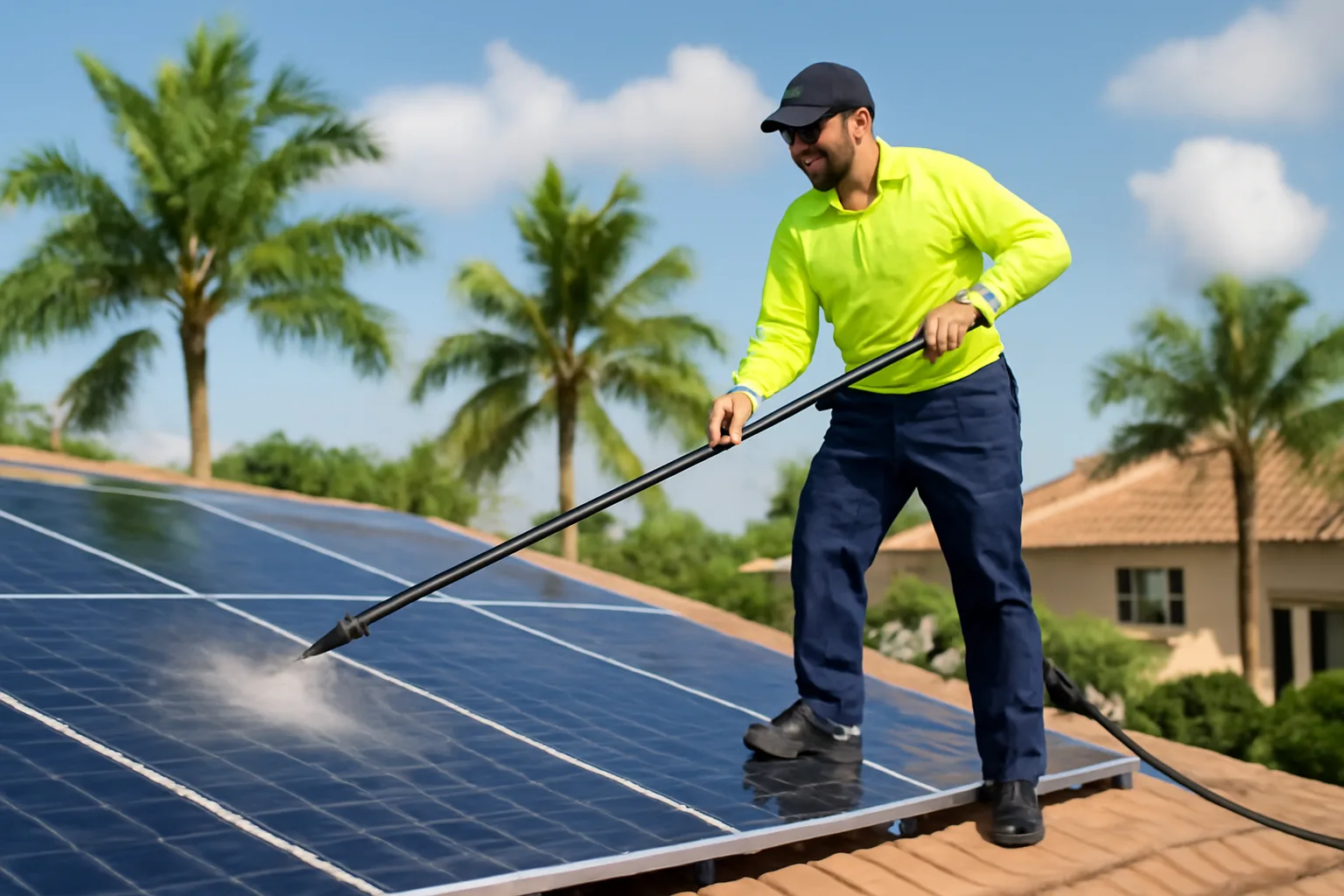
TL;DR
Florida does not issue a specific solar panel cleaning license. Most operators need a local business tax receipt from their county. If you use a water-fed pole and deionized water without pressure washing or electrical work, no state contractor license is triggered. Pressure washing or any structural attachment typically requires a contractor license from the Florida DBPR. General liability insurance is almost always required by commercial clients.
Do you need a license for solar panel cleaning in Florida?
No. Florida has no license called "solar panel cleaning license" at the state level. The Department of Business and Professional Regulation (DBPR) does not list it as a regulated activity. That is the short, correct answer.
But it is not the whole answer. The real question is: which existing license categories might your specific cleaning method trip? Because Florida regulates construction contracting tightly under Florida Statutes Chapter 489. If your work falls into a definition there, you need a license. If it does not, you do not. Most pure solar panel cleaning operations, done correctly, fall outside those definitions.
The DBPR is explicit about what counts as contracting. Under Florida Statute 489.105(3), a "contractor" is someone who undertakes to construct, repair, alter, remodel, add to, or improve any building or structure. The key word is "structure." Solar panels mounted on a roof are part of the structure. Cleaning them with a soft brush and water, standing on the ground using a water-fed pole, does not involve construction, alteration, or repair. It is maintenance. Maintenance does not require a contractor license. Several DBPR informal opinions over the years have confirmed that routine cleaning of existing surfaces, without disassembly or pressure systems, is not contracting [1].
Where the line gets crossed: if you get on the roof and use a pressure washer, you might be viewed as performing "pressure cleaning" as a specialized service. Florida does not have a statewide pressure washing license, but some municipalities treat it as a type of specialty contracting requiring local registration. If you touch wiring, remove panels, or make any structural attachment, you are in electrical or solar contractor territory, and those licenses are mandatory. The Florida DBPR issues Certified Solar Contractor (CVC) licenses, but those are for installation and repair, not cleaning [2].
My honest advice: call your county's tax collector or business licensing office and ask two questions: "Do you consider water-fed pole window or solar panel cleaning as requiring a contractor registration?" and "What is the business tax receipt process for a maintenance service business?" Most will say no to the first and hand you a simple form for the second.
What local business license does a solar panel cleaner need in Florida?
Every Florida business must obtain a local business tax receipt (BTR), formerly called an occupational license, from the county where it operates. Florida Statute 205.032 says that anyone maintaining a business location or doing business in a county must pay the tax. This is not optional. It is cheap and it is the first paper you get [3].
Cost varies by county. In Miami-Dade County, the BTR application fee is $46.25 for most service businesses as of 2025 [4]. Orange County charges $25.00 for a new business tax receipt plus a $3.00 convenience fee if done online [5]. Hillsborough County is roughly $35.00 for a general service business. These are annual renewals. You pay it, you get a receipt, you are legal at the county level.
Some cities within counties also require a separate municipal business tax receipt. If you work inside city limits of Miami, Orlando, Tampa, Jacksonville, or any incorporated city, check the city clerk's office. Miami Beach, for example, requires its own local business tax receipt on top of Miami-Dade's. This can add $50 to $150 per municipality annually. I tell people starting out: pick your primary county, get that BTR first, then add city receipts as your territory expands.
A common mistake: people register with SunBiz, Florida's Division of Corporations, get an LLC, and think they are done. SunBiz registration is a legal entity formation, not a business license. The BTR is separate. You need both. LLC formation costs $125 via SunBiz [6]. Add your county BTR, and you have a legal operating base.
Does solar panel cleaning trigger Florida contractor licensing rules?
This is where most out-of-state advice gets Florida wrong. Contractor licensing in Florida is serious, with fines up to $10,000 for unlicensed contracting under F.S. 489.127. But the trigger is whether your activity meets the definition of contracting. Let me break down the three paths that matter.
Path 1: Pure water-fed pole cleaning. You stand on the ground, use a carbon-fiber pole with deionized water and a soft brush head. No chemicals, no pressure above 100 psi (usually 40-60 psi), no roof access. This is maintenance cleaning. The DBPR has consistently treated window cleaning and surface cleaning done without pressure systems or structural alteration as non-contracting. I am not aware of a single DBPR disciplinary case against a pure water-fed pole solar cleaner operating without a contractor license. The activity simply does not map to the statutory definitions [1].
Path 2: Pressure washing. If you use a pressure washer at 500+ psi, especially on a roof, Florida's definition gets messy. Pressure cleaning of building exteriors sometimes gets classified as "specialty structure cleaning" in local ordinances. More importantly, some counties require a contractor license for pressure washing because the equipment is considered capable of causing property damage requiring skilled operation. If your solar cleaning service includes pressure washing as an upsell, you should hold at minimum a Florida Certified General Contractor license, a Residential Contractor license, or a specialty license. The DBPR does not offer a standalone "pressure cleaning license," but some contractors register under the "Specialty Contractor" category. Check with DBPR directly on whether your exact method qualifies [7].
Path 3: Working on the roof with attachments. If you walk the roof, use a squeegee directly on panels, or attach anything to the mounting system, a contractor license becomes more likely needed. Some insurers will not cover a non-licensed individual doing rooftop work. And a commercial client with a large array will usually require a contractor license as part of their vendor onboarding. I have seen this specifically with utility-scale sites and mid-size commercial rooftops in Orlando and Tampa.
Bottom line: if your business model is residential and small commercial cleaning with a water-fed pole from the ground, you do not need a Florida contractor license. If it involves pressure washing, roof walking, or electrical contact, you probably do.
What insurance do solar panel cleaners need in Florida?
Florida does not mandate insurance for solar panel cleaning as a category. But commercial clients do. Almost every property manager, HOA, and commercial solar owner in Florida requires a certificate of general liability insurance naming them as an additional insured. Minimum coverage demanded is typically $1,000,000 per occurrence, $2,000,000 aggregate.
Workers' compensation is a subtle but real trap in Florida. Under Florida Statute 440.02, construction industry businesses with one or more employees must carry workers' comp. If your cleaning operation is classified as construction by an insurer or a court, that kicks in. If it is maintenance, you might be exempt if you have fewer than four employees. But honestly, almost every solar panel cleaner I know in Florida carries workers' comp anyway. Commercial clients ask for it. It runs roughly $1.50 to $4.00 per $100 of payroll depending on your class code. The NCCI class code for window cleaning is 9154, which often gets applied to solar panel cleaning. Some insurers use code 9015 for building cleaning services.
General liability for a small solar cleaning operation in Florida typically costs $500 to $1,500 per year for a one-person operation with low revenue. If you add pressure washing, the premium jumps because pressure washing is rated separately and has higher risk. One independent agent I spoke with in St. Petersburg told me her solar cleaning clients pay around $800 annually for GL only, no pressure exclusion. Commercial auto insurance adds another $1,200 to $2,400 per vehicle. Do not skip this; Florida roads and parking lots are hard on vehicle claims.
How much does solar panel cleaning cost in Florida?
Florida pricing follows a per-panel model more than a per-job flat rate, because system sizes vary so widely. Residential systems in Florida average 20 to 40 panels. Commercial rooftops often run 100 to 500 panels. The price per panel generally sits between $2.50 and $6.00 for pure water-fed cleaning. On a 28-panel residential array, that is $70 to $168 per cleaning visit.
Here is a table of what I see across the state as of mid-2025:
| System Type | Panels | Typical Price Range (per visit) |
|---|---|---|
| Small residential (ground access) | 10-20 | $60-$120 |
| Average residential | 21-35 | $90-$210 |
| Large residential | 36-50 | $120-$300 |
| Small commercial (flat roof, easy access) | 50-150 | $200-$900 |
| Large commercial/utility | 150-500 | $750-$3,000 |
Prices include deionized water, labor, and basic travel within a 20-mile radius. Travel beyond that usually adds $0.50 to $1.00 per mile or a flat $25-$50 trip charge.
Geographic variation matters. South Florida (Miami-Dade, Broward, Palm Beach) runs higher, with per-panel rates often $4 to $8 because of higher cost of living, vehicle insurance, and commercial client expectations. Central Florida (Orlando, Tampa) is more competitive, $2.50 to $5 per panel. The Panhandle is cheaper but has fewer solar arrays.
New operators often underprice. I see people advertising $50 flat rate for any residential system. That loses money quickly when you factor in deionized water resin replacement, equipment depreciation, vehicle costs, and insurance. A sustainable floor is about $75 per residential stop. The SolarWashPath $149 one-time DI water plus roof-safety kit is built for this reality: it drops equipment cost enough that a new cleaner can charge $80-$120 confidently without losing margin to gear debt.
Add-on revenue is normal. Panel inspection with thermal imaging is an upsell that brings $50 to $150 extra. Bird-deterrent mesh installation adds $3 to $7 per linear foot. If you offer these, your average ticket grows significantly.
How long does solar panel cleaning take in Florida?
Timing is straightforward but worth breaking down honestly, because new cleaners always underestimate travel and setup.
A typical 25-panel residential array on a one-story home, accessed from the ground with a water-fed pole, takes 35 to 55 minutes of active cleaning. Setup and breakdown (pulling hose, filling the DI tank, testing water quality, packing up) adds 15 to 20 minutes. Field studies from the National Renewable Energy Laboratory report that robotic cleaning of utility-scale arrays takes 2 to 4 minutes per kilowatt of capacity, but manual residential cleaning is slower: roughly 1.5 to 2.5 minutes per panel for a solo worker who knows the rhythm [8].
A two-person crew on a 100-panel commercial flat roof often completes the work in 2.5 to 3.5 hours, including setup. If roof access requires a ladder or lift, add 30 minutes. Florida's climate affects this directly: in July and August, midday heat can push you to early-morning or late-afternoon schedules. That stretches the working day but does not change the per-job time much. Rain delays are real; June through September has daily thunderstorms, and you will lose about 20% of scheduled days to weather. Build that into your timeline.
Travel between jobs eats the rest. A Florida cleaner doing 3 to 4 residential stops per day will spend 4 to 5 hours on cleaning and 2 to 3 hours driving, even within a metro area. That reality means net revenue per day is tied as much to route density as to hourly rate.
Step by step: starting a legal solar panel cleaning business in Florida
This is the paper path I would follow today, in order. It covers every step needed to be legally clean and client-ready.
1. Choose a business structure. Single-member LLC is the standard. File with SunBiz at sunbiz.org. $125 filing fee plus a registered agent fee ($50-$150 per year if you use a service). Processing takes 3 to 7 business days [6].
2. Get an EIN from the IRS. Free, online, instant. You need this to open a bank account.
3. Register with the Florida Department of Revenue for sales tax. Solar panel cleaning is generally not subject to sales tax as it is a service not involving the sale of tangible personal property, but you must still register and confirm. Registration is free online [9].
4. Obtain your county business tax receipt. Go to your county tax collector's office or website. Pay the fee ($25-$47 typical). This is required before you perform any service. Some counties issue same-day; others take 1 to 2 weeks [3].
5. Add city business tax receipts as needed. Check each municipality where you plan to work. Keep a spreadsheet of renewal dates.
6. Get insurance. General liability first. Ask your agent to add "solar panel cleaning" as a described operation. Get a certificate template you can send to clients.
7. Buy equipment. A water-fed pole system with DI resin is the standard entry setup. Pure water avoids soap, which is a selling point with Florida environmental sensibilities. A basic kit: 30-foot carbon fiber pole, DI tank, brush, hose, and TDS meter. Budget $500 to $1,500.
8. Open a business bank account. Keep finances separate from personal. This matters for liability protection.
9. Set your pricing, service area, and booking system. Go live.
What you skip: you do not file with the DBPR unless you are going the pressure washing or contractor route. You do not get a "solar panel cleaning certification" from any Florida body; none exists.
Pressure washing and solar panels: the license trap in Florida
I see this confusion constantly. Someone buys a pressure washer, offers "pressure washing and solar cleaning" as a bundle, and assumes they are covered under a general business tax receipt. They are not.
Pressure washing at high PSI on a roof or on solar panels carries two concerns in Florida: contractor licensing and manufacturer warranties. On the licensing side, the DBPR has at times classified high-pressure exterior cleaning of structures as contracting if it involves roof surfaces. This is not settled in every jurisdiction, but the trend in enforcement is toward requiring a contractor license for any service that can damage a structure if done incorrectly. Roof cleaning is the main flashpoint. If your solar cleaning involves cleaning the roof around the panels with pressure, the risk rises.
On the warranty side, solar panel manufacturers almost universally state that high-pressure washing voids the panel warranty. A typical spec sheet from a major manufacturer lists a maximum allowable pressure of 35-50 psi at the glass surface. Most consumer pressure washers start at 1,200 psi. One misaimed wand can destroy a panel's seal. Panel damage on a 15 kW system at $1.00 per watt replacement cost is a $15,000 problem. This is not hypothetical; I know of a claims situation in Lee County where a worker pressure washed panels, water intruded into the junction box, and the entire string failed.
My blunt view: do not pressure wash solar panels. Use deionized water and a soft brush. If a client demands pressure cleaning of their roof, sub it out to a licensed contractor and you stick to the panels. It separates liability and keeps you firmly on the maintenance side of the regulatory line.
Florida solar maintenance market: scale and demand signals
Florida is the third-largest state for installed solar capacity, behind California and Texas. As of Q2 2024, Florida had 13,127 megawatts of solar installed across approximately 220,000 residential and commercial systems [10]. The utility-scale segment is large: Florida Power & Light alone operates more than 65 solar sites statewide. Those utility sites use their own maintenance crews or contracted specialty firms, not independent cleaners. But the residential and mid-size commercial segment is under-serviced.
A 2020 study from the University of California estimated soiling losses at 1.5% to 4% annually in high-pollen, high-humidity environments [11]. Florida's climate, with daily rain in summer and heavy pollen in spring, produces a soiling pattern that runs roughly 2% to 5% annual loss for panels not cleaned. On a 10 kW residential system producing 14,000 kWh per year, that is 280 to 700 kWh of lost production worth $33 to $84 per year at Florida's average rate of $0.12/kWh. A $120 cleaning once or twice a year has a decent ROI narrative.
Commercial arrays lose more because flat-roof installations accumulate standing water and debris. A 2019 NREL study found flat-panel soiling in humid climates can exceed 6% annually if not cleaned [12]. Property managers in Orlando and Miami are increasingly adding panel cleaning to maintenance contracts. HOA boards ask for it. The market is real and growing.
Florida does not allow power purchase agreements (PPAs) for residential solar, unlike California, but third-party ownership through leases is permitted. Leased systems typically include maintenance clauses. Lease providers (Sunrun, Sunnova) often contract cleaning separately or require the homeowner to handle it. That creates a customer base of homeowners with leased systems who get compliance requests to clean panels. This is a steady lead source if you market to that segment.
County-by-county differences that actually matter
Most Florida counties follow the same basic pattern: BTR plus no contractor requirement for maintenance cleaning. But a few have wrinkles that matter.
Miami-Dade County is the strictest. The county's contractor licensing board has historically been aggressive on unlicensed contracting enforcement. The county also requires a separate Certificate of Use before you operate from a commercial location, even a home office if it generates client visits. That is $64.25 as of 2025 [4].
Broward County has a straightforward BTR process but requires businesses to be registered with the county's Central Examining Board if they engage in any trade that touches building systems. Solar cleaning usually does not, but pressure cleaning sometimes does.
Orange County (Orlando) is simpler. The BTR is $25. The county planning division does not require additional permits for a home-based service business with no customer traffic [5].
Hillsborough County (Tampa) is moderate. Business tax receipt, no contractor license for cleaning. But the City of Tampa requires a separate business tax receipt if you operate within city limits. Cost is $53.08 annually for a service business [13].
Duval County (Jacksonville) consolidates city and county functions, so one BTR covers both. $29.50 annually for most service businesses.
Collier County (Naples) and Sarasota County are both high-income solar markets with significant rooftop installations. Both have simple BTR processes, but clients there expect high professionalism: branded vehicle, uniform, proof of insurance, and often a local business history.
What I tell anyone starting out: get your county's specific checklist from its tax collector site. Ask about home-based business rules, signage restrictions, and whether a resale certificate is needed. Never assume one county mirrors another.
Environmental and water rules in Florida: what's worth knowing
Florida does not regulate deionized water use for solar panel cleaning specifically. Deionized water is not a pollutant. It is tap water that has had minerals removed. No NPDES permit is triggered. No Florida Department of Environmental Protection (FDEP) permit is required for runoff from pure water solar cleaning, because there is no chemical discharge.
If you use soap or detergents, that changes. Any cleaning agent that creates a sheen or contains phosphates can trigger a water quality issue. The FDEP regulates nonpoint source pollution under Florida Administrative Code 62-4. Any discharge of cleaning chemicals into storm drains is a potential violation. My advice: stick to pure deionized water. It cleans better without chemicals, it avoids environmental liability, and "chemical-free cleaning" is a good marketing line in an environmentally conscious state.
One practical rule: if you are cleaning large commercial arrays where runoff volume is high, be aware that some municipalities require erosion control if the water flow could carry sediment. This is rare but has come up in Palm Beach County on large ground-mount systems near waterways. Ask the property manager if a site-specific SWPPP (Stormwater Pollution Prevention Plan) exists and follow it.
Water use itself: Florida faces periodic drought restrictions. Some counties issue watering restrictions that could technically apply to outdoor water use for commercial purposes, though enforcement against solar cleaners is unheard of. If you are on well water, no restriction. If you use municipal water, during a declared water shortage the restrictions could require limiting nonessential outdoor water use. This has never been a practical barrier for any solar cleaner I know, but it is on the radar.
What to know before your first Florida solar cleaning job
This section is the pre-job checklist that prevents the five most common first-day disasters. I have seen all of them.
First, water quality matters more in Florida than anywhere else. Florida municipal water is hard. Calcium carbonate is 120 to 180 ppm in much of the state. That means your DI resin exhausts faster. A standard mixed-bed DI cartridge might last 300 to 600 gallons before output rises above 10 ppm TDS, which is your cutoff for spot-free cleaning. Budget $25 to $50 per resin refill and track your gallon throughput. A TDS meter is not optional; it is the instrument that proves you did the job right [14].
Second, Florida heat and humidity kill productivity in July and August. Real working hours on a roof or even at ground level with full sun are 7:00 AM to 11:00 AM and 4:00 PM to 7:00 PM. Midday cleaning is possible but dangerous. Heat index above 105°F is common. You need a hydration plan, a cooling vest if you are on a commercial roof, and a written heat safety policy. OSHA's heat illness prevention campaign provides free materials [15].
Third, alligators and fire ants. Ground-mount solar arrays in Florida, especially on rural acreage or near retention ponds, have fire ant mounds adjacent to panels and occasionally alligators in nearby water. I know of a cleaner in Gainesville who had a gator walk across the array field while he was working. The risk is small but real. Carry a walking stick, visually scan before stepping, and always ask the property owner about pests. Fire ant stings are a workers' comp claim waiting to happen.
Fourth, afternoon thunderstorms are a safety hazard. Lightning is the number one weather killer in Florida. A carbon fiber pole is a conductor. If you hear thunder, get off the roof or away from the array immediately. No exceptions. The job can wait.
Fifth, document everything. Before-and-after photos with a timestamp, TDS readings, panel count, and a simple service report signed by the customer. This habit builds a defense against "you scratched my panels" claims and is required by some insurers. A cell phone and a Google form are enough. The SolarWashPath kit includes a basic inspection checklist, but even a handwritten note is better than nothing.
If you do these five things, your first 50 jobs will be a lot less eventful than the people who skip them.
Frequently asked questions
Does Florida have a solar panel cleaning certification?
No. Florida does not offer or recognize any solar panel cleaning certification at the state level. Third-party training organizations offer certifications, but these are not legally required and carry no regulatory weight with the DBPR. They can be useful for marketing and client confidence, but they do not replace a business tax receipt or a contractor license where one is required.
Can I clean solar panels as a handyman in Florida without a license?
Generally yes, if you use a water-fed pole from the ground without pressure washing or electrical work. Handyman services in Florida are not separately licensed, but the handyman exemption from contractor licensing applies only to minor repairs and maintenance not involving structural or electrical work. Pure panel cleaning fits that maintenance definition.
What happens if I clean solar panels without a license when one is required?
Unlicensed contracting in Florida is a first-degree misdemeanor under F.S. 489.127, with fines up to $10,000 and potential jail time up to one year. The DBPR issues cease-and-desist orders and can impose administrative fines. Civil penalties include restitution to harmed customers. This applies only if your activity meets the statutory definition of contracting. Pure maintenance cleaning does not.
Do I need a Florida solar contractor license for solar panel cleaning?
No, unless your work extends beyond cleaning into an installation or repair activity. A Florida Certified Solar Contractor license (CVC) is required for installing, repairing, or altering solar panels per F.S. 489.105. Cleaning that does not involve disassembly, electrical work, or structural change does not require a CVC license.
Is there a Florida business license specifically for window or solar panel cleaning?
No state-level specific license exists. The required license is the local business tax receipt from the county where you operate, sometimes supplemented by a city-level tax receipt. This is a general business registration, not a competency license.
How often should solar panels be cleaned in Florida?
Most residential systems benefit from cleaning once or twice per year. Florida's heavy summer rains provide some natural rinsing, but pollen in spring (especially oak pollen in March-April) and dust in dry winter months create the primary soiling. Commercial flat-roof arrays may need quarterly cleaning because debris accumulation is higher without rain runoff.
Do I need a special license to use deionized water for solar panel cleaning in Florida?
No. Deionized water is produced from tap water using resin filtration. No environmental permit, FDEP registration, or water-use license is required for on-site DI water production and use for cleaning. The equipment itself requires no operator license.
Is solar panel cleaning taxable in Florida?
Solar panel cleaning as a pure service (labor only, no products sold) is generally not subject to Florida sales tax. However, if you sell cleaning agents, replacement parts, or any tangible personal property as part of the service, those sales may be taxable. You must register with the Department of Revenue regardless to obtain a resale certificate and confirm your tax obligations.
Can a solar panel cleaning business be home-based in Florida?
Yes, in most counties. A home-based business requires the same county business tax receipt plus compliance with any local zoning rules for home occupations. Typical restrictions: no exterior signage, no customer foot traffic at the residence, no commercial vehicle storage visible from the street. Each county has specific requirements in its land development code.
Do I need workers' compensation as a solo solar panel cleaner in Florida?
If you are a sole proprietor or single-member LLC with no employees, workers' compensation is not required by Florida law. However, commercial clients and HOAs often require a certificate of workers' compensation insurance as a condition of the contract. A ghost policy (minimum-premium policy for owner-only operations) costs $500 to $1,000 annually and satisfies client requirements.
What equipment do I need to start solar panel cleaning in Florida?
The minimum setup: a water-fed carbon fiber or aluminum pole (24-36 feet), a deionized water tank or portable DI filtration system, a soft nylon brush head, a 100-foot hose, a total dissolved solids (TDS) meter, and basic safety gear (non-slip shoes, sun protection, hydration pack). Budget $500 to $1,500 for a starter kit. A vehicle with ladder and hose storage is essential.
Is solar panel cleaning a good business in Florida?
It is a growing service market with relatively low barriers to entry. Florida's high solar adoption, heavy pollen and dust soiling, and lack of a special license requirement make it an accessible business. However, competition is increasing in major metros, and the margin model requires disciplined pricing and efficient routing to be profitable. It works best as a multi-service exterior maintenance business rather than a standalone offering.
Sources
- Florida DBPR, Construction Industry Licensing Board: Florida Statute 489.105 definition of 'contractor' limits licensure to construction, repair, alteration, and improvement activities; maintenance cleaning is not included.
- Florida DBPR, Certified Solar Contractor License: Certified Solar Contractor (CVC) license is required for solar installation and repair, not for routine cleaning.
- Florida Legislature, Local Business Tax: Florida Statute 205.032 requires every business operating in a county to obtain a local business tax receipt.
- Orange County Tax Collector, Business Tax Receipt: Orange County business tax receipt costs $25.00 for a new business plus $3.00 online convenience fee.
- Florida Division of Corporations, SunBiz LLC Filing: Florida LLC formation filing fee is $125 via SunBiz; processing takes 3-7 business days.
- Florida DBPR, Unlicensed Contracting Enforcement: Unlicensed contracting fines and enforcement authority under F.S. 489.127.
- SEIA, Florida Solar Market Data: Florida had 13,127 MW of installed solar capacity as of Q2 2024, third nationally.
- City of Tampa, Business Tax Receipt: City of Tampa business tax receipt costs $53.08 annually for service businesses.
- OSHA, Heat Illness Prevention Campaign: OSHA provides heat safety guidance and free materials; heat index above 105°F requires written safety plans.