Last updated 2026-08-18
TL;DR
To start solar panel cleaning in Georgia, you don't need a state license. Form an LLC online for $100, get a local business license (Atlanta requires one), buy deionized water gear (a starter kit costs about $149), and insure yourself. Jobs pay $150 to $300 and take under two hours.
Do you need a license for solar panel cleaning in Georgia?
The short answer: no. Georgia doesn't issue a state license for solar panel cleaning, or general window cleaning, the way it does for electricians or plumbers. The Georgia Secretary of State's Professional Licensing Boards Division oversees dozens of occupations, from accountants to veterinarians. You can scan the whole list at sos.ga.gov/licensing [1]. Solar panel cleaning is not on it. That means you skip the exam fees, the hours of experience paperwork, and the renewal hassle that some neighboring states throw at you. For instance, check how Alabama handles it if you're curious. Georgia is lighter touch.
But "no state license" doesn't mean "zero paperwork." Almost every city and county in Georgia wants you to hold a local business license, also called an occupational tax certificate. Atlanta is the obvious example: the City of Atlanta requires any person or company performing services inside city limits to obtain a business license from the Office of Revenue [3]. A small cleaning operation will typically pay a base fee of $75 to $150 annually, depending on the exact classification [10]. If you're outside a big city, check with the county probate court or the city clerk. The state itself also demands that you register for tax purposes. The Georgia Department of Revenue puts it plainly: 'If you are starting a new business in Georgia, you may need to register with the Georgia Department of Revenue for tax purposes' [2]. That step is free and takes ten minutes online.
What business structure and local registrations do I really need?
Most people starting solar panel cleaning in Georgia use a limited liability company (LLC). It's simple, separates your personal assets from business debts, and costs $100 to form online through the Georgia Secretary of State's Corporations Division [8]. The annual registration fee is $50. You can file the Articles of Organization in about fifteen minutes at ecorp.sos.ga.gov. If you'd rather keep things even simpler as a sole proprietor, you can. No LLC is legally required. Just be aware that a sole proprietor's personal assets are on the line if someone gets hurt and sues.
After you have your LLC, or decide to go solo, register with the Georgia Department of Revenue if you haven't already. That's where you'll get a state tax ID number for withholding if you hire anyone. Next, head to your local city hall or county office to get the business license. In Atlanta, the Office of Revenue's business license portal walks you through it. In smaller towns, you might fill out a half page form and pay a flat $50. Every January you'll need to renew. It's not glamorous, but it's the paper path that keeps you legal. The Georgia Department of Revenue's business registration page is the first stop for any new enterprise [2].
How much does solar panel cleaning cost in Georgia?
Most Georgia homeowners pay $150 to $330 for a professional cleaning, according to national cost data from SolarReviews [6]. That translates to roughly $10 to $25 per panel, with the final number depending on roof pitch, accessibility, and how dirty they are. In Georgia, with our pine pollen, summer thunderstorms, and occasional red clay dust, panels get dirty fast. A 20 panel array on a single story ranch might be a $200 job. A steep, two story roof with 30 panels could run closer to $330.
Charging by the panel is the most straightforward approach. A rate of $15 per panel plus a small trip fee ($25 to $50) is common among new solo operators. That puts you right in the middle of what local competitors are charging. You can check forums and local Facebook groups to see the going rate in your county. Because solar panel cleaning Georgia homeowners are price sensitive, offering a flat rate package (like $175 for up to 20 panels) often wins the job.
How long does solar panel cleaning take in Georgia?
A regular residential cleaning (a 20 panel ground mount or a low pitch roof) takes one to two hours from arrival to hose roll up. Angi's cleaning cost guide notes that 'professional solar panel cleaning typically takes between 45 minutes and two hours for a standard residential system' [7]. That estimate lines up with what I see on the ground in Georgia. The biggest time sink is setup: positioning your ladder, hoisting the water fed pole, filling your DI tank if you didn't pre fill. The actual brushing and rinsing might be done in 30 minutes.
Bigger systems (30 plus panels) or arrays on steep tile roofs can stretch to two and a half hours. If you're working alone, count on two jobs a day max when you factor in drive time. That's part of why the per job rates stay healthy: you're billing for the round trip, more than the water spray.
What equipment do you need to start?
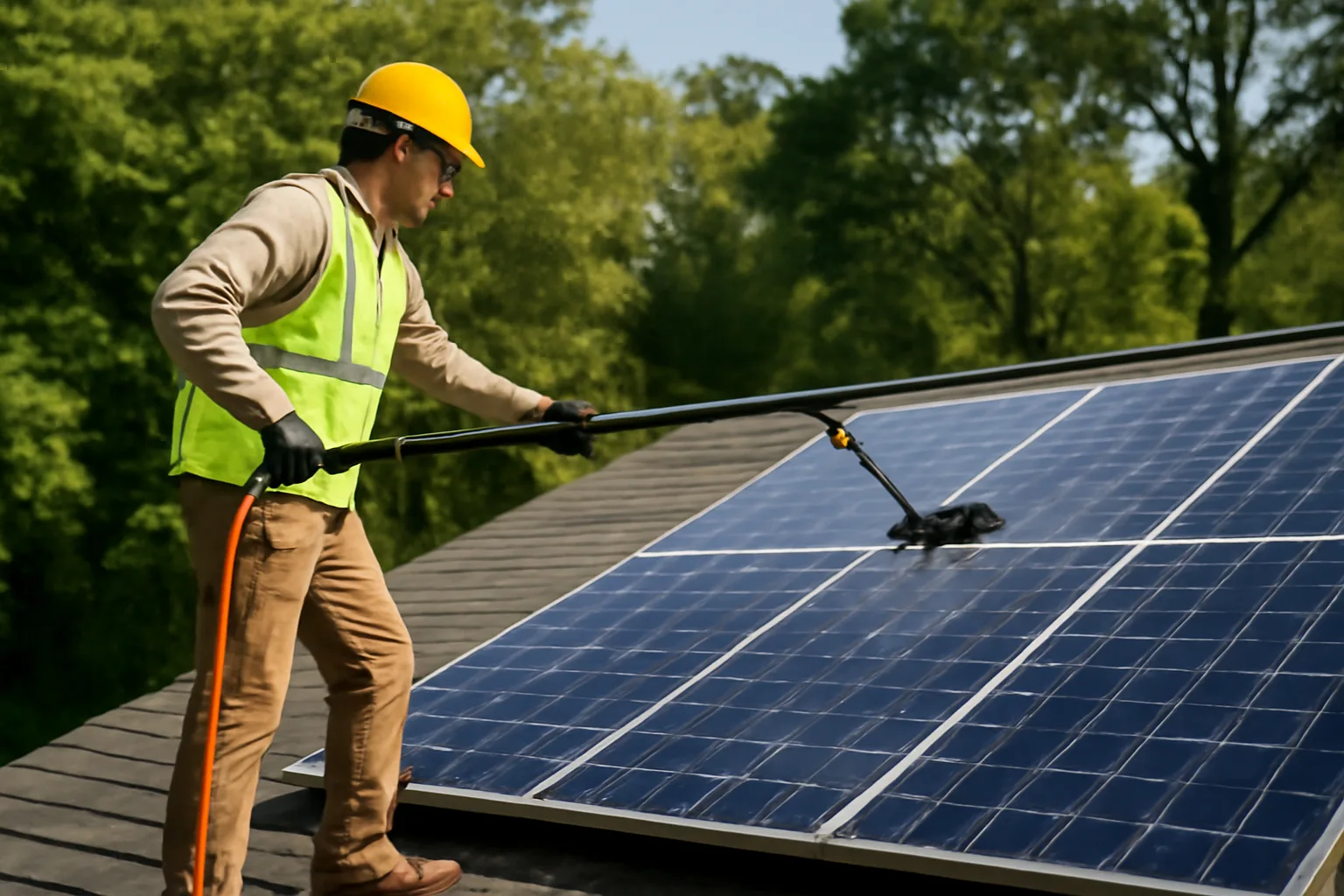
You don't need a truck full of gear. A reliable water fed pole, a deionized (DI) water tank, a soft brush, and a safety harness cover most jobs. You can spend anywhere from $500 to $1,500 on a mid range pole system from cleaning supply shops, but you can also start with a compact kit. One example: the DI Water and Roof Safety Kit from SolarWashPath sells for $149 and includes the DI filtration, a pole adapter, and a fall protection strap [4]. It's not a complete pro rig, but it gets you cleaning safely on day one.
Here's the full list of what I'd buy: telescoping water fed pole (at least 24 feet), a DI water tank or inline resin cartridge, a squeegee or soft nylon brush head, a hose and pump system if your water source pressure is weak, a ladder stabilizer, and a roof safety harness. All in, you can be fully outfitted for under $2,000. Forget pressure washers. Too much risk of cracking panels. DI water leaves zero spots and dissolves the pollen film that settles on Georgia panels every spring.
How much does insurance cost, and what kind do I need?
At a minimum, get a commercial general liability policy with a $1 million per occurrence limit. Window cleaning insurance often covers solar panel cleaning because the risks are similar: working at heights, water damage claims, accidental panel breakage. Insureon reports that the average annual premium for window cleaners is $500 to $1,200 per year [5]. A solo operator with no employees and a strong safety record can land on the lower end of that range.
If you hire even one helper, you'll need workers' compensation insurance. Georgia law mandates workers' comp for any employer with three or more employees, according to the State Board of Workers' Compensation [11]. But many general liability policies exclude coverage for subcontractors, so if you use 1099 helpers, verify coverage. Also consider an inland marine policy (tool coverage) and a surety bond if a large commercial client demands one. Expect to budget about $75 per month for insurance all in. That's cheap peace of mind compared to a shattered panel or a slip and fall lawsuit.
How do I find customers in Georgia?
The most obvious warm market is solar installers. Companies that put panels on roofs, like Georgia Power's residential solar program, often get asked by customers about cleaning. Strike up referral partnerships: you handle the maintenance, they get happy clients who see production numbers climb. Next, target homeowners associations in neighborhoods with visible rooftop solar. A well crafted postcard with a $25 first clean discount can bring five to ten bookings in a month.
Google Business Profile is your free storefront. Claim your listing, add photos of you cleaning a local roof, and ask two early customers for reviews. The keywords 'solar panel cleaning Georgia' and 'solar panel cleaning near me' will start working for you. Join local Facebook community groups and Nextdoor. A simple post ("Just cleaned 28 panels in Peachtree City, got a 12% output jump") does more than any flyer. Also, don't ignore commercial: big box stores with solar canopies sometimes need quarterly cleaning contracts. One steady commercial account can pay the bills while you build the residential side.
How much can you actually make?
A part time solo cleaner doing two jobs a week at $200 each pulls in $1,600 a month. That's $19,200 a year, with maybe $3,000 in expenses (equipment refills, vehicle fuel, insurance, license renewals). A full time route with four jobs a day, five days a week, at an average of $175 per job, hits $14,000 a month before costs, $168,000 per year. Those are real numbers, but you won't hit them the first spring.
Most Georgia cleaners report that the first summer you earn $30,000 to $50,000 while you build a client list. By year two, referrals start to compound. Charge a premium for hard to access roofs and for commercial contracts. The low overhead is the real advantage: no inventory, no storefront, no employees if you stay solo. If you hate ladders, this might not be for you. But if you like working outside and want a six figure small business without a college degree, it's one of the simplest paths going.
Is the Georgia solar market big enough?
Absolutely. SEIA reports that Georgia has over 3,000 megawatts of installed solar capacity, enough to power more than 350,000 homes [9]. The state ranks in the top 10 nationally for total solar installations. That means hundreds of thousands of residential arrays, each needing a cleaning at least once a year, more often in pollen season. And growth is still strong, with major utility scale farms and residential adoption rising fast. The market for solar panel cleaning Georgia has not reached saturation. In cities like Atlanta, Savannah, and Augusta, you might be the only dedicated cleaning business on Google Maps.
Common startup mistakes (so you skip them)
First, using tap water. Hard water leaves mineral deposits that bake onto glass. Spend the $149 on a DI kit [4]. Second, climbing a roof without a harness. A fall is a career ender and you'll lose your insurance. Third, underpricing. When you start, you might be tempted to offer $75 cleans. Don't. Your time, gear depreciation, and risk are worth at least $150. Fourth, skipping the local license. Atlanta enforcement is real; they'll fine you. Fifth, not getting photos before and after. Solar panel owners love seeing production data jump. A before and after dust study shot is your best sales tool. Last, forgetting to renew your LLC and business license. Set calendar reminders for the annual $50 renewal [8].
Frequently asked questions
Do you need a license for solar panel cleaning in Georgia?
No. Georgia doesn't have a state license for window or solar panel cleaning. You must still register your business with the Georgia Department of Revenue and get a local business license from your city or county (Atlanta requires one).
How much does solar panel cleaning cost in Georgia?
Typical residential jobs run $150 to $330, or $10 to $25 per panel. Single story homes on a 20 panel system average around $200. Steep roofs and large systems push prices higher.
How long does solar panel cleaning take in Georgia?
A standard 20 panel home takes 1 to 2 hours including setup, cleaning, and packing up. Large or hard to reach arrays can take up to 2.5 hours. Factors like roof pitch, accessibility, and whether you use a helper affect total time.
What chemicals do you use to clean solar panels?
None. Professional solar panel cleaning in Georgia uses deionized (DI) water and a soft brush only. DI water has no dissolved minerals, so it dries spot free. Soaps or chemical cleaners can leave film that attracts dirt and may void panel warranties.
Can I clean my own solar panels in Georgia?
Yes, but it's risky. You'll need a DI water system (a kit starts at $149), a safe ladder, and a harness. Without DI water, hard water spots reduce output. Many DIY attempts end up with mineral etching that requires professional buffing later.
How often should solar panels be cleaned in Georgia?
Once a year is the minimum for most Georgia homes. In high pollen areas like Augusta or coastal regions with salt spray, twice a year (spring and fall) is common. After a long dry spell followed by a dust storm, you might need a midyear rinse.
Do I need a contractor's license in Georgia for solar panel cleaning?
No. Georgia's residential and general contractor license (O.C.G.A. Title 43, Chapter 41) applies to construction work over $2,500. Solar panel cleaning is a maintenance service, not construction, so the contractor board does not regulate it.
What insurance do solar panel cleaners need in Georgia?
A $1 million general liability policy is the floor. Workers' comp is required if you have three or more employees. Many solo operators spend $500 to $1,200 per year. You can also get tool coverage and a surety bond for commercial jobs.
How do I get an EIN in Georgia?
Apply free online at IRS.gov/EIN. You don't need a Georgia specific EIN; the federal Employer Identification Number is used for state tax registration too. The whole process takes about 15 minutes and you get the number instantly.
Do I need a business license in every Georgia city I work in?
In practice, many cleaners get a license in the city where they're based and comply with home rule ordinances when working in larger municipalities like Atlanta, Savannah, or Augusta. Rural counties often don't enforce out of area licenses. Check each city's rules before you quote.
What's the best time of year to clean solar panels in Georgia?
Spring, right after pollen season peaks (late April to early May), is ideal. Fall is also good after leaf drop. Avoid cleaning in the heat of a July afternoon; the panels can be too hot to touch and water evaporates before you rinse.
How do I avoid damaging solar panels when cleaning?
Never use a pressure washer, abrasive sponges, or stiff brushes. Use only a soft nylon brush and DI water. Don't walk on the panels; use a water fed pole from the roof edge or a ladder. Check the manufacturer's cleaning guide before you start.
Sources
- Georgia Secretary of State, Professional Licensing Boards Division: The list of regulated professions does not include solar panel cleaning or general cleaning services.
- City of Atlanta, Office of Revenue, Business License: The City of Atlanta requires a local business license for companies performing services within city limits.
- SolarWashPath, Starter Kit: A DIY DI water and roof safety kit costs $149.
- Angi, How Long Does Solar Panel Cleaning Take?: Professional cleaning typically takes between 45 minutes and two hours for a standard residential system.
- Georgia Secretary of State, Corporations Division Fee Schedule: LLC online filing fee is $100 and annual registration is $50.
- Solar Energy Industries Association, Georgia Solar: Georgia has over 3,000 MW of installed solar capacity, powering over 350,000 homes.
- City of Atlanta, Business License Fees: Atlanta's base business license fee for a cleaning service is approximately $75 to $150, depending on classification.
- Georgia State Board of Workers' Compensation, Employer Information: Employers with three or more workers must have workers' compensation insurance.